Why Roof Pitch Comes Up So Often in Colorado
Homeowners across the Denver Metro and Northern Colorado region run into the term "roof pitch" when they're comparing material options, pricing out a project, or just trying to understand why their roof looks the way it does. Pitch is simply the steepness of the roof, expressed either in degrees or as a rise-over-run ratio, and it shapes nearly every other decision that goes into a roofing project.
A 30 degree roof pitch shows up a lot in older Front Range neighborhoods and in newer builds alike, because it strikes a practical balance between water and snow shedding, attic space, and material compatibility. Understanding what that number actually means helps you have a more informed conversation whether you're planning a repair, a full replacement, or just trying to figure out what you're working with.
How Roof Pitch Is Measured and Why It Matters
Pitch describes the angle of a roof's slope, and it can be expressed two ways: in degrees, like 30 degrees, or as a ratio of rise to run, like 7/12. Both describe the same geometry. The rise-over-run format is more common in the roofing trade because it's easier to measure on site with basic tools, while degrees are more familiar to homeowners and architects.
Converting Degrees to a Rise-Over-Run Ratio
To convert 30 degrees into a workable ratio, roofers use basic trigonometry: the tangent of 30 degrees is about 0.577. Multiply that by 12 (the standard run measurement) and you get roughly 6.93, which rounds to a 7/12 pitch. That means for every 12 horizontal inches the roof runs, it climbs about 7 inches vertically.
This matters in practice because most material manufacturers, building codes, and roofing crews talk in rise-over-run terms, not degrees. If a contractor tells you that you have a 7/12 roof, they're describing the same slope as a 30 degree angle. Knowing both lets you follow the conversation whether you're reading a spec sheet or talking through a quote.
Where 30 Degrees Falls on the Pitch Spectrum
Roof pitches generally fall into three broad categories: low-slope (under roughly 10 to 15 degrees), moderate-slope (around 15 to 30 degrees), and steep-slope (above 30 degrees). A roof at exactly 30 degrees sits right at the boundary between moderate and steep, which is part of why it's such a commonly built angle for residential homes.
This middle-ground position gives a 30 degree roof some practical advantages. It sheds water and snow noticeably better than a flatter roof, but it's still walkable enough that most roofing crews can work on it safely with standard fall protection, rather than needing the specialized rigging that very steep roofs sometimes require.
| Pitch Category | Typical Degree Range | What It Means for Your Roof |
|---|---|---|
| Low-slope | Under 15° | Water drains slowly, often needs membrane-style materials instead of standard shingles |
| Moderate-slope (includes 30°) | 15° to 30° | Good balance of water shedding and walkability, works with most common materials |
| Steep-slope | Above 30° | Sheds snow and water fast, usually requires extra fall protection for crews working on it |
What a 30 Degree Pitch Means for Your Roofing System
Pitch doesn't just affect how a roof looks from the street. It influences how water and snow move across the surface, how much attic space sits underneath, and which materials are a sensible fit. At 30 degrees, a roof sheds precipitation efficiently enough that most standard roofing products, from asphalt composition shingles to metal panels, are rated to perform well.
The pitch also affects the framing underneath. Steeper roofs like a 30 degree slope typically create more usable attic space than a low-slope roof of the same footprint, which is one reason this angle is so common in homes built with finished or semi-finished attic space in mind. It's a structural decision made early in a home's design that keeps showing up decades later in material and maintenance choices.
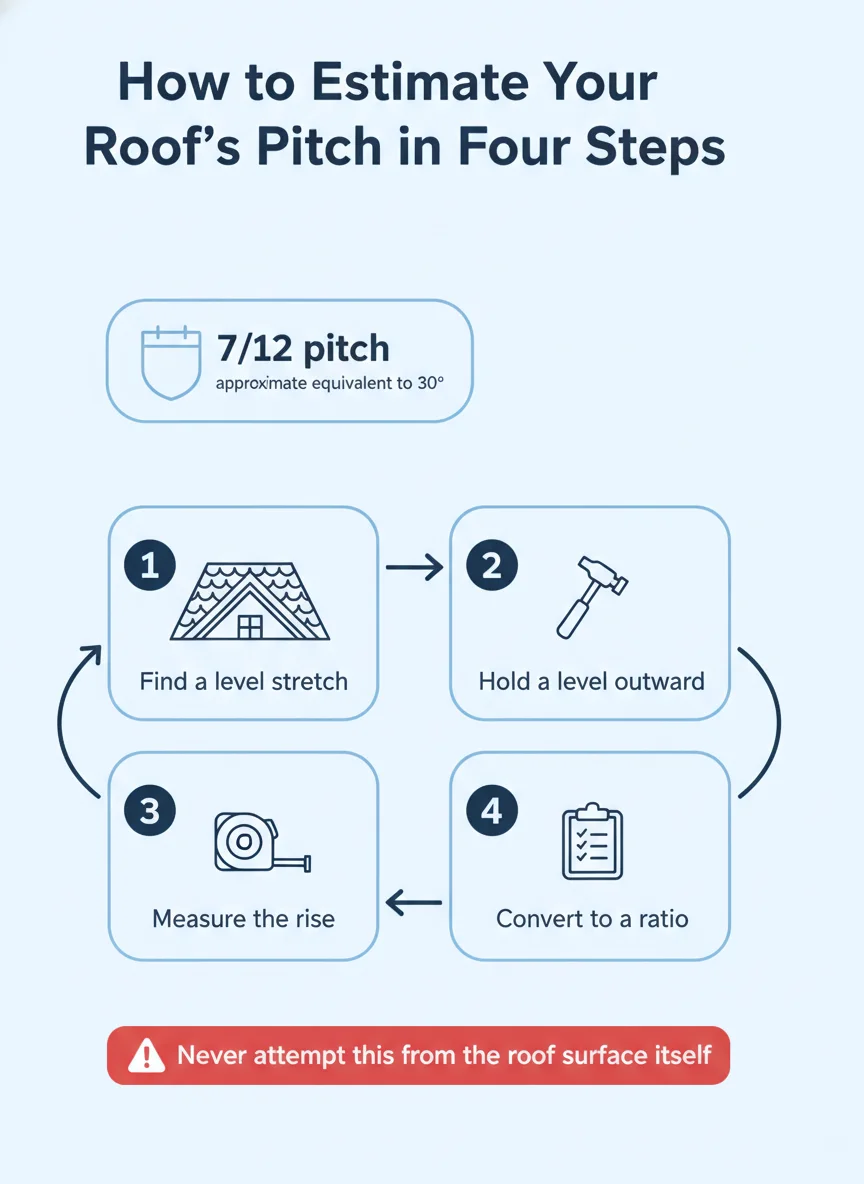
Step-by-Step: Estimating Your Roof's Pitch From the Ground
You don't need to get on the roof to get a reasonable estimate of its pitch. A few basic tools and a little patience from inside the attic or at the gable end will get you close enough to understand which category your roof falls into.
- Gather basic tools: You'll need a torpedo level or a standard carpenter's level, a tape measure, and a pencil to jot down numbers as you go.
- Find a flat run point: In the attic, hold the level horizontally against the underside of a rafter so it reads perfectly level, extending outward 12 inches.
- Measure the rise: At the 12 inch mark on the level, measure straight down to the rafter surface. That vertical measurement is your rise in inches.
- Write it as a ratio: If your rise measured close to 7 inches over that 12 inch run, your roof is sitting right around a 30 degree, or 7/12, pitch.
- Double check at another rafter: Repeat the measurement at a second rafter to confirm consistency, since older homes sometimes have slight variations across the roofline.
- Note any unusual sections: Dormers, porches, and additions often carry a different pitch than the main roof, so measure those sections separately if you have them.
What a 30 Degree Pitch Looks Like in Practice
Once you know your roof sits around 30 degrees, a few practical realities follow. The first is material flexibility. This pitch is steep enough to meet manufacturer minimums for asphalt shingles, metal panels, and most other common residential roofing products, so you generally aren't restricted to specialty low-slope systems.
Snow and Water Performance
At 30 degrees, snow and rain move off the roof surface at a noticeably faster rate than on a flatter roof, which reduces how long moisture sits against the roofing material. That said, no pitch eliminates ice buildup entirely in a Colorado winter, especially along eaves where heat loss from the attic can cause snow to melt and refreeze.
Gutters and edge details still matter at this pitch. A steeper roof moves more water and snow to the edges faster, which puts extra demand on gutters, flashing, and drip edges to handle that volume without backing up or overflowing onto siding below.
Walkability and Safety During Work
A 30 degree roof is walkable for trained crews but it's steep enough that fall protection equipment and careful footing are standard practice, not optional extras. This is part of why professional roofing work on this pitch typically costs more in labor than a low-slope roof of the same size, independent of material choice.
For homeowners, this pitch is firmly in the category where getting on the roof yourself for anything beyond a quick visual check from a ladder is not worth the risk. Even experienced crews use harnesses and anchor points on a 30 degree slope.
DIY vs. Calling a Professional
Measuring your roof's approximate pitch from inside the attic is a reasonable DIY task that most homeowners can handle safely with a level and a tape measure. It's a useful first step before a conversation with a contractor, especially if you're trying to understand quotes or material options ahead of time.
Anything beyond that estimate, including confirming exact pitch for a material spec, inspecting the roof surface itself, or doing any repair or replacement work, is a job for a licensed professional. A 30 degree pitch is walkable for trained crews with the right equipment, but it carries real fall risk for anyone without that training and gear.
If you're planning a project and need to know your exact pitch along with a full assessment of the roof's condition, a roof inspection gives you both in one visit, measured properly and safely from the surface rather than estimated from the attic.
Putting the Number to Work
Knowing that a 30 degree roof translates to roughly a 7/12 pitch gives you a practical vocabulary for talking with contractors, comparing material specs, and understanding why your roof performs the way it does through Colorado's seasons. It's a common, middle-ground pitch that works with most standard materials while still shedding snow and water well, and it's worth confirming the actual number on your own home rather than guessing from the curb.
If you're weighing material options for a home at this pitch, it also helps to see how different roofing materials hold up over time, covered in how long each roof type lasts in Colorado. For homeowners in Westminster and across the region who want that number measured accurately and explained in plain terms, Virtuous Roofing and Exteriors can walk through it during an on-site visit.
Frequently asked questions
What roof pitch is 30 degrees in a rise over run ratio?
A 30 degree slope works out to roughly a 7/12 pitch, meaning the roof rises about 7 inches for every 12 inches of horizontal run. Roofers in Colorado describe pitch in this rise-over-run format rather than degrees because it's easier to measure with a level and tape measure.
Is a 30 degree roof considered steep?
Yes, a 30 degree roof falls into the steep-slope category, which generally starts around 20 to 21 degrees (roughly a 4/12 pitch). It's steep enough to shed snow and rain well but still walkable for most trained crews with proper footing and fall protection.
How do I find out my roof's pitch without climbing on it?
You can estimate pitch from the ground or attic using a level, a tape measure, and some basic math, or you can ask a roofing contractor to measure it during a [roof inspection](/services/roof-inspection). Attic measurements are usually safer and more accurate for a DIY estimate.
Does roof pitch affect which materials I can use?
Yes, pitch is one of the biggest factors in material selection because very low slopes shed water too slowly for some products and very steep slopes create installation and walkability challenges for others. A 30 degree roof sits in a flexible middle range that works with most standard materials.
Why does roof pitch matter in a place like Colorado?
Pitch determines how fast snow and water slide off instead of sitting and soaking into the roofing material. In Colorado's freeze-thaw cycles, a steeper pitch like 30 degrees tends to shed snow load faster and reduce the chance of ice building up along the edges.