
Why the Valley Is the Hardest Part of Any Colorado Roof
A roof valley is the seam where two slopes come together and funnel water, snowmelt, and debris into one channel. On a typical home that channel carries far more volume than any other section of the roof, which is exactly why it fails first when something's built wrong. In the Denver Metro and Northern Colorado, that channel also has to survive freeze-thaw cycles that can turn standing water into ice dams almost overnight.
Homeowners usually don't think about their valleys until water shows up on a ceiling below one, and by then the underlayment has often been compromised for a while. Understanding how a valley is actually built, not just what it looks like from the driveway, is the difference between catching a problem early and discovering it as a stain on the dining room ceiling.
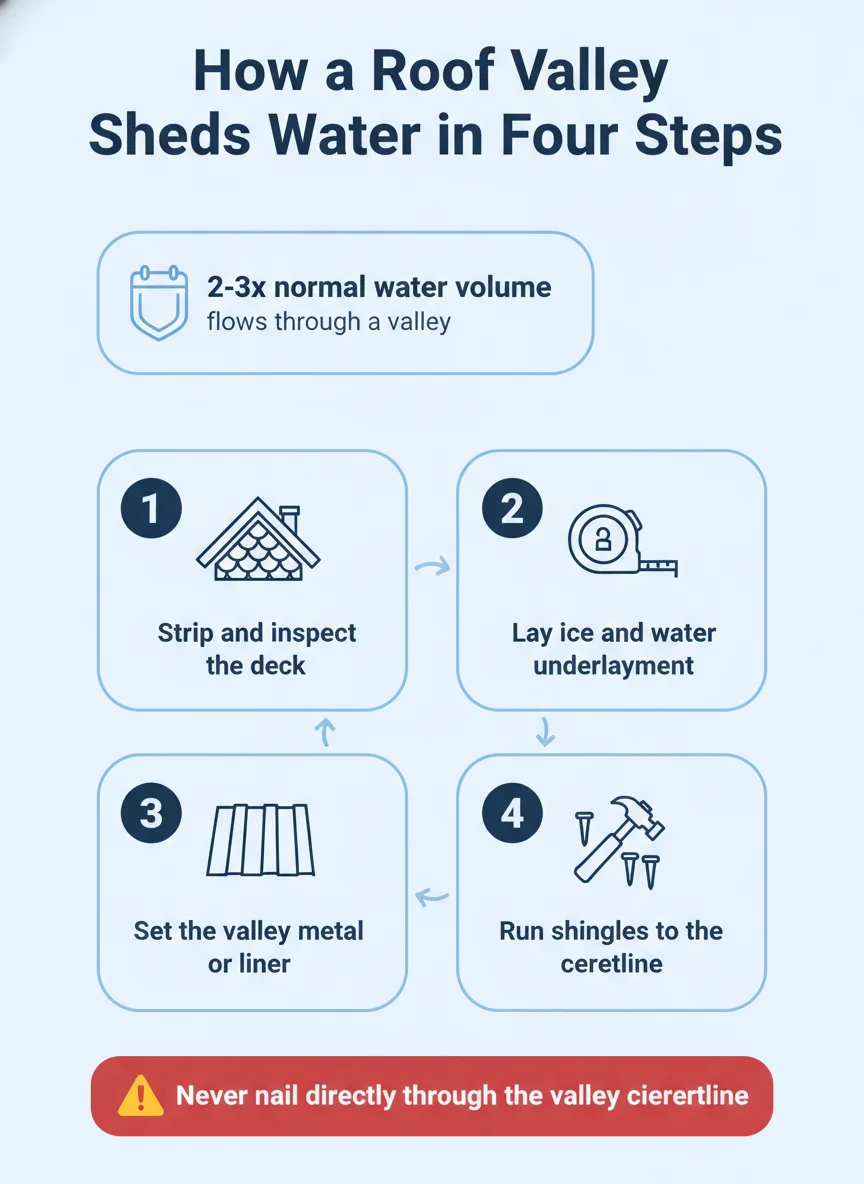
What Makes a Valley Leak-Prone, and How Builders Account for It
Every valley design is trying to solve the same problem: get a large volume of water off two slopes and down to the gutter line without letting any of it find a gap in the layers underneath. The two most common approaches are the open valley and the closed (or woven) valley, and each handles that job a little differently.
Open Valleys
An open valley uses a strip of metal, usually aluminum or galvanized steel, running down the center of the seam with the shingles on either side cut back to expose it. Water runs on the metal itself rather than over a shingle seam, which generally handles heavy flow better and clears debris more easily.
The tradeoff is that an open valley exposes more metal to the elements, so the flashing material and its fastening pattern matter more here than almost anywhere else on the roof. A properly installed open valley should never have a nail closer than a few inches to the centerline, since that's exactly where water pools during heavy melt.
Closed and Woven Valleys
A closed valley skips the exposed metal and instead laces or overlaps shingles across the seam so the shingles themselves become the waterproofing layer. Woven valleys interlace shingles from both slopes; cut valleys lay one slope's shingles through and trim the other slope's shingles to meet the seam.
Closed valleys can look cleaner since there's no visible metal strip, but they ask more of the shingles themselves and depend heavily on precise cutting and consistent overlap. In a region with real snow load, many roofers lean toward open valleys for that reason alone.
| Valley Type | How It's Built | Best Use Case |
|---|---|---|
| Open valley | Metal flashing exposed down the center, shingles cut back on both sides | Heavy water or snow volume, steep pitches |
| Closed/woven valley | Shingles interlaced across the seam, no exposed metal | Lower water volume, aesthetic preference |
| Closed/cut valley | One slope's shingles run through, other slope cut and sealed at the seam | Moderate water volume, cleaner sightline than woven |
What's Actually Under the Shingles in a Valley
Before any shingle or metal goes down, the deck in a valley gets its own layer of protection separate from the rest of the roof. Ice and water shield membrane is laid first, running the full length of the valley and extending well up both slopes, because this is the one spot on the roof where standard felt underlayment usually isn't enough.
That membrane is self-adhering and designed to seal around nail penetrations, which matters because it's the last line of defense if water ever gets past the metal or shingles above it. Skipping this layer, or skimping on how far it extends up the slope, is one of the most common corners cut on a rushed job.
Step-by-Step: How a Valley Gets Roofed
The sequence below reflects how a valley is typically built during a full roof replacement, whether it's an open or closed design. Each step depends on the one before it being done correctly, which is part of why this section takes more time per square foot than open field shingles.
- Strip and inspect the deck: Old shingles, metal, and underlayment come off the valley first so the decking underneath can be checked for rot or soft spots before anything new goes down.
- Lay ice and water membrane: Self-adhering membrane runs the full length of the valley and extends up both slopes well past where the finished metal or shingles will cover.
- Set the valley metal or liner: For open valleys, metal flashing is centered and fastened well clear of the centerline; for closed valleys this step is skipped in favor of the first course of shingles.
- Snap chalk lines: Lines are snapped on either side of the centerline to guide a consistent, straight cut or overlap line all the way down the valley.
- Run shingles to the line: Shingles from both slopes are installed up to the chalk lines, with fasteners kept well back from the centerline so the valley itself stays clear of penetrations.
- Cut and seal the edges: Shingle edges along the valley are trimmed clean and sealed with roofing cement where needed to keep wind and water from lifting the cut edge.
- Flow-test the channel: Water is run down the valley to confirm it sheds cleanly to the gutter line without pooling or backing up under any shingle edge.
What a Failing Valley Usually Looks Like
Valley problems don't always announce themselves as an obvious leak right away. Early signs tend to be subtle, which is why valleys deserve a closer look during any routine checkup.
Visible Warning Signs
Granule buildup at the bottom of the valley, a rusted or discolored strip of metal, or shingles that look lifted or curled right along the seam are all signs the valley is under more stress than it should be. Dark streaking running down from the valley onto the slope below it often means water is finding a path it shouldn't.
From the ground, a valley that looks slightly sunken compared to the rest of the roofline can mean the decking underneath has started to soften. That's usually a sign the problem has been developing for a while and is worth a closer look sooner rather than later.
Interior Clues
Inside the house, a ceiling stain that appears below where two roof slopes meet, rather than under a flat section, almost always points back to a valley issue. The same goes for a musty smell in an attic space near where two rafters converge, since that's usually where valley moisture shows up first.
Because valley leaks often travel before they show up visibly, the stain on a ceiling isn't always directly under the actual failure point. That's part of why a roof inspection that includes attic access tends to catch valley problems earlier than a walk-around from the yard.
What a Homeowner Can Handle vs. What Needs a Licensed Roofer
Keeping a valley clear of leaves, pine needles, and debris is something any homeowner can and should do, especially heading into fall and spring when debris tends to pile up fastest. A quick visual check from the ground or a ladder for obvious granule loss, rust, or lifted shingle edges is also reasonable for most people to do a couple of times a year.
Anything beyond that, cutting new shingles to a valley line, replacing valley metal, or re-laying underlayment, really does call for a licensed roofer. The margin for error is small, the consequences of a bad cut or a misplaced nail are a slow leak that's expensive to trace later, and the work usually requires being on a steep slope in a spot where water is actively trying to get past you.
If a valley is actively leaking right now, that's a different situation entirely and calls for emergency tarping to stop active water intrusion before a permanent fix gets scheduled. Waiting on a active leak almost always costs more in the long run than acting on it fast.
Getting a Valley Done Right the First Time
A roof valley might only be a few linear feet on most homes, but it does more work than almost any other section of the roof, and it's one of the first places that shows the difference between a careful install and a rushed one. Whether you're in Boulder, Fort Collins, or anywhere else across the region, the same principles apply: proper underlayment, the right valley style for the pitch and climate, and a clean, consistent cut line.
If a valley on your home looks questionable or you're just not sure what's going on underneath those shingles, it's worth having it looked at before the next heavy snow or spring melt puts it to the test. Virtuous Roofing and Exteriors can take a look and tell you honestly what that section of your roof needs.
Frequently asked questions
What is a roof valley and why does it leak so often?
A valley is the V-shaped channel formed where two roof slopes meet, and it's the busiest drainage path on the whole roof. Because water, snow, and ice from both slopes funnel into one narrow line, any gap in the underlayment or flashing there shows up as a leak faster than it would on a flat section of shingles.
What's the difference between an open and closed valley?
An open valley leaves a strip of metal flashing exposed down the center so water runs on metal, while a closed valley weaves or laces shingles across the seam so the shingles themselves form the water barrier. Open valleys tend to handle heavy water volume better, which matters in a state with sudden spring melt.
Can a homeowner reroof a valley themselves?
Technically yes, but it's one of the few sections of a roof where a small mistake causes a big problem, since a misaligned cut or a nail placed too close to the centerline can funnel water straight into the deck. Most homeowners are better off having a licensed roofer handle this specific section even if they're comfortable with simpler repairs elsewhere.
How do I know if my valley needs ice and water shield?
If your roof sees any snow load at all, the valley is one of the first places that should get ice and water membrane underneath the metal or shingles, because it's where meltwater refreezes and backs up. Building codes in snow country generally call for this protection in valleys and at eaves regardless of the roofing material above it.
Why does my valley leak even though the shingles look fine?
A valley can look fine on the surface while the underlayment or flashing underneath has already failed, since the damage usually starts below what you can see from the ground. Granule loss, rusted metal edges, or a soft spot in the decking near the valley seam are usually the first visible clues something's wrong underneath.