Why This Matters in Colorado
Roofing a house isn't just laying shingles in rows. It's a layered system built to handle sun, wind, snow load, and freeze-thaw cycles, and Colorado puts all of those to work on a roof in a single year. The Front Range and Northern Colorado see intense UV at altitude, sudden hail, and heavy wet snow that sits on a roof for days, so the materials and installation details that work fine at sea level don't always hold up the same way here.
Understanding the process matters whether you're planning a full replacement, vetting a quote, or just trying to figure out if the crew on your neighbor's roof is doing it right. A roof that's installed out of sequence, or missing a step, often looks fine for a year or two before the shortcuts show up as a leak or premature wear.
Why a Roof Comes Off and Goes On the Way It Does
Every layer in a roofing system has a specific job, and the order they go on in isn't arbitrary. The deck has to be solid and dry, the underlayment has to seal the deck before anything else touches it, flashing has to redirect water away from every joint and penetration, and the shingles (or metal, or other covering) are the last line that sheds the bulk of the water and takes the UV hit.
The Deck Has to Be Sound First
The roof deck, usually plywood or OSB sheathing, is the structural base everything else attaches to. If it's soft, rotted, or delaminated from years of moisture, nailing a new roof over it doesn't fix the problem, it just hides it until the new roof fails too.
A thorough tear-off exposes the entire deck so any damaged sections can be identified and replaced before anything new goes down. This is one of the biggest reasons a full Roof Replacement outperforms a layer-over job in the long run, even though it costs more labor up front.
Underlayment and Flashing Do the Quiet Work
Underlayment is the water-resistant membrane that goes directly over the deck, and in cold climates it's often paired with an ice-and-water shield at the eaves and valleys where meltwater tends to back up. This layer is invisible once the job is done, but it's what keeps a small gap or a wind-driven leak from reaching the deck.
Flashing is the metal detail work around chimneys, vents, skylights, and roof-to-wall transitions. These are the spots where most leaks actually originate, not in the open field of shingles, so flashing quality and installation are worth as much attention as the shingles themselves.
| Layer | What It Does | Why It Matters in Colorado |
|---|---|---|
| Deck | Structural base for the whole system | Must be sound before anything attaches to it |
| Underlayment | Backup water barrier under the covering | Ice-and-water protection matters in freeze-thaw cycles |
| Flashing | Seals joints, vents, chimneys, valleys | Most leaks start at flashing, not open shingle field |
| Covering (shingles/metal) | Primary weather and UV barrier | High-altitude UV accelerates wear on lower-grade materials |
What a Roofing System Is Actually Made Of
A finished roof looks like one surface, but it's a stack of distinct materials working together. Starter strips along the eaves, the field shingles or metal panels, hip and ridge caps, flashing at every penetration, and ventilation components all have to be matched to each other and to the pitch and style of the house.
Ventilation is often the overlooked piece. Intake vents at the eaves and exhaust vents near the ridge keep air moving through the attic space, which controls moisture and heat buildup that can shorten the life of the decking and the covering above it from underneath.
Step-by-Step: How a Roof Replacement Actually Happens
The exact order varies a little by crew and roof type, but a standard asphalt shingle replacement generally follows this sequence from first tarp to final cleanup.
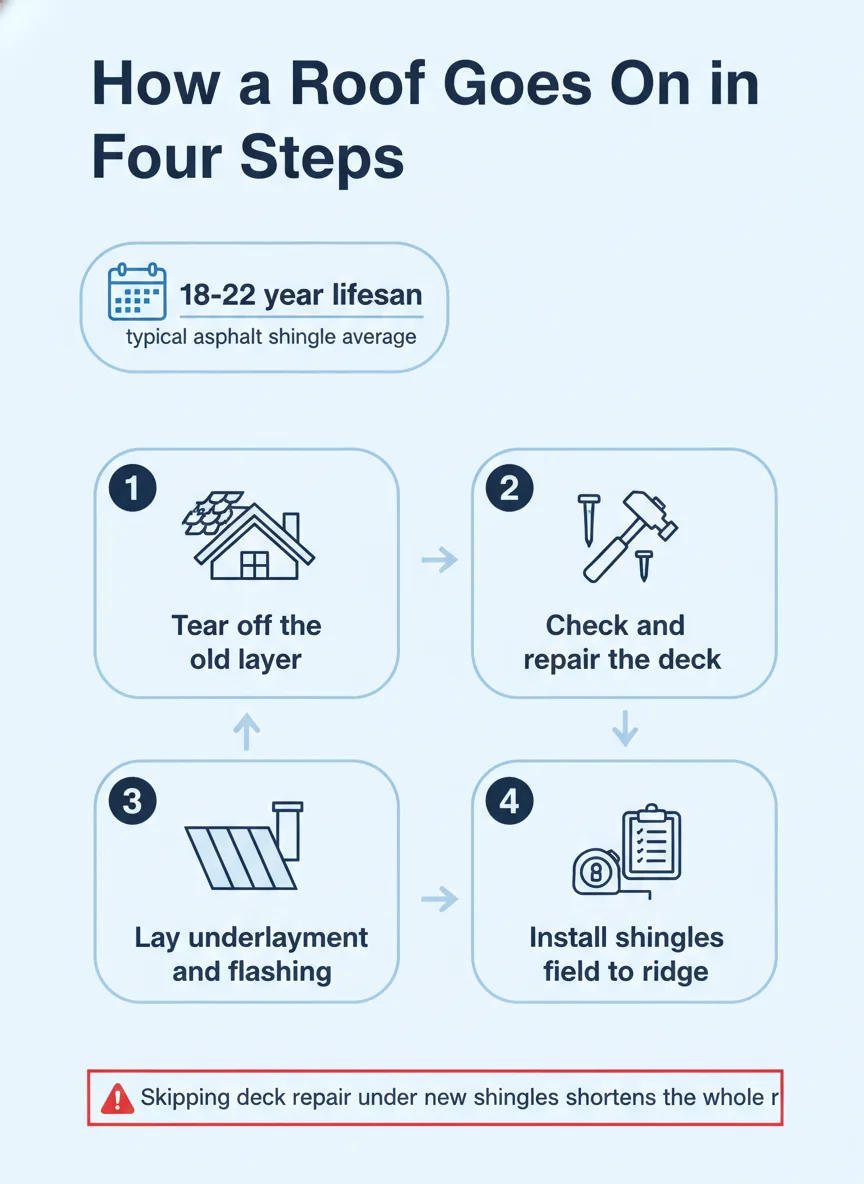
- Protect the property: Tarps go over landscaping, AC units, and anything in the drop zone before the first shingle comes off.
- Tear off the old roof: Crews strip the existing covering down to bare decking so it can be inspected for soft spots or rot.
- Repair or replace decking: Any damaged sheathing gets swapped out before underlayment goes down over the repaired surface.
- Install underlayment and ice protection: Water-resistant membrane and ice-and-water shield go down at eaves, valleys, and penetrations first.
- Install flashing: Metal flashing goes in around chimneys, vents, skylights, and wall transitions before the field covering.
- Lay the field covering: Shingles or panels go on starting at the eave and working up, with proper nailing pattern and exposure.
- Final details and cleanup: Ridge caps, vents, and ventilation components go on last, followed by a magnetic sweep for nails and debris.
What You'll Notice When It's Done Right
A properly installed roof reads as uniform from the ground: straight shingle lines, flush flashing with no visible gaps, and ridge caps that follow a clean line down the peak. Underneath, in the attic, you should notice better airflow and less temperature swing if the ventilation was updated along with the covering.
Signs the Job Was Rushed
Wavy shingle lines, exposed nail heads, mismatched flashing, or shingles nailed too high or too low on the exposure line are all signs a crew moved too fast. These issues often don't cause a problem immediately, which is exactly why they're easy for a homeowner to miss at the time.
The other common shortcut is skipping the tear-off and layering new shingles over old ones. It's faster and cheaper in the moment, but it hides the deck from inspection and adds weight the structure wasn't necessarily built to carry long-term.
What to Ask Before Work Starts
A homeowner getting quotes should ask whether the job includes a full tear-off, what underlayment and ice protection will be used, and how flashing at chimneys and vents will be handled. A Roof Inspection before the project starts is also worth doing so any deck damage is known upfront instead of discovered mid-job.
It's also worth asking what happens if hidden rot is found once the old roof comes off. A straightforward answer about how that gets handled and documented tells you a lot about how the rest of the job will go.
What a Homeowner Can Do vs. What Needs a Licensed Roofer
There are a few things a homeowner can reasonably handle: clearing debris from gutters and valleys, keeping an eye out for lifted or missing shingles after a windstorm, and doing a visual check from the ground with binoculars after a hailstorm. None of that requires getting on the roof itself.
Actually replacing or repairing a roof is a different category of risk and skill. Working at height on a pitched surface, nailing patterns that meet manufacturer specs for warranty coverage, and flashing details that actually keep water out are all things that take training and the right equipment to get right consistently.
A roof is also one of the few home systems where a mistake isn't just expensive, it's dangerous. Falls are the leading cause of injury in the roofing trade, which is the practical reason most homeowners call a licensed, insured crew rather than tackling even a straightforward-looking job themselves.
Getting It Right the First Time
Roofing a house correctly comes down to sequence and attention to detail: sound decking, proper underlayment and flashing, and a covering installed to spec, all topped off with ventilation that keeps the attic doing its part. Skip a step and the roof might still look fine for a while, but it won't perform the way it's supposed to when a hard Colorado winter or a hailstorm tests it.
If you're comparing quotes or just trying to understand what a crew should be doing on your roof, it helps to also read up on how long roof replacement takes once a project gets underway. Homeowners in Westminster and across the region can reach out to Virtuous Roofing and Exteriors for a straightforward look at what their roof actually needs.
Frequently asked questions
Can a homeowner roof their own house in Colorado?
It's physically possible on a simple, low-pitch roof, but it's a demanding, dangerous job that most homeowners aren't equipped for safely. Steep pitches, high-altitude sun exposure, and the risk of a fall or a bad install that voids a warranty are why most people hire a licensed roofer instead.
How many layers of shingles can a roof have?
Most building codes limit roofs to two layers of shingles before a full tear-off is required, and many roofers recommend tearing off down to the deck regardless. A full tear-off lets the crew inspect the decking underneath, which a layer-over install skips entirely.
What is roof underlayment and why does it matter?
Underlayment is the water-resistant barrier installed directly on the deck before shingles go down, and it's the backup line of defense if wind or ice ever gets under the shingles. In Colorado's freeze-thaw climate, a quality underlayment with proper ice-and-water protection at the eaves matters more than in milder states.
How long does it take to roof an average house?
Most residential roofs go on in a day or two once a crew is on site, though size, pitch, and weather windows can stretch that out. A clear timeline should be part of any estimate before work starts.
Do I need a permit to roof my house?
Most municipalities require a building permit for a full roof replacement, and a licensed roofer typically pulls it as part of the job. Check with your local building department before starting any project to confirm what's required where you live.