
Why the timeline question matters more in Colorado
Colorado's weather swings hard between seasons, and that affects how a replacement actually plays out once a crew shows up. A clear morning can turn into an afternoon wind advisory, and that changes what a crew can safely do on a pitched surface. Homeowners across Denver, Westminster, and the surrounding Front Range towns ask this question for a practical reason: they need to plan around pets, parking, and noise, not just get a vague answer.
The honest answer is that most homes fall into a predictable range, but a handful of variables push a job longer or shorter. Knowing what those variables are before your crew arrives means fewer surprises and a better sense of what 'done' actually looks like on your specific house. It also helps you ask sharper questions when you're comparing estimates from different contractors.
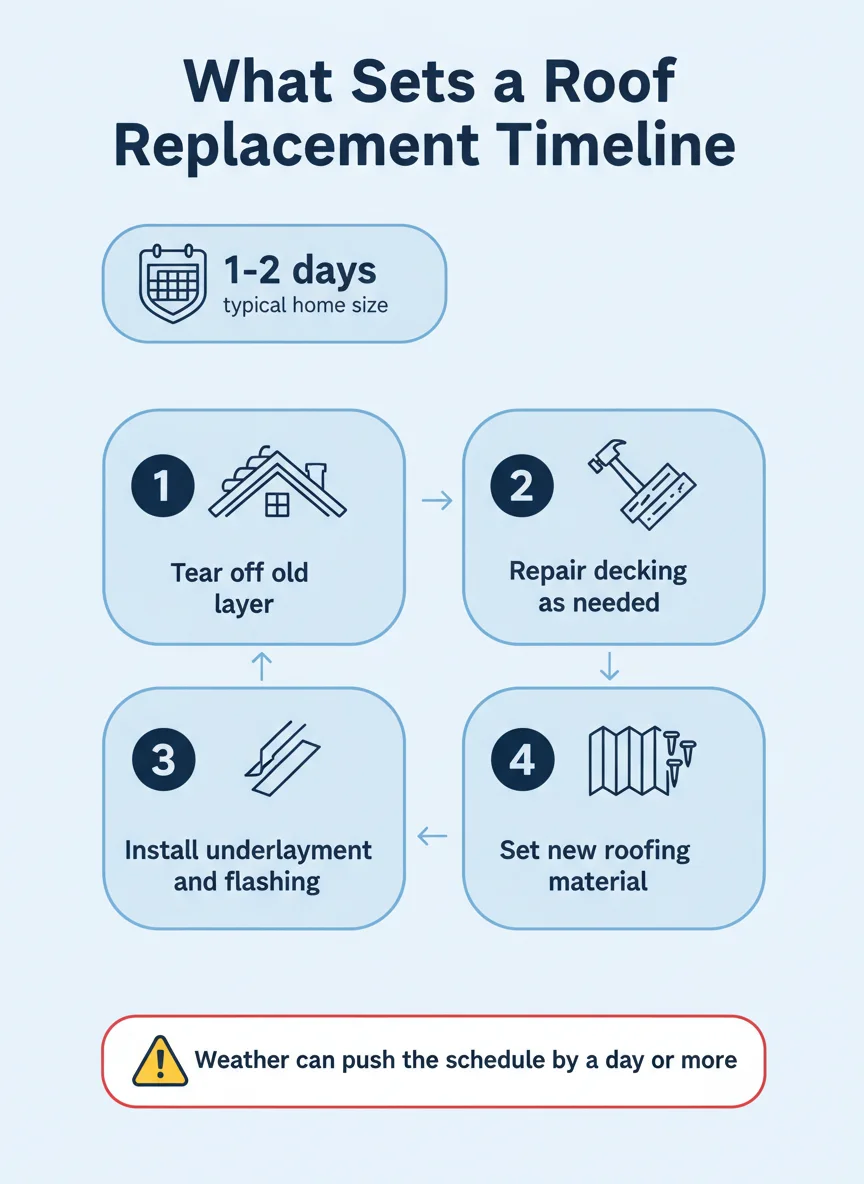
What actually sets the clock on a replacement
A roof replacement timeline comes down to a handful of physical realities: how big the roof is, how steep it is, how many layers of old material have to come off, and what the weather does on the days scheduled for work. None of these are mysteries once you know to ask about them, and a good contractor will walk through each one before quoting a timeline.
Size and roof complexity
A simple rectangular roof on a single-story home goes faster than a roof with multiple valleys, dormers, skylights, and chimneys. Every penetration and transition point takes extra care to flash correctly, and that adds hours a crew has to build into the schedule. Steeper pitches also slow the pace, since crews move more carefully and use additional safety gear on a steep slope.
Square footage matters too, but it's not the only driver. A large, simple roof can move faster than a smaller roof with a complicated layout, which is why an accurate roof inspection up front matters more than a quick drive-by guess. The layout of your specific roof is what the estimate should reflect, not a generic per-square number.
What's underneath the old material
Once the old layer comes off, the crew can see the decking underneath for the first time. If there's rot, soft spots, or old water damage, that section needs to be repaired or replaced before new material goes down, and that adds time that wasn't visible from the ground. This is one of the most common reasons a job runs a bit longer than the original estimate.
Homes with more than one layer of old roofing material also take longer to strip, since every layer has to come off before the deck is exposed. A contractor who does a thorough roof inspection before the job starts can often spot signs of multiple layers or deck trouble ahead of time, which helps set a more realistic schedule from the start.
| Factor | Faster job | Slower job |
|---|---|---|
| Roof shape | Simple rectangle, few penetrations | Multiple valleys, dormers, chimneys |
| Layers of old material | Single layer | Two or more layers to remove |
| Decking condition | Solid, no repairs needed | Rot or soft spots found at tear off |
| Weather during the window | Dry, calm days | Wind, rain, or snow delays |
The parts of the system that take time to install correctly
A roof isn't just the visible shingles or metal panels on top. Underneath, there's an underlayment layer that acts as a secondary water barrier, flashing around every chimney, vent, and valley to direct water away from seams, and ventilation components that let the attic breathe properly. Each of these gets installed in sequence, and rushing any of them is how leaks show up down the road.
Flashing work in particular takes patience, since it has to be cut, fitted, and sealed around irregular shapes like chimneys and skylights. A crew that takes the time to do this right is adding minutes here and there that add up to a more durable result, which is part of why a thorough job sometimes runs a little past a bare-bones estimate.
Step-by-step: what happens on a typical replacement
Here's the general order of operations a crew follows once they arrive on install day, start to finish.
- Setup and protection: The crew protects landscaping, siding, and gutters, and stages material and equipment for the day.
- Tear off old material: The old roofing layer comes off down to the decking, exposing the surface underneath for inspection.
- Deck repair if needed: Any rotted or damaged decking found during tear off gets replaced before anything new goes down.
- Underlayment installed: A water-resistant barrier goes down across the full deck as the first layer of protection.
- Flashing and valleys: Metal flashing is fitted around chimneys, vents, and valleys to direct water away from seams.
- New material installed: The new roofing material goes on in rows, following manufacturer spacing and nailing patterns.
- Cleanup and final walk: The crew runs a magnetic sweep for nails, hauls away debris, and walks the property with you.
What you'll see on day one versus a multi-day job
Single-day jobs
On a straightforward single-story home with a simple roofline, it's common to see tear off, deck inspection, and full installation wrapped up in one day. The crew arrives early, works through the sequence above, and finishes with cleanup before they leave. You'll generally have a finished roof by evening.
These jobs move fast because there's less flashing work, fewer penetrations to navigate, and usually only one layer of old material to remove. If your estimate came back on the shorter end, this is likely why, and it's not a sign of corner-cutting as long as the full sequence of steps still happened.
Two-day and multi-day jobs
Larger homes, steep pitches, complex rooflines, or decking repairs push a job into a second day. Crews will often finish tear off and address any deck issues on day one, then complete installation and detail work like flashing and cleanup on day two. This isn't unusual, and it doesn't mean something went wrong.
Weather is the wildcard that can stretch any job, single-day or multi-day. A contractor won't install material in active rain or high wind for safety and performance reasons, so a day that was supposed to be the finish can get pushed. A reliable crew will communicate that change as soon as they know, rather than letting you wonder.
What homeowners handle versus what the crew handles
On replacement day, your part is mostly preparation beforehand and patience during the work. Moving vehicles out of the driveway, trimming back plants near the house, and letting the crew know about anything fragile nearby (a greenhouse, solar panels, a skylight) goes a long way toward a smooth day. Pets are usually happier somewhere quiet, since the noise from tear off and nailing runs most of the day.
Everything from the tear off sequence through flashing and final installation is work that calls for a licensed, insured crew. This isn't a project for DIY, both because of the fall risk on a pitched surface and because improperly flashed penetrations are one of the most common causes of leaks. A full roof replacement involves permitting and sequencing that benefits from experience.
If you're unsure whether your current roof needs a full replacement or just a targeted fix, a roof inspection is the right starting point before you commit to a timeline at all. It's also worth reading up on how long a roof typically lasts in Colorado if you're trying to decide whether replacement is even the right call yet.
Setting realistic expectations before install day
The clearest way to know your own timeline is to ask for it directly during your estimate, and to ask what could change it. A good contractor will walk your roof, point out anything that might complicate the job, like multiple layers or a tricky roofline, and give you a range rather than a single number pulled out of thin air.
Across Westminster and the rest of the Denver Metro and Northern Colorado, weather and roof complexity are the two things that move a timeline more than anything else. Virtuous Roofing and Exteriors walks homeowners through that timeline before the first bundle of material gets unloaded, so there's no guessing about what to expect on install day.
Frequently asked questions
How long does it take to replace a roof on an average house?
Most single-family homes in the region are a one to two day job once a crew is on site. Size, roof pitch, and how many layers need to come off all affect which end of that range you land on.
Can a roof be replaced in a day?
Yes, smaller or simpler roofs are sometimes finished in a single day, especially single-story homes with a straightforward pitch and only one layer of material to remove. Larger homes, steep pitches, or decking repairs usually push the job into a second day.
What slows down a roof replacement?
Weather is the biggest factor, since wind, rain, or snow can pause work for safety reasons. Hidden deck damage, multiple layers of old material, and complex rooflines with lots of valleys or dormers also add time.
Do I need to be home during roof replacement?
You don't have to be home, but it helps to have someone reachable in case the crew finds something during tear off that changes the plan. Most homeowners prefer to be around for at least part of the first day.
How far in advance should I schedule a roof replacement?
It depends on the season and how booked the local market is, since spring and early summer tend to fill up fastest after winter weather. Getting on a schedule a few weeks ahead gives you more flexibility on timing.