Why This Decision Matters More in Colorado
Front Range and Northern Colorado homes deal with a mix most regions don't see in one place: intense hail seasons, heavy wet snow, big daily temperature swings, and strong UV at elevation. Whatever material goes on your roof has to handle all of it, not just one season's worst weather.
That's why the metal versus shingle question comes up so often here. Both materials are proven performers nationwide, but Colorado's climate puts a sharper point on certain strengths and weaknesses than a milder state would. Understanding those differences before you commit to a roof replacement saves you from second-guessing the choice ten years in.
What Actually Separates the Two Materials
Asphalt shingles and metal panels are built and installed in fundamentally different ways, and that's where most of the performance gap comes from. Shingles are layered, overlapping pieces that rely on an asphalt and granule surface for weather resistance. Metal is a continuous or interlocking panel system that sheds water and impact differently.
How Asphalt Shingles Perform
Asphalt shingles are the most common roofing material in Colorado because they're familiar, widely available, and reasonably priced to install. They come in three-tab, architectural, and designer grades, with architectural being the standard choice for most homes today. Industry lifespan in a Colorado UV and hail climate typically lands in the 18 to 22 year range.
Their main vulnerability is hail. A hard enough hit can bruise or crack the mat under the granules, which weakens the shingle even if it doesn't look dramatically damaged from the ground. That's part of why storm damage inspections after a hail event focus closely on granule loss and mat bruising, not just obvious holes.
How Metal Roofing Performs
Metal roofing, whether standing seam or a screw-down panel system, is built to flex and shed impact rather than absorb it the way shingles do. That makes it more resistant to hail denting in most cases, though large enough hail can still leave cosmetic marks on a metal surface. Metal also sheds snow faster, which matters on steep-pitch mountain homes near Breckenridge or Red Feather Lakes.
The trade-off is upfront material and installation cost, which runs higher than asphalt. Metal roofs also carry a different sound profile in rain and hail, and some homeowners associate that with a commercial or barn look rather than a traditional residential style, though modern panel profiles have closed that gap considerably.
| Factor | Asphalt Shingles | Metal Roofing |
|---|---|---|
| Typical lifespan | 18-22 years in Colorado's climate | 40-70 years industry-wide |
| Hail performance | Can bruise or crack under impact | More impact-resistant, may dent cosmetically |
| Snow shedding | Holds snow load on the surface | Sheds snow faster on steep pitches |
| Upfront cost | Lower material and labor cost | Higher material and labor cost |
What's Actually Being Installed Up There
Whichever material you choose, the roofing system is more than the visible surface. Underneath both shingles and metal sits an underlayment layer that acts as a secondary water barrier, along with flashing at every valley, chimney, and penetration point. The quality of that unseen layer affects how either material performs over its lifespan.
Ventilation also matters for both. A roof deck that can't breathe properly traps heat and moisture, which shortens the life of shingles and can cause condensation issues under metal panels too. A reputable installer accounts for deck condition and attic ventilation during the estimate, not just the surface material.
Step-by-Step: How to Decide Between Metal and Shingles
Working through the decision in order keeps you from picking a material based on price or looks alone and missing a factor that matters more for your specific home.
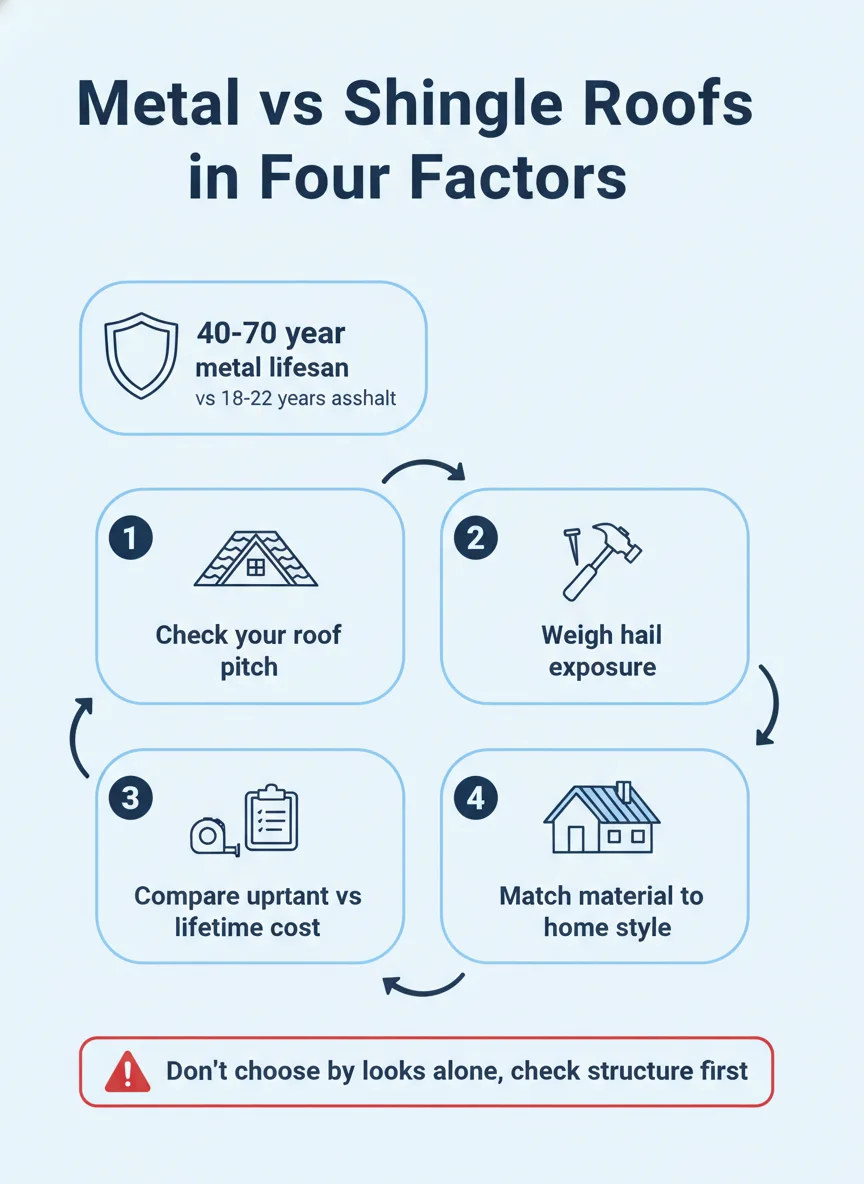
- Check your timeline: If you plan to stay in the home for decades, metal's longer lifespan has more time to pay off. If you're selling within a few years, asphalt may make more financial sense.
- Assess hail exposure: Homes on open, high-elevation lots with a history of hail may benefit more from metal's impact resistance than a sheltered in-town lot.
- Review your roof pitch: Steep mountain pitches near Breckenridge shed snow and debris more effectively with metal panel systems than with shingles.
- Confirm structural fit: Have a contractor verify your deck and framing can support the material you want before you finalize a quote.
- Compare total cost of ownership: Factor in replacement cycles over 40 to 60 years, not just the first installation, when weighing the price difference.
- Match your home's style: Consider how either material looks against your neighborhood and whether it affects resale appeal in your area.
What You'll Notice With Each Material Over Time
Living under an asphalt shingle roof, you'll likely see granule buildup in the gutters after storms and may need a repair or two over its lifespan as individual shingles age or take wind damage. That's normal wear, and it's typically addressable with targeted roof repair rather than a full replacement.
Living With Asphalt Long-Term
Expect periodic maintenance as the roof approaches the back half of its lifespan, including checking for curling edges, lifted shingles after wind events, and granule loss after hail. Most of this is visible from the ground or during a routine roof inspection.
Replacement, when it comes, is a well-understood process with wide material availability, which tends to keep both material and labor costs more predictable than specialty systems.
Living With Metal Long-Term
Metal roofs need less routine attention over the years, but fastener checks on screw-down systems and occasional panel seam inspections matter, especially after major wind or hail events. Repairs to metal are less common but can be more specialized when they're needed.
Snow and ice slide off metal more aggressively, which is a benefit for the roof but something to plan for with landscaping, walkways, and anything parked below the eaves during winter.
DIY vs. Calling a Pro
Picking between metal and shingles isn't a DIY decision in the sense of installation, both require licensed, experienced crews to install correctly and keep any manufacturer or workmanship warranty valid. But homeowners can absolutely do the early legwork themselves.
You can research material options, check your HOA's rules if panel color or profile is restricted, and get a sense of your budget range before calling anyone out. What you can't reliably judge from the ground is deck condition, structural capacity for a heavier material, or the right underlayment and flashing details for your specific roof geometry.
That's where a licensed roofer earns their keep, walking the roof, checking the deck, and giving you a straight answer on what each material would actually involve for your home rather than a generic sales pitch toward whichever product they happen to stock.
Making the Call for Your Home
There's no universal right answer between metal and shingles, only the right answer for your home, your budget, and how long you plan to live under that roof. Both materials have a strong track record in Colorado when they're installed correctly by people who understand the local climate.
If you want an honest look at which option fits your specific roof, Virtuous Roofing and Exteriors can walk the deck with you and lay out both paths before you decide.
Frequently asked questions
Is metal roofing better than shingles in Colorado?
Neither material is universally better, it depends on your priorities. Metal holds up longer and sheds snow more easily, while asphalt shingles cost less upfront and are easier to match if you ever need a repair.
Does metal roofing hold up better in hail?
Metal generally dents less severely than shingles in hail, but it can still show cosmetic dimpling depending on the panel gauge and hail size. Impact-rated asphalt shingles close some of that gap and are worth asking about either way.
How long does a metal roof last compared to shingles?
Metal roofing commonly lasts 40 to 70 years industry-wide, while asphalt shingles in a Colorado climate typically run 18 to 22 years. That longer lifespan is the main reason homeowners consider the higher upfront investment in metal.
Is a metal roof worth the extra cost?
It depends on how long you plan to stay in the home and how much you value fewer replacement cycles. Homeowners who plan to stay long-term often find the lifespan and durability trade-off worthwhile, while those selling sooner may not recoup the difference.
Can you put a metal roof on a house built for shingles?
In most cases, yes, as long as the roof deck and structure can support it, which a contractor should verify before quoting the job. Steep pitches and standard framing usually convert without issue, but it's worth having it checked first.