
Why Roof Replacement Pricing Varies So Much in Colorado
Ask five homeowners across the Denver Metro area what their roof replacement cost and you'll likely get five different answers, even for houses that look similar from the street. That's normal. Roof replacement pricing depends on a combination of material, roof geometry, what's found once the old roofing comes off, and how accessible the property is for a crew and equipment.
Understanding what actually moves the number helps you evaluate quotes on their merits instead of just comparing bottom-line totals. Two quotes that look far apart on paper might reflect two very different scopes of work, and knowing what to ask about closes that gap fast.
What's Actually Driving the Number Up or Down?
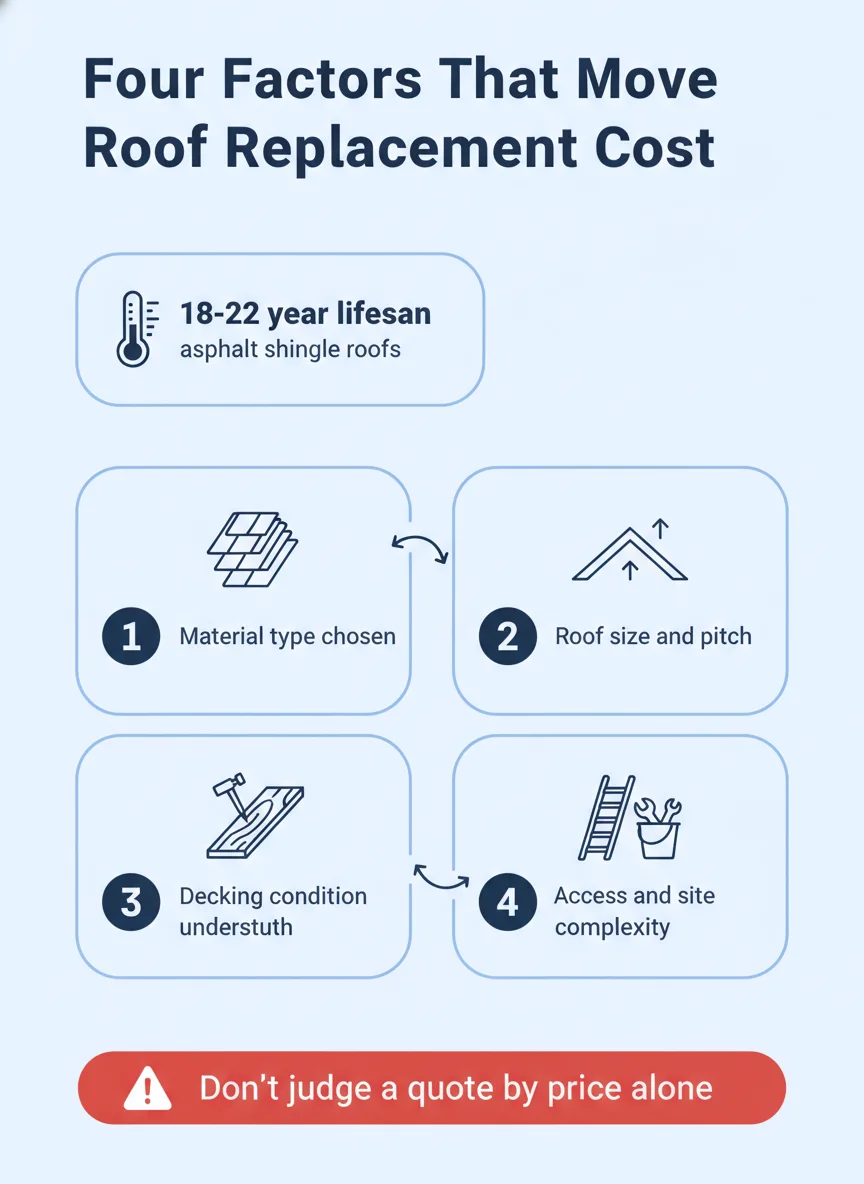
At a high level, roof replacement cost comes down to how much material is needed, how hard it is to install, and how much labor the job requires. From there, several specific factors do most of the heavy lifting on price.
Material Type and Roof Size
Asphalt shingles remain the most common and generally the most budget-friendly option, while metal roofing typically costs more upfront but offers a longer service life and different maintenance profile. The total square footage of the roof is the other obvious lever, since more material and more labor hours both scale directly with size.
Beyond square footage, the number of roof planes, valleys, and penetrations like vents and chimneys also adds complexity. A simple rectangular roof with few features installs faster than one with multiple angles, dormers, and cutouts, even at the same total square footage.
Pitch, Decking Condition, and Access
Steep roofs slow a crew down and require more safety equipment, which adds labor cost compared to a low-slope roof of the same size. Decking condition is another major variable that's often invisible until the old roofing comes off. If sections of decking are soft, rotted, or damaged, they need to be replaced before new material goes down, and that's additional cost that a visual inspection alone can't always predict.
Site access matters too. A roof that's easy to stage material near, with clear driveway access for dumpsters and delivery trucks, is faster and cheaper to work than one on a tight lot or with obstacles like mature trees close to the house.
| Factor | Pushes Cost Up | Pushes Cost Down |
|---|---|---|
| Material | Metal or higher-end options | Standard asphalt shingles |
| Pitch | Steep, multi-plane roofs | Low-slope, simple layouts |
| Decking | Rot or damage found underneath | Solid decking, no replacement needed |
| Access | Tight lots, tall trees, tricky staging | Easy driveway and yard access |
What's Included in a Full Roof Replacement
A proper roof replacement is more than swapping the top layer of material. It includes tearing off the old roofing down to the decking, replacing any compromised decking sections, installing new underlayment, flashing, and ventilation components, then laying the new roofing material itself. Permitting is typically part of the process too, since most jurisdictions require a permit for a full tear-off and reinstall.
Warranty coverage is another part of what you're paying for, not just the physical materials and labor. A workmanship warranty on the install itself, separate from the manufacturer's material warranty, is worth asking about directly when comparing quotes, since it protects you if something about the installation itself causes a problem down the line.
Step-by-step: How a Roof Replacement Quote Comes Together
A solid quote is built from a real inspection, not a guess from the street.
- Initial roof inspection: We walk the roof to measure size, pitch, and condition, and check for existing damage or wear.
- Material discussion: We talk through options like asphalt or metal based on your goals, budget, and how long you plan to stay in the home.
- Decking assessment: We flag any visible signs decking replacement may be needed, though full extent isn't known until tear-off.
- Written estimate: You get a clear, itemized breakdown of what's included before any work starts.
- Permit pulled: We handle the permitting process required for a full tear-off and reinstall.
- Install and walkthrough: The crew completes the tear-off and reinstall, then walks you through the finished roof.
What Homeowners Usually Find Once They Compare Quotes
When a Lower Quote Makes Sense
A lower quote can be perfectly reasonable when the roof is simple, in good structural shape, and the material chosen is standard asphalt. In these cases, there's less labor complexity and less risk of hidden costs showing up once the old roof comes off, so the lower number is likely to hold.
It's still worth confirming the quote includes permitting, cleanup, and a workmanship warranty, since a bare-bones number that skips those can end up costing more once those pieces get added back in.
When a Higher Quote Reflects Real Complexity
A higher quote often reflects a steep or complex roof, upgraded materials, or an older home where decking issues are likely once the tear-off starts. In those cases, the higher number usually buys you a more thorough process and fewer surprises mid-project rather than padding.
The way to sort this out is to ask what's driving the difference specifically, rather than assuming either quote is automatically the better deal.
DIY vs Calling a Pro
Roof replacement itself isn't a realistic DIY project for most homeowners, given the safety risks, the permitting requirements, and the skill involved in a proper tear-off and reinstall. What homeowners can reasonably do is the research phase: comparing materials, understanding roof pitch and its impact on labor, and asking clear questions about what's included in a quote.
Getting multiple quotes and asking each contractor to walk through their pricing in plain language is a reasonable and useful step before committing. It's the best way to spot which quote reflects the actual scope of your roof versus a generic estimate.
The install itself, including tear-off, decking repair, and reinstall, belongs to a licensed roofing crew. This is structural work on your home's largest exterior surface, and mistakes are expensive and hard to reverse.
Getting a Quote That Actually Reflects Your Roof
The best way to get an accurate number is a real inspection, not a phone estimate based on square footage alone. A roof inspection surfaces the pitch, material condition, and any early signs of decking trouble that all factor into the final price, so you're comparing quotes built on the same information.
Homeowners across Littleton, Centennial, and the rest of the region ask these same cost questions before every replacement project. Virtuous Roofing and Exteriors walks through the full picture with a free assessment so you know exactly what's driving your number before any work starts.
Frequently asked questions
What's the biggest factor in roof replacement cost?
Material choice usually has the biggest swing, since asphalt, metal, and other options carry very different price points and labor requirements. Roof size and complexity come in close behind, since a steep or cut-up roof takes longer to work than a simple one.
Does roof pitch really affect the price?
Yes, steeper roofs are slower and riskier to work on, which adds labor time and often requires more safety equipment. A low-pitch roof of the same square footage is typically faster and cheaper to replace than a steep one.
Why do two roofs the same size get different quotes?
Condition of the decking underneath the old roofing is a common reason. If sections of decking are rotted or damaged, they need to be replaced before new roofing goes on, which adds material and labor that isn't visible until the old roof comes off.
Does the type of material change the long-term cost?
It can, since different materials come with different lifespans and warranty terms, which affects how often you're replacing the roof over the life of the house. A material with a longer service life often costs more upfront but less over time.
Is a cheaper quote always a worse deal?
Not necessarily, but it's worth understanding what's included, like whether decking repair, permits, and cleanup are part of the number or added later. A clear, itemized quote is more useful for comparison than a single bottom-line figure.