Why Shingle Pricing Feels So Unpredictable in Colorado
Homeowners across the Denver Metro and Northern Colorado often get two quotes for the same project that land far apart, and the shingles themselves are usually the reason. Grade, brand tier, wind rating, and warranty length all sit on a sliding scale, and no two contractors spec a job the same way unless you ask them to.
That gap matters more here than in milder climates. Colorado roofs take a beating from UV exposure at altitude, swinging temperatures, and regular hail, so the shingle you choose has to hold up to more than just rain. Understanding what's actually driving the number on your estimate helps you compare quotes honestly instead of just picking the cheapest page.
What Actually Moves the Price Up or Down
Shingle cost is really a mix of material grade, roof complexity, and labor, and the three interact. A basic three-tab shingle on a simple gable roof is the cheapest combination you'll find. Swap in an impact-rated architectural shingle on a steep, multi-valley roof and the price climbs from both directions at once, material and labor together.
Material grade and rating
Three-tab shingles sit at the entry level: flat, lightweight, and the shortest-lived option on the market. Architectural shingles cost more per square because they're thicker, layered, and rated for higher wind speeds. Impact-resistant shingles, often called Class 4, add a reinforced mat designed to resist cracking from hail, which is a real consideration anywhere in Colorado's hail corridor.
Warranty length tracks with grade too. A basic shingle usually carries a shorter manufacturer warranty than a premium or designer-tier product. That's worth weighing against the upfront cost difference, especially if you plan to stay in the home for the long haul rather than selling in a few years.
Roof size, pitch, and layout
Contractors price in squares, a roofing term for 100 square feet of surface, so a bigger roof naturally costs more regardless of shingle grade. Pitch adds another layer: a steep roof slows a crew down and requires more fall-protection gear, which shows up as labor cost even before the shingles are factored in.
Layout complexity, meaning valleys, dormers, chimneys, and skylights, adds cutting and flashing work around every penetration. A simple rectangular roof with no obstructions installs quickly. A roof with six valleys and three roof-to-wall transitions takes a lot more time to do right, and that labor cost lands in the total just as much as the shingle itself.
| Shingle Grade | Typical Lifespan | What Drives the Price |
|---|---|---|
| Three-tab | Shorter end of the range | Thinnest material, basic wind rating, lowest material cost |
| Architectural | Mid to upper range | Thicker, layered construction with a higher wind rating |
| Impact-resistant (Class 4) | Upper range with proper care | Reinforced mat built to resist hail impact, often a longer warranty |
| Designer/premium | Upper range | Heaviest profile and most material per square, built for curb appeal and durability |
What's Actually Included in a Shingle Price
A shingle quote is never just the shingles. Underlayment, ice-and-water shield at eaves and valleys, starter strip, ridge cap, and flashing are all part of a complete install, and each one adds a small amount to the total. Skipping any of these to shave the price usually shows up as a leak a few years down the road.
Tear-off and disposal of the old roofing material is another line item that catches homeowners off guard when it's missing from a bid. Removing old shingles, hauling debris, and disposing of it properly takes real labor and a dumpster rental, and a quote that leaves this out isn't comparable to one that includes it.
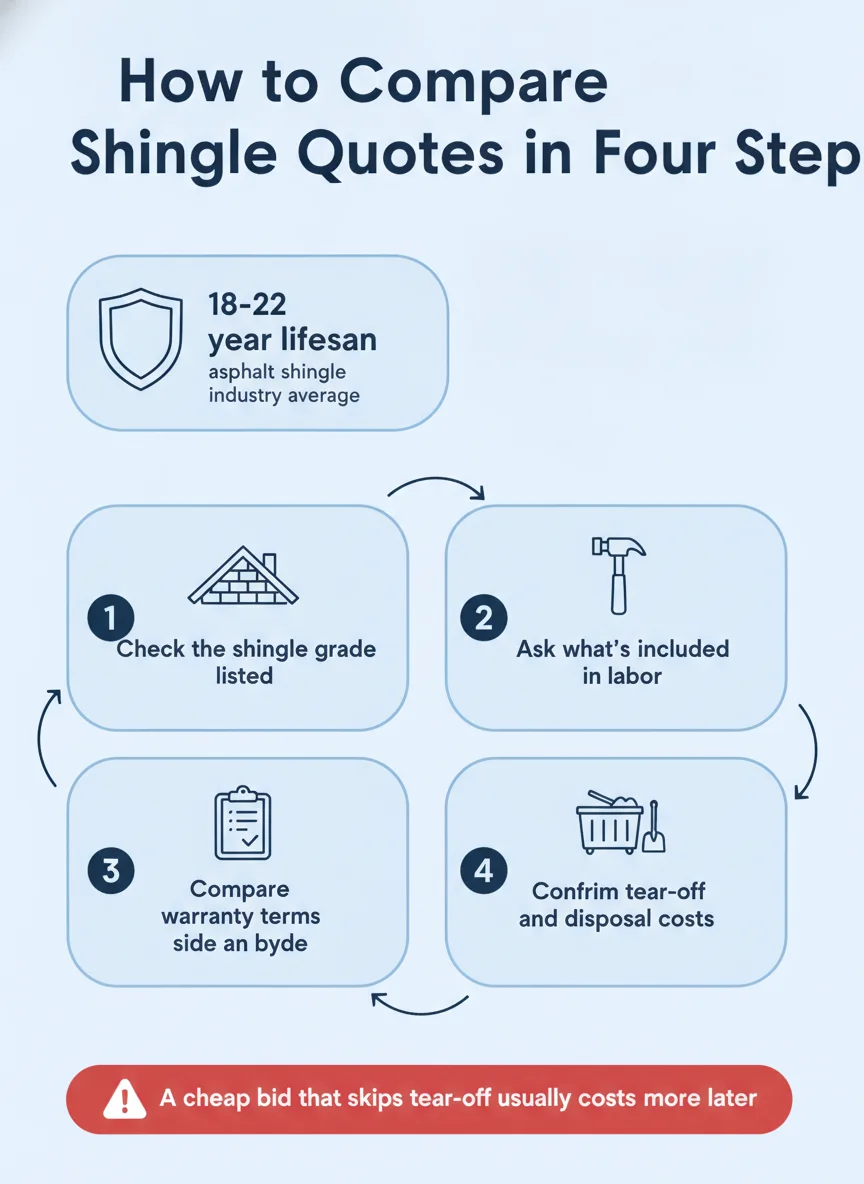
Step-by-step: How to Evaluate a Shingle Quote
Before you sign anything, walk through each bid line by line rather than comparing bottom-line numbers. These steps help you spot what's really being offered.
- Confirm the shingle brand and grade: Ask for the exact product name, not just "architectural shingle," so you can compare the same tier across bids.
- Check the wind and impact rating: A higher wind rating or Class 4 impact rating matters in a hail-prone region and should be stated clearly in writing.
- Ask what underlayment is included: Confirm whether ice-and-water shield and synthetic underlayment are part of the price or an add-on.
- Verify tear-off and disposal: Make sure removing and hauling away the old roof is built into the number, not billed separately after the fact.
- Review the warranty terms: Compare both the manufacturer's material warranty and the contractor's workmanship warranty side by side.
- Get the full scope in writing: A written estimate should list materials, labor, and any permit work, not just a single total figure.
What a Low Bid Usually Means
Thin material or missing scope
The most common reason a bid comes in low is that it specs a thinner shingle or leaves out part of the job, most often tear-off, disposal, or proper underlayment. On paper the total looks great, but the roof going on the house isn't the same product a competing bidder is offering.
Some low bids also shortcut flashing details around chimneys, skylights, and valleys, areas where a few extra minutes of labor prevent most future leaks. It's worth asking directly how these transitions will be handled rather than assuming they're covered.
A legitimately efficient crew
Not every competitive bid is a red flag. A crew that runs efficiently, buys material in volume, and doesn't carry excess overhead can genuinely quote less without cutting a single corner. The way to tell the difference is the written scope, not the number on the page.
If two bids list the same shingle grade, the same underlayment, and the same tear-off and disposal terms, and one is meaningfully lower, that's worth asking about directly rather than assuming the worst or the best.
What You Can Evaluate Yourself vs. What Needs a Pro on the Roof
You can do a lot of this homework from the ground. Reading a written estimate line by line, researching the shingle product named in the quote, and asking pointed questions about warranty terms are all things any homeowner can handle before a crew ever shows up.
What you can't reliably judge from a driveway is the actual condition of the decking underneath, the state of the flashing, or whether the attic ventilation is adequate to support a new shingle warranty. Those require someone on the roof with the right experience, and guessing wrong on any of them turns into a bigger repair bill later.
A straightforward way to cut through the guesswork is a hands-on look from a licensed roofer who will walk you through grade options, measure the actual roof, and put the real scope in writing. That's a better starting point than trying to price a project off a phone call alone, and it's why a roof replacement estimate should always include a physical walk of the roof, not just a square-footage guess.
Getting a Number You Can Actually Trust
Shingle cost isn't one number, it's a combination of grade, roof size, pitch, layout, and what's included in the labor. The only way to get an apples-to-apples comparison is to ask every bidder for the same level of detail: product name, wind rating, underlayment, and whether tear-off is part of the price.
If you're weighing shingle grades against each other in more depth, the comparison of three-tab, architectural, and designer shingles breaks down what separates each tier beyond price. Homeowners in Westminster and across the region can expect Virtuous Roofing and Exteriors to lay out the shingle grade, warranty, and full scope in writing before any work begins.
Frequently asked questions
Why do shingle prices vary so much between quotes?
Shingle prices vary because grade, wind rating, and installation labor are not standardized across contractors. Two bids for the same house can list different shingle tiers, different underlayment, and different crew sizes, and all of that shows up in the total before you've compared anything apples to apples.
Are more expensive shingles always better?
Not always, but higher tiers usually mean thicker material, a stronger wind and impact rating, and a longer warranty. For a Colorado home dealing with hail and wind, the upgrade from a basic three-tab to an architectural or impact-rated shingle often earns its keep over the life of the roof.
Does roof pitch affect shingle cost?
Yes, steep or complex roofs cost more to shingle because crews work slower and need more safety gear on a steep pitch. A simple ranch roof with a gentle slope installs faster than a two-story home with multiple valleys and dormers, and labor is usually the bigger swing factor than the shingles themselves.
Should I get more than one shingle estimate?
Yes, a second estimate is one of the easiest ways to catch a mismatched grade or a missing line item. Ask each contractor to write out the exact shingle product, the warranty terms, and whether tear-off and disposal are included, then compare the bids side by side rather than just the bottom line.
Does the color or style of shingle change the price?
Color rarely changes price, but style and profile can. A dimensional or designer-style shingle with a heavier texture generally costs more per square than a flat three-tab, mostly because it uses more material and takes longer to install correctly.