
Why Knowing Your Roof's Age Actually Matters
Homeowners across the Denver Metro and Northern Colorado run into this question at the worst possible times: mid-claim after a hailstorm, mid-negotiation on a home sale, or mid-phone call with an insurance agent asking a question nobody prepared them for. The roof's age affects how an adjuster values storm damage, how a lender underwrites a mortgage, and how much life a buyer thinks they're getting when they make an offer.
The frustrating part is that this information usually exists somewhere, it's just scattered across paperwork most people never think to keep. A permit record, a closing disclosure, an old invoice stuffed in a drawer. Before you guess or assume, it's worth spending twenty minutes tracking down the real answer, because an estimate that's off by a decade can cost you more than the time it takes to find the truth.
Why the Build Date on Your House Isn't the Same as the Roof's Age
This is the single most common mix-up homeowners make, and it's an easy one. The county assessor's record lists the year a house was built, not the year the roof covering it was last replaced. Those two dates line up only if the original roof has never been touched, which is rare, especially in a state where severe weather regularly shortens a roof's working life.
Roofs Get Replaced Before the House Changes Hands
Most asphalt shingle roofs in this region have a working life somewhere in the range industry data points to, and plenty of homes have cycled through two or three roofs since they were originally framed. If you bought a 1998 home, the roof over your head could easily be from 2015, 2020, or last year, depending on what happened before you owned it.
Sellers aren't always forthcoming about this either. Some genuinely don't know the roof's age themselves if they inherited the house or bought it without digging into the records, which means the number you were told at closing may be a guess passed down from someone else's guess.
Colorado's Hail and Wind History Means Roofs Change More Often
Severe hail and high wind events are a regular part of life along the Front Range and into Northern Colorado, and they tend to shorten the interval between roof replacements compared to calmer climates. A roof that would otherwise last two decades in a milder state might get replaced early here after a significant storm, whether through an insurance claim or an out-of-pocket repair.
That history is actually good news for tracking down an age, because storm-driven replacements usually come with a permit, an insurance claim file, and a contractor invoice, all three of which are durable records that outlive the memory of the people involved.
| Source | Where to Find It | How Reliable It Is |
|---|---|---|
| Building permit | City or county building department records, often searchable online | Very reliable when the job was permitted and finalized |
| Closing documents | Seller's disclosure or inspection report from when you bought the home | Reliable if the seller disclosed accurately |
| Contractor invoice | Previous owner, your own files, or the roofing company if they kept records | Reliable when the paperwork still exists |
| Insurance claim file | Your insurer's file or the prior owner's agent | Reliable for storm-related replacements |
The Four Places Roof Age Shows Up on Paper
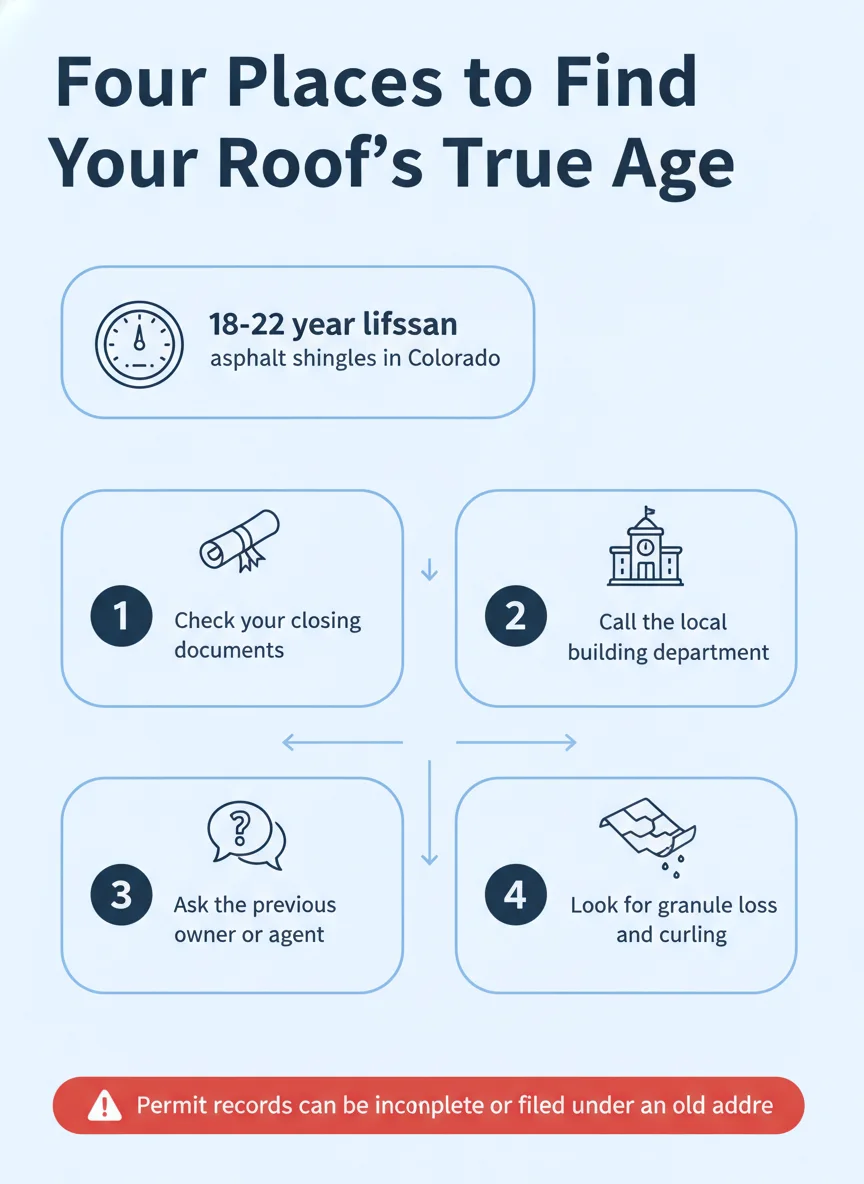
Permit records are usually the strongest starting point. Most cities and counties in the Denver Metro and Northern Colorado require a permit for a full roof replacement, and many now keep those records searchable by address online. A finalized roofing permit will show the date the work was completed and sometimes the type of material installed.
If the permit search comes up empty, your own closing paperwork is next. Seller disclosures often ask directly when the roof was last replaced, and a home inspection report completed before you bought the house may note the roof's apparent age or condition at that point in time. From there, a previous owner's invoice or an old insurance claim file can fill in gaps the official records miss.
Step-by-step: Tracking Down Your Roof's Installation Date
Work through these in order. Most homeowners find their answer in the first two or three steps without needing to go further.
- Pull your closing file: Check your seller's disclosure and home inspection report for any mention of roof age or replacement date.
- Search the permit database: Look up your address on your city or county's online permit portal for a finalized roofing permit.
- Contact the previous owner: A quick email or call to the seller or their agent can turn up an invoice or a direct answer.
- Check your insurance file: If a past claim covered the roof, your insurer or their agent may have a record of the work date.
- Ask the installing contractor: If you know who did the work, many roofing companies keep records of jobs for years after completion.
- Schedule a visual inspection: If the paperwork trail runs dry, a Roof Inspection can estimate the age range from the materials and wear on the roof.
What the Roof Itself Can Tell You
When no paperwork turns up, the roof is still giving off clues. None of these pin down an exact installation date, but taken together they narrow the range considerably and tell a trained eye roughly where the roof sits in its lifespan.
Granule Loss and Curling Edges
Asphalt shingles are coated in granules that protect the asphalt layer underneath from UV exposure. As a roof ages, those granules wear away, often showing up as grit collecting in gutters or bare, shiny patches on the shingle surface. Heavy, widespread granule loss points toward a roof well into its service life rather than a recent installation.
Curling or cupping at the shingle edges is another aging signal, caused by years of heat cycling and moisture exposure. A roof with flat, tight shingle tabs reads as newer, while one with lifted or wavy edges across large sections has likely been in place for a long stretch of its expected lifespan.
Flashing, Vents and Attic Clues
Flashing around chimneys, vents, and skylights tends to show rust, cracking, or sealant that's dried out and separated well before the shingles themselves look obviously worn. Fresh, unpainted metal flashing is usually a sign of recent work, even on a roof with older-looking shingles elsewhere.
Inside the attic, look at the underside of the roof deck for daylight gaps, water staining, or the type of decking material used. Newer installations often use materials and fastening patterns that differ from what was standard decades earlier, which gives an experienced roofer another data point when estimating age.
Should You Pull the Records Yourself or Call a Roofer?
The paperwork search is something any homeowner can do without help. Checking a permit portal, digging through a closing folder, or emailing a previous owner costs nothing but time, and it's worth exhausting those options first since an exact documented date beats any visual estimate.
Where a roofer earns their keep is when the paper trail dead-ends or when you need more than a rough age range, like for an insurance claim, a sale, or a decision about whether to repair or replace. Reading granule wear, flashing condition, and deck materials accurately takes an eye trained on hundreds of roofs, not one homeowner's single data point.
There's also a practical reason to combine both approaches. A documented age tells you what year the roof went on, but it doesn't tell you its current condition, which matters more for deciding what to do next. For that fuller picture, see how material choice affects the number in How Long Each Roof Type Lasts in Colorado: A Lifespan Chart.
Getting a Clear Answer on Your Roof's Age
Between permit records, closing paperwork, past invoices, and the visible condition of the shingles and flashing, almost every homeowner in the Denver metro and across Northern Colorado can land on a reliable age range for their roof, even without an original receipt in hand.
If the records come up short or you just want a second opinion on what the roof itself is telling you, Virtuous Roofing and Exteriors can walk the roof with you and lay out an honest read on where it stands.
Frequently asked questions
Does the year my house was built tell me how old my roof is?
No, the build date on your house and the age of the roof covering it are usually two different numbers. Most homes get at least one full roof replacement during their lifetime, sometimes more in a hail-prone state like Colorado, so the original roof from the build date is often long gone.
Where is a roof replacement usually recorded?
A roof replacement is typically recorded as a permit with the city or county building department where the work took place. If a licensed contractor pulled a permit for the job, that record lists the type of work and the date it was finalized.
What if I can't find any paperwork on my roof?
If no permit, invoice, or disclosure turns up, a visual inspection is the next best option. A roofer can estimate the roof's age range by looking at the materials, wear patterns, and installation style used.
Does the age of my roof affect my homeowners insurance?
Yes, many insurers ask for the roof's age and some adjust coverage or premiums once a roof passes a certain age threshold. Check your policy or ask your agent what their specific age guidelines are, since they vary by carrier.
How can I tell if my roof is nearing the end of its life just by looking at it?
Granule loss, curling or cupping shingle edges, and cracked or missing flashing are all visible signs of an aging roof. None of these pin down an exact year, but together they tell you whether a replacement is likely years away or already overdue.