Why shingle brand comparisons matter in Colorado
Homeowners across the Denver Metro and Northern Colorado often start their research by comparing shingle brand names, assuming one maker builds a fundamentally better product than another. In reality, the major manufacturers compete in the same market with similar raw materials, similar testing standards, and overlapping warranty structures. The real differences show up in the details: how a product is rated for wind and impact, how long the algae resistance holds, and how the warranty is structured if something fails.
That matters because a roof replacement is a decision homeowners live with for decades, and picking a shingle based on a sales pitch instead of the spec sheet can mean paying for coverage that's weaker than it looks on paper. Understanding what the names actually differ on puts you in a better position to ask the right questions before you sign a contract, whether you're in Boulder, Fort Collins, or anywhere in between.
What actually separates one shingle brand from another
The biggest manufacturers in the asphalt shingle market, names like GAF, Owens Corning, CertainTeed, Atlas, and Tamko, all produce three-tab and architectural lines tested to the same industry standards for wind uplift and impact resistance. The differences come down to formulation details, warranty fine print, and regional availability, not a dramatic gap in base quality.
Wind and impact ratings
Wind ratings describe the sustained wind speed a shingle is tested to withstand when the fastening pattern matches the manufacturer's installation instructions exactly. Standard architectural shingles typically carry ratings in the 110 to 130 mph range, though the number is only as good as the install behind it. A shingle rated for 130 mph winds that's under-nailed performs like a much weaker product.
Impact resistance is graded separately, most commonly as a Class 4 rating under the UL 2218 test standard, which measures how a shingle holds up against simulated impact. Not every shingle in a manufacturer's lineup carries this rating, and it's usually reserved for a specific product tier rather than the whole line, so it's worth confirming on the exact shingle being quoted rather than assuming it applies across the board.
Algae resistance and warranty structure
Algae-resistant shingles use copper-infused or similar granules designed to slow the dark streaking that develops on shaded or north-facing roof slopes over years of moisture exposure. Most manufacturers now build algae resistance into their standard and premium lines, with coverage periods that vary by product rather than by brand name alone.
Warranty structure is where the real variation shows up. A lifetime warranty sounds identical across brands until you read how it's prorated after the first decade, whether labor is covered beyond a short initial window, and whether the coverage transfers if the home sells. Two shingles can carry the same headline warranty length and still leave a homeowner with very different protection fifteen years in.
| Feature | Entry-level lines | Premium lines |
|---|---|---|
| Wind rating | Typically lower end of range | Typically higher end of range |
| Impact (Class 4) availability | Rarely offered | Often available as an option |
| Warranty structure | Shorter, more heavily prorated | Longer, often non-prorated for more years |
| Algae resistance coverage | Standard but shorter duration | Standard, often longer duration |
What makes up a shingle, and why it affects performance
Asphalt shingles are built from a fiberglass mat saturated with asphalt and topped with mineral granules that provide color, UV protection, and in some products, algae resistance. The thickness of the mat and the amount of asphalt saturation are two of the biggest factors separating a basic three-tab shingle from a heavier architectural or designer product, more than the brand name printed on the wrapper.
The granules on top do more work than most homeowners realize. They shield the asphalt layer underneath from direct UV exposure, which is a real factor at Colorado's elevation, and they're the first thing to show wear as a roof approaches the end of its service life. Granule loss showing up in gutters or at the base of downspouts is one of the earliest visible signs a shingle roof is aging out, regardless of which manufacturer made it.
Step-by-step: how to compare shingle options before you choose
A side-by-side comparison only works if you're looking at the same information for each option. Here's a practical sequence for evaluating shingle choices during a quote.
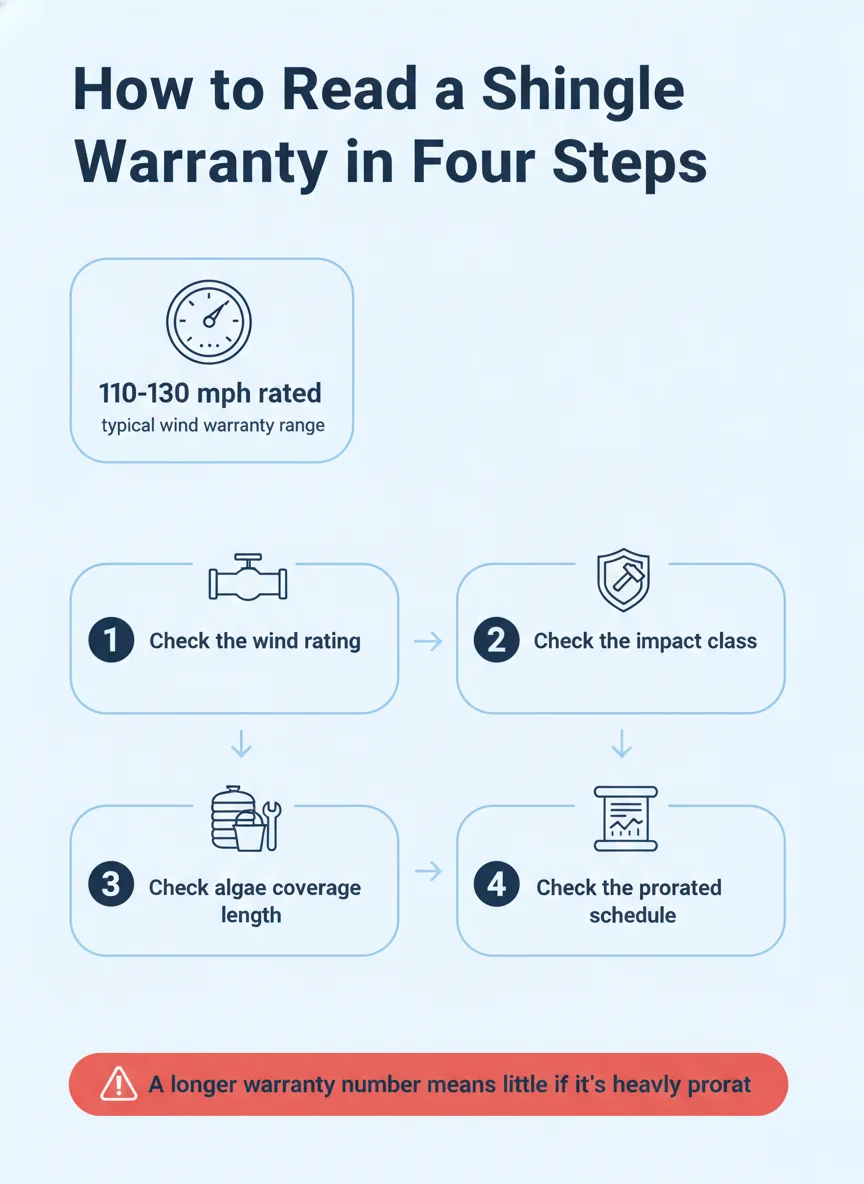
- Request the spec sheet: Ask for the manufacturer's official spec sheet for the exact product being quoted, not a general brand brochure.
- Check the wind rating: Confirm the rated wind speed and whether it depends on an enhanced nailing pattern or special fasteners.
- Check impact class: Ask whether a Class 4 impact-rated version of that product exists and whether it's being quoted.
- Read the warranty terms: Look for the proration schedule, labor coverage period, and transferability, not just the headline number.
- Compare algae coverage: Check how many years the algae resistance is warrantied, especially on shaded or north-facing slopes.
- Confirm local availability: Ask whether the product ships quickly to Colorado or requires a longer special order lead time.
What you'll actually find once you compare the fine print
The marketing gap vs. the spec sheet gap
Most homeowners find that the marketing language between brands sounds nearly identical: lifetime protection, industry-leading durability, superior curb appeal. The spec sheet is where real differences surface, usually in the wind rating footnotes, the impact class availability, and the warranty proration table buried several pages in.
That gap is exactly why it pays to ask a contractor to walk through the actual spec sheet rather than relying on a glossy brochure. A roofer who installs multiple manufacturers' products regularly can usually explain the real tradeoffs faster than a sales rep representing a single brand.
Where price and quality tend to diverge
Higher price doesn't automatically mean a better-performing shingle for your specific roof. A mid-tier architectural shingle with a solid wind rating and decent algae resistance can outperform a premium designer shingle on a roof where the dimensional look isn't the priority. The right call depends on roof pitch, sun exposure, and how long you plan to stay in the home.
Where price differences are most justified is in impact resistance and extended non-prorated warranty coverage, both of which add real cost to manufacture and insure. If hail exposure is a bigger concern than aesthetics, that's where the extra cost tends to pay off.
What a homeowner can evaluate alone vs. what needs a pro
Reading spec sheets, comparing warranty language, and researching manufacturer reputations are all things a homeowner can do from a laptop before ever calling a contractor. It's reasonable to walk into a quote conversation already knowing the wind rating and warranty structure you want.
What's harder to evaluate alone is how a specific product performs on your roof's pitch, sun exposure, and ventilation setup, since those factors change how any shingle ages over time. A licensed roofer can look at your roof's conditions and tell you whether a given product's rated performance is realistic for your situation or whether it's overbuilt or underbuilt for what you actually need.
Installation quality also matters more than brand selection in most failure cases. A premium shingle installed with the wrong nailing pattern will underperform a mid-tier shingle installed to spec, which is why the contractor doing the work deserves as much scrutiny as the shingle brand itself.
Making a confident shingle decision
Comparing shingle brands comes down to reading past the marketing language and into the actual wind rating, impact class, algae coverage, and warranty proration schedule for the specific product being quoted, not the brand name as a whole. Those details tell you far more about how a roof will perform over the next few decades than any brochure claim.
For homeowners weighing options before a project, it also helps to understand how shingle grades differ, which is covered in Three-Tab, Architectural and Designer Shingles: What the Grades Actually Mean. Homeowners in Boulder and across the region can bring their spec sheet questions to Virtuous Roofing and Exteriors during a quote conversation.
Frequently asked questions
Does the shingle brand actually matter for how long a roof lasts?
The brand matters less than the installation and the local climate the shingle sits in. Every major manufacturer makes a product rated for Colorado's UV and wind exposure, so proper installation and ventilation usually decide how long a roof actually performs more than the logo on the wrapper.
What's the difference between a three-tab and an architectural shingle?
Three-tab shingles are flat, single-layer, and lighter-duty, while architectural shingles are laminated with two or more layers for a dimensional look and a stronger wind rating. Most manufacturers have phased three-tab out of their premium lines in favor of architectural styles.
What does a shingle's wind rating actually mean?
A wind rating is the sustained wind speed a shingle is tested and warrantied to withstand when installed to the manufacturer's specifications. Ratings commonly fall in the 110 to 130 mph range for standard architectural shingles, though the number only holds if the nailing pattern and fastener count match the spec sheet.
Are algae-resistant shingles worth it in Colorado?
Algae-resistant shingles are worth considering on roofs that stay shaded or hold moisture longer, since the algae-fighting granules slow the dark streaking that shows up on north-facing slopes over time. In Colorado's drier climate the effect is less dramatic than in humid regions, but it's rarely a reason to avoid a product if it's otherwise a good fit.
Do all shingle brands offer the same warranty length?
No, warranty length and structure vary by manufacturer and by product tier within the same manufacturer's lineup. Entry-level lines often carry shorter, more heavily prorated coverage while premium lines offer longer non-prorated periods, so the number on the brochure only tells part of the story.