Why This Decision Matters More in Colorado
Front Range and Northern Colorado homeowners face a roofing climate that's tougher than most of the country. Intense UV at altitude, wide temperature swings between day and night, heavy snow loads in the foothills, and frequent hail all put real stress on a roof system. Choosing between asphalt shingles and metal roofing isn't just a style decision here, it's a decision about how your roof will hold up to the specific weather pattern of the Denver Metro area and Northern Colorado.
Both materials show up on homes across Denver, Aurora, Boulder, and Fort Collins, and both can be installed correctly or poorly. The material itself matters less than how it's installed and maintained, but the two systems respond so differently to hail, heat, and wind that it's worth understanding the tradeoffs before you commit to one for the next few decades.
What Makes Each Material Behave Differently
Asphalt shingles are layered mats of fiberglass or organic material coated in asphalt and mineral granules. They flex slightly under impact and heat, which is part of why hail can bruise or knock granules loose without always puncturing through. Metal roofing is a continuous or interlocking panel system, usually steel or aluminum, that sheds impact differently and doesn't rely on granules for its weather protection.
How Asphalt Shingles Respond to Colorado Weather
Shingles handle moderate hail reasonably well when they're in good condition, but repeated hail seasons wear down the granule layer that protects the asphalt mat underneath. Once that granule coverage thins out, UV exposure accelerates and the shingle's remaining service life drops. This cycle is a big reason insurance claims after hail events are common across the region.
How Metal Roofing Responds to Colorado Weather
Metal panels resist puncture and granule loss because there's no granule layer to lose in the first place. Large hail can leave cosmetic dents, especially on lighter gauge panels, but the roof's waterproofing usually stays intact even when the surface shows marks. Metal also sheds heavy snow more readily than shingles, which matters for homes at higher elevations.
| Factor | Asphalt Shingles | Metal Roofing |
|---|---|---|
| Typical lifespan | 18-22 years industry-wide in Colorado's UV and hail conditions | 40-70 years depending on panel type and finish |
| Hail behavior | Granule loss and bruising, can puncture in severe events | Cosmetic denting possible, waterproofing usually holds |
| Upfront cost | Generally lower material and labor cost | Generally higher material and labor cost |
| Noise and heat | Standard attic noise levels, moderate heat absorption | Quiet with solid decking, often reflects more heat |
The Roof System Behind Either Material
Neither shingles nor metal panels work alone. Underlayment, flashing at valleys and penetrations, ice and water shield in vulnerable areas, and proper attic ventilation all do as much work as the surface material itself. A well-ventilated attic reduces heat buildup under either roof type and helps prevent the ice damming that's common after Colorado's freeze-thaw cycles, a topic covered in more depth in our attic ventilation guide.
Flashing and underlayment choices also shift depending on material. Metal systems often use different fastening patterns and sealant details at seams, while shingle roofs rely more heavily on properly lapped underlayment and nail placement. A roof replacement done right accounts for all of this, not just the surface layer the homeowner sees from the street.
Step-by-step: Deciding Which Material Fits Your Home
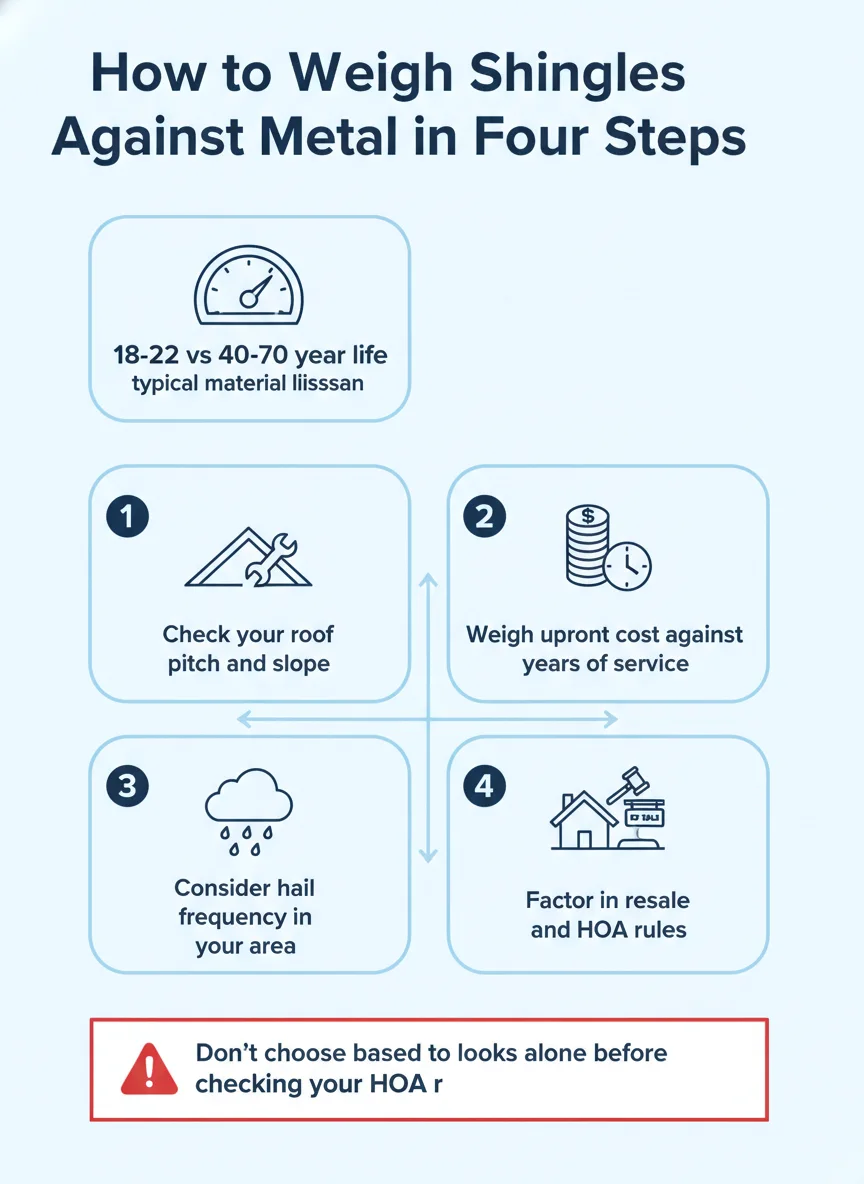
Working through these steps in order helps narrow the decision down to what actually applies to your house, rather than going purely on preference or price.
- Check your roof pitch: Steeper pitches shed snow and water faster under either material, but very low-slope sections may limit metal panel options or shingle warranty terms.
- Review your HOA rules: Many Colorado HOAs restrict colors, panel profiles, or shingle types, so confirm what's allowed before you fall in love with a look.
- Think about how long you'll stay: A 10-year ownership horizon changes the math compared to a forever home, since metal's long lifespan pays off more over decades.
- Factor in past hail history: Homes in hail-heavy pockets of the region may see more value from metal's resistance to granule loss over repeated storms.
- Compare total cost over time: Upfront price matters, but so does how many replacement cycles each material needs across 30 or 40 years.
- Get an informed comparison: Ask for a side-by-side look at both options for your specific roof during a roof inspection or estimate visit.
What You'll Notice After Living With Each Material
Homeowners who've had both often describe different day-to-day experiences. Shingle roofs are familiar, blend into most neighborhoods without standing out, and are generally easier to match in a partial repair. Metal roofs draw more attention aesthetically and tend to generate fewer maintenance calls over the years once installed correctly.
Signs a Shingle Roof Is Reaching the End of Its Life
Granule loss showing up in gutters, curling or cupping shingle edges, and bald patches where the mat is visible all signal a shingle roof nearing the end of its service life. After a hail event, bruising that feels soft to the touch under a gloved hand is a common claim indicator adjusters look for.
Signs a Metal Roof Needs Attention
Metal roofs show wear differently, usually through loosening fasteners, sealant breakdown at seams, or scratches in the finish that expose bare metal to moisture. These issues tend to be isolated repairs rather than whole-roof failures, which is part of why metal's maintenance needs are often lighter over time.
What You Can Evaluate Yourself vs. What Needs a Professional
A homeowner can reasonably check for obvious granule buildup in gutters, visible shingle curling from the ground with binoculars, or dented metal panels visible from a ladder at a safe height. These are useful early signs that something needs a closer look.
Climbing onto the roof itself, walking the surface to check for soft spots, and assessing flashing and seam integrity is a job for a licensed professional. Both materials hide their real condition under the surface, and an untrained walk across a roof risks causing damage or injury.
If you're also weighing storm damage and insurance considerations alongside the material decision, it helps to understand how a claim typically moves from inspection to approval, which our insurance claim timeline guide walks through in detail.
Making the Right Call for Your House
There's no single right answer between asphalt shingles and metal roofing, there's only the right answer for your specific home, budget, and how long you plan to live under that roof. Pitch, HOA rules, hail history, and how many years you want out of the investment all factor into the decision differently for every homeowner in Westminster, Boulder, or anywhere across Northern Colorado.
Walking a roof with someone who installs both materials regularly is the fastest way to get a straight answer for your house instead of a generic one. Virtuous Roofing and Exteriors can look at your specific roof and talk through both options honestly before you decide.
Frequently asked questions
Is metal roofing worth it in Colorado?
For many Colorado homes, yes, because metal roofing generally outlasts asphalt shingles by decades and handles hail and wind differently. Whether it's worth it for your specific house depends on your budget, how long you plan to stay in the home, and your HOA's rules on material and color.
Do metal roofs dent from hail?
Metal roofs can show cosmetic denting in a significant hail event, but most are built to resist the kind of punctures and granule loss that asphalt shingles suffer. Whether denting affects your insurance claim or your warranty depends on your specific policy and the metal panel's impact rating.
Are metal roofs noisier in rain and hail?
A properly installed metal roof with solid decking and underlayment is not noticeably louder inside the home than a shingle roof during rain or hail. Noise complaints usually trace back to older installs without a solid substrate underneath the panels.
Do asphalt shingles last as long in Colorado as other states?
Asphalt shingles in Colorado typically land in the same general range as the rest of the country, often falling toward the shorter end because of intense UV exposure at altitude and repeated hail cycles. A shingle roof that avoids major hail events can still reach the higher end of that range.
Does a metal roof increase home resale value?
Metal roofing is often viewed favorably by buyers because of its longevity and lower long-term maintenance, which can support a stronger asking price. The actual resale impact varies by neighborhood, buyer preference, and how the roof was installed.