
Why Storm Prep Matters on the Front Range
Colorado's Front Range sees a wide swing of weather in a single season, from spring hail cells rolling off the foothills to summer wind gusts that come out of nowhere on an otherwise calm afternoon. Westminster sits right in that path, and most homeowners here have a story about a storm that showed up faster than the forecast promised. The good news is that the roof, gutters, and anything loose in the yard can be checked and secured in a few minutes if you know what to look at first.
This isn't about turning your driveway into a construction zone every time a cloud rolls in. It's a short, repeatable routine: a few photos, a gutter glance, and a walk around the yard. Running it before a forecasted storm gives you two things at once, a safer property during the event and a clear before-and-after record if you end up needing storm damage and insurance help afterward.
What Actually Happens to a Roof During a Storm
Wind and hail don't damage a roof the same way. Wind gets under an edge or a loose piece and lifts it, working it back and forth until a seal breaks or a piece tears free. Hail hits straight down and bruises or cracks the surface without always removing anything, which is part of why storm damage is so easy to miss from the ground.
What wind does
Wind damage usually starts at an edge, a ridge, or anywhere a roofing material has already been lifted slightly by age or a prior storm. Once wind finds that gap, it works like a crowbar, and a 50 or 60 mph gust can do in seconds what months of lesser weather couldn't. That's why loose or aging materials fail first in a wind event, even when the rest of the roof holds up fine.
Loose items in the yard add a second layer of risk. A patio umbrella, a trash can, or an unsecured ladder becomes a projectile in high wind, and it can do as much damage to a roof or a window as the storm itself. Securing those items takes under a minute per item and removes one more variable you don't control once the wind picks up.
What hail does
Hail bruises roofing material on impact, which can crack a surface, knock granules loose, or dent metal without leaving an obvious hole. That damage is often invisible from the driveway, which is exactly why a lot of homeowners don't realize they have a problem until a leak shows up months later or a roof inspection catches it first.
The size of the hail and the angle it falls at both matter. Small hail driven by strong wind can do more damage than larger hail falling straight down, because the sideways force concentrates the impact on edges and ridgelines instead of spreading it across the field of the roof. That's one more reason a post-storm check should cover the whole roof, not just the parts you can see from the yard.
| Prep Step | Do It Before a Storm | Why It Matters |
|---|---|---|
| Photograph roof and gutters | Yes, anytime skies are clear | Gives you a before record for comparison and for any insurance claim |
| Clear gutters and downspouts | Yes, if no wind or lightning yet | Keeps water moving off the roof instead of backing up under the edge |
| Secure loose yard items | Yes, as soon as a watch is issued | Stops patio furniture and tools from becoming wind-driven debris |
| Climb up to inspect closely | No, never during or right before a storm | Wet, windy, or icy conditions make roof access unsafe for homeowners |
The Parts of Your Home That Take the Hit First
Four areas on a typical Westminster home absorb most of the stress in a storm: the roof field itself, the gutters and downspouts, anything overhanging the roofline, and the attic space underneath it all. Each one plays a different role, and each one is worth a quick look before weather rolls in.
Gutters and downspouts matter more than most people think. A gutter packed with leaves and debris can't move water fast enough during a heavy downpour, so it backs up, overflows at the edge, and can push moisture up under the roofing material instead of away from the house. Clearing them is one of the simplest things you can do and takes only a few minutes with a stepladder on a calm day.
Step-by-Step: The 5-Minute Pre-Storm Routine
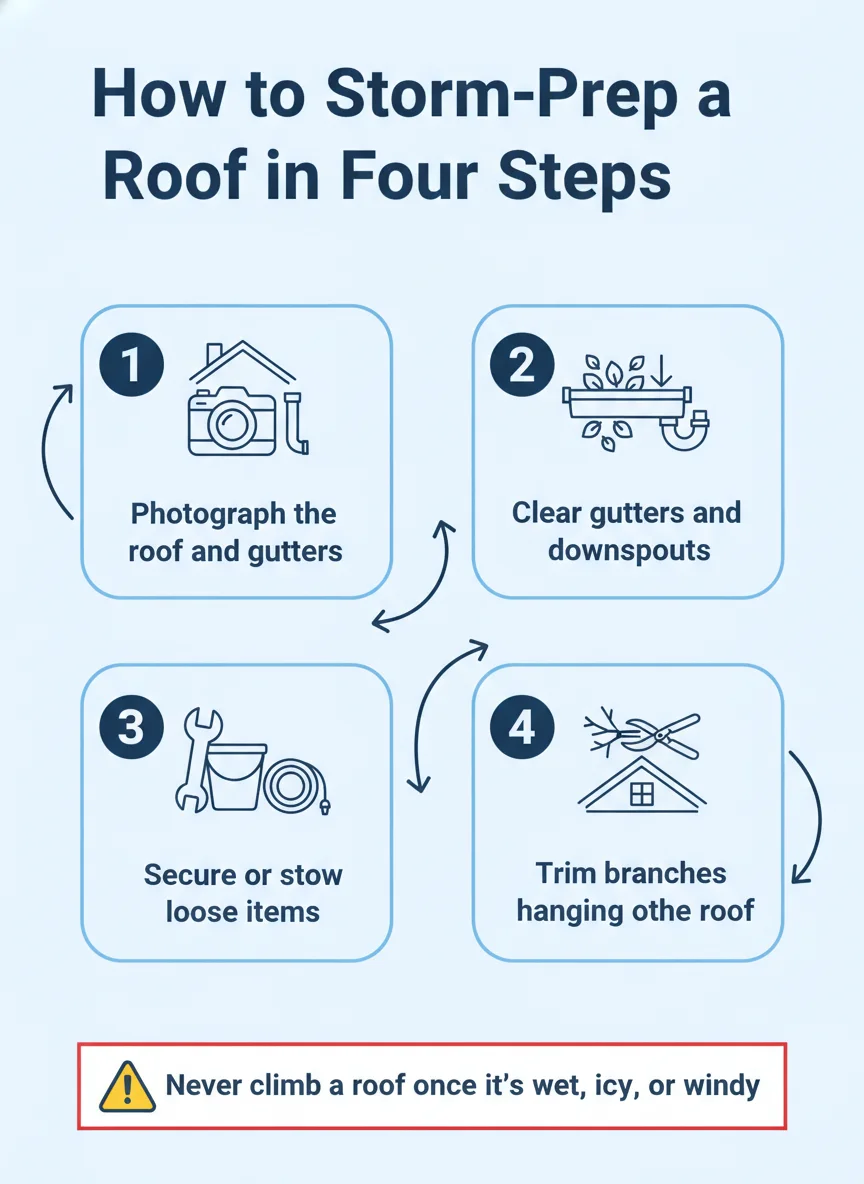
Run this whenever a storm watch goes up for your area, ideally with enough daylight left to finish before conditions turn. None of these steps require climbing onto the roof itself.
- Check the forecast timing: Note how much daylight and calm weather you actually have left before deciding how much of the list you can finish safely.
- Photograph every roof slope: Stand at each corner of the house and get a clear shot of the roofline, gutters, and any visible damage from prior weather.
- Clear visible gutter debris: Pull leaves and buildup from ground level or a stable stepladder so water has a clear path off the roof during heavy rain.
- Walk the yard for loose items: Bring in or tie down furniture, planters, trash cans, toys, and tools that wind could pick up and throw against the house.
- Trim branches near the roofline: Cut back anything already hanging close to or over the roof, since wind turns overhanging limbs into a direct impact risk.
- Locate the attic access and water shutoff: Know where both are before you need them in the dark, so a leak or burst line doesn't turn into a scramble.
- Move vehicles under cover: If a garage or carport is available, use it. Hail and falling branches damage cars as often as roofs.
What to Look for the Morning After
Once the storm passes, the instinct is to look up at the roof from the driveway and call it good if nothing looks obviously wrong. That's the least reliable way to check, because most storm damage doesn't show up as a hole you can spot from fifty feet away.
Signs you can check from the ground
Walk the full perimeter of the house and look for granules collecting in the gutters or at the base of downspouts, shingles or pieces that look out of alignment, dented gutters or downspouts, and any debris that fell directly onto the roof. Compare what you see against the before photos you took, since side-by-side comparison catches changes a quick glance misses.
Signs you'll only find inside
Head up to the attic with a flashlight and look for new light coming through anywhere it shouldn't, damp insulation, or water staining on the underside of the roof deck. These signs often show up before a ceiling stain ever appears downstairs, which means catching them early can be the difference between a straightforward repair and a bigger problem. If anything looks off, a same-day look from a roof repair and emergency tarping crew is worth the call before the next round of weather moves through.
What You Can Check Yourself vs. What Needs a Pro
Everything on the 5-minute list, photos, gutter clearing from a stepladder, securing yard items, and trimming low branches, is reasonable for a homeowner to handle. These are ground-level or short-ladder tasks that don't require climbing onto the roof itself or working at height on a sloped surface.
Anything that requires walking the roof field, checking flashing around vents and chimneys up close, or confirming whether a dent or bruise is cosmetic or structural is a job for someone trained to do it safely and who knows what storm damage actually looks like versus normal wear. Guessing wrong in either direction costs you, either an unnecessary repair or a missed problem that gets worse with the next storm.
If you're ever unsure which category something falls into, the safer move is to document it with a photo and get a professional opinion rather than deciding on your own from the ground. A short visit to confirm nothing is wrong costs far less than discovering a leak months later.
Building the Habit Before the Next Front Moves Through
Storm prep works best as a habit, not a one-time scramble. Running the same short routine every time a watch goes up for Westminster means you're never caught starting from zero, and your before photos stay current enough to actually be useful if you need them. Pair it with a seasonal walk-around, like the one covered in this storm season checklist, and you've got most of the year handled.
For the mornings when the storm already came through and something doesn't look right, Virtuous Roofing and Exteriors is a call away to take a closer look and tell you plainly what you're dealing with.
Frequently asked questions
How much time do I actually need to prep my roof before a storm?
Five to ten minutes covers the basics: a quick photo set, a gutter check, and clearing loose items from the yard. If a watch has already turned into a warning, skip the ladder and just get people and pets inside.
Should I clear my gutters myself before a storm?
Clearing visible debris from ground level or a stable stepladder is fine, but skip it if the forecast already shows wind or lightning. A clogged gutter during a storm is a lot less risky than a fall from one.
What should I photograph before a storm hits?
Take wide shots of each roof slope, the gutters, and any existing dents, dings, or missing pieces you can see from the ground. These before photos make it much easier to show an adjuster exactly what changed if you end up filing a claim.
What should I check on my roof the morning after a storm?
Walk the perimeter of your house and look up at the roofline, gutters, and downspouts for anything that looks different from your before photos: granules in the yard, bent metal, or shingles out of place. Check the attic for new light leaks or damp spots before you assume everything is fine.
Is it safe to go on my roof after a storm to check for damage?
No, not on your own. Wet, icy, or storm-loosened roofing is one of the most common ways homeowners get hurt after weather events, so leave the climbing to a professional with the right equipment.