Why Attic Ventilation Matters for Colorado Homes
Colorado roofs deal with wide temperature swings, intense summer sun at altitude, and cold, dry winters that can flip to heavy snow almost overnight. The attic underneath that roof has to handle all of it too, and most homeowners never think about it until something goes wrong. Attic ventilation is the quiet system that keeps that space from overheating in July or trapping moisture in January, and it works whether anyone upstairs notices it or not.
The problem is that ventilation issues don't show up as a sudden leak. They show up slowly, as curling shingles, rotting decking, or a musty smell that creeps in over a few seasons. By the time a homeowner notices, the damage is often already done to the roof structure itself, not just the shingles on top of it. Understanding how the system is supposed to work is the first step to catching a problem early.
How Intake and Exhaust Ventilation Work Together
A healthy attic ventilation system is really just two parts working as a pair: cooler air comes in low, and hot or moist air leaves high. Neither half does much good without the other, which is why a roof with a ridge vent but blocked soffits can still have serious ventilation problems.
Soffit and Ridge Vents: The Basic System
Soffit vents sit under the eaves, where the roofline overhangs the exterior wall, and they're the intake side of the system. Ridge vents run along the peak of the roof and serve as the exhaust, letting hot air escape as it naturally rises. Some homes use box vents or power vents instead of a ridge vent, but the intake-and-exhaust principle stays the same.
When this pair is working, air moves continuously through the attic space, carrying heat and moisture out before they can do any damage. It's a passive system in most homes, no fans or electricity required, just physics and a clear path for air to travel.
What Happens When Airflow Gets Blocked
The most common failure point is insulation. When blown-in or batt insulation gets pushed too far into the eaves, it smothers the soffit vents from the inside, cutting off intake even though the vents look fine from outside. Paint, debris, or nesting materials can block them from the outside too.
Once intake is blocked, the exhaust vents have nothing to pull from, and the whole system stalls. Hot air sits in the attic through summer, and in winter, moisture from the living space below has nowhere to go, which is when frost and rot problems start.
| Season | What You'll Notice | What's Happening in the Attic |
|---|---|---|
| Summer | Upstairs rooms feel hotter than the rest of the house | Trapped heat is building up under the roof deck |
| Winter | Frost or ice on the underside of the decking or nails | Warm, moist household air is condensing on cold wood |
| Year-round | Shingles curling or granules wearing unevenly | Repeated heat cycling is aging the shingles from below |
| Spring/Fall | Musty smell near the attic hatch | Moisture has been sitting long enough to support mold growth |
The Parts of a Ventilation System
Intake vents, usually at the soffits, bring in outside air. Exhaust vents, usually at or near the ridge, let that air leave once it has picked up heat and moisture. Baffles are the small plastic or cardboard channels installed against the roof deck before insulation goes in, and their only job is to keep a clear air gap over the soffit vents so insulation can't choke them off.
Insulation itself is part of the picture too, even though it isn't a vent. Good insulation on the attic floor keeps conditioned air inside the living space where it belongs, which reduces how much warm, moist air ever makes it into the attic in the first place. Ventilation and insulation work as a team, not as substitutes for each other.
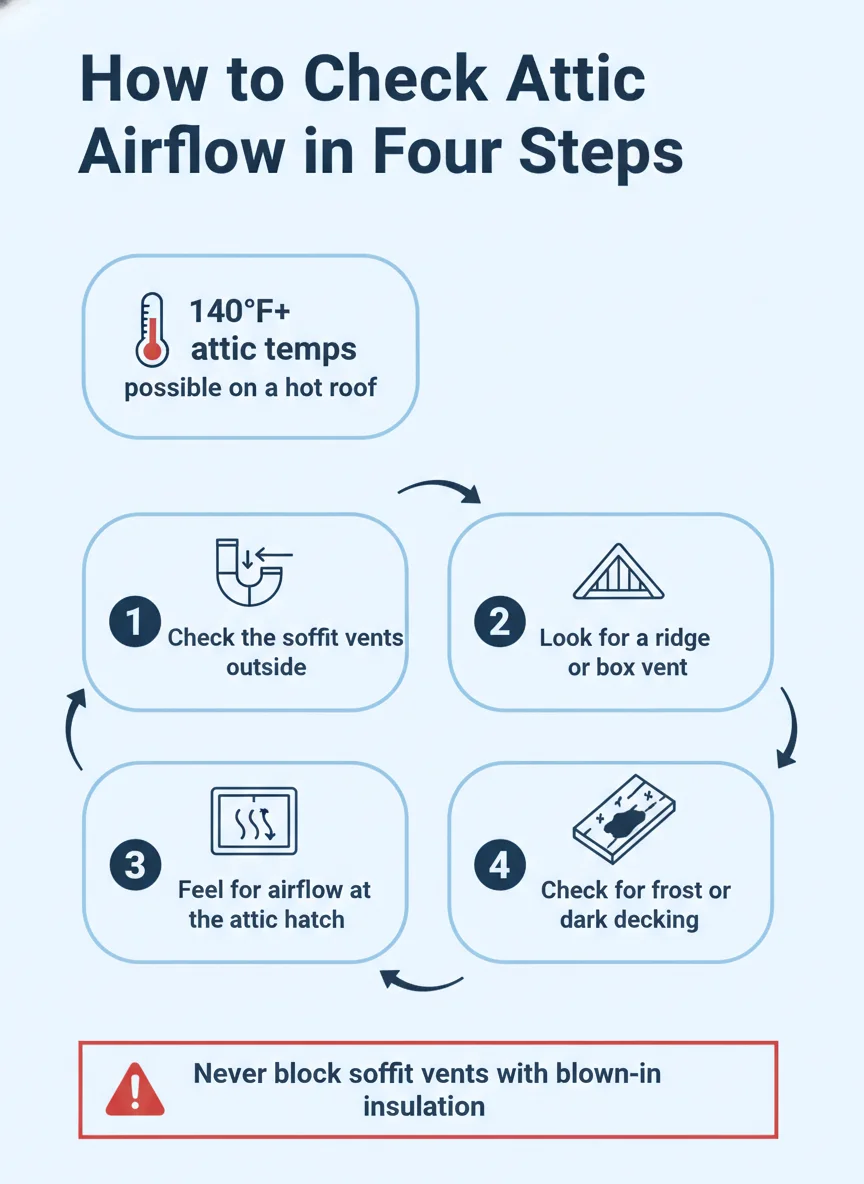
Step-by-step: How to Check Your Attic's Ventilation
A basic check doesn't require climbing on the roof. Most of this can be done from inside the attic and from the ground looking up at the eaves, and it only takes a few minutes on a clear day.
- Look at the soffits: Walk the perimeter of the house and check that soffit vents are open, unpainted over, and free of nests or debris.
- Find the exhaust vent: Look along the roofline for a ridge vent, or check for box vents or a power vent fan mounted on the roof surface.
- Check the attic hatch: Open the attic access and feel for a slight temperature difference or airflow compared to the room below.
- Inspect the insulation line: Confirm insulation stops short of the soffit vents rather than being packed all the way into the eaves.
- Look for frost or staining: In cold months, check the underside of the roof deck near the eaves for frost, water stains, or darkened wood.
- Note any smells: A musty or damp odor in the attic is often the first sign of moisture buildup before visible damage appears.
- Schedule a closer look: If anything looks off, a roof inspection can confirm whether ventilation is the cause.
What a Poorly Ventilated Attic Looks Like
Signs in Summer
In warm months, a blocked attic traps heat that can climb well above outdoor temperatures. That heat radiates down into living spaces, forcing air conditioning to work harder, and it also bakes the underside of the shingles day after day. Over years, that constant heat cycling ages shingles faster than normal sun exposure alone would.
Homeowners often notice this first as an uneven comfort problem, the upstairs is always warmer than the rest of the house no matter how the thermostat is set. That's usually a ventilation clue before it's ever diagnosed as one.
Signs in Winter (Frost and Ice)
Cold-weather problems look different but come from the same root cause. Warm, moist air from the house rises into the attic and, without a clear path out, condenses on the cold underside of the roof deck. That condensation shows up as frost on nail tips or sheathing on cold mornings, and it melts and refreezes as temperatures swing.
Over a season or more, that repeated condensation cycle can rot the wood decking itself, which is a structural problem, not just a cosmetic one. It's also a common contributor to ice buildup at the eaves, which puts extra strain on gutters and the roof edge during Colorado's freeze-thaw cycles.
DIY vs Calling a Pro
Checking vents, clearing visible debris from soffits, and confirming insulation isn't packed against the roof deck are all tasks a comfortable homeowner can handle with a flashlight and a Saturday afternoon. These checks don't require cutting into anything and carry little risk if done carefully.
Adding a ridge vent, cutting in additional exhaust vents, or replacing baffles under existing insulation involves working on or inside the roofing system itself. That work affects how the roof sheds water and how warranties on the roofing materials apply, so it's worth having a licensed roofer handle it rather than risking a cut in the wrong spot.
If an attic check turns up frost, rot, or shingles that look prematurely worn from underneath, that's a sign the issue has been going on for a while and is worth a professional look rather than a patch job. Catching it early is almost always less involved than waiting until the decking needs to be replaced along with the shingles.
Protecting Your Roof from the Inside Out
Most homeowners spend their attention on what they can see: the shingles, the flashing, the gutters. Ventilation works quietly in the background, and it's just as responsible for how long a roof lasts as the materials on top of it. A few minutes checking the attic a couple times a year, alongside the seasonal checks covered in A Colorado Roof Calendar, goes a long way toward catching a ventilation problem before it becomes a decking problem.
Whether you're in Fort Collins or anywhere else across the region, the climate swings are similar enough that attic airflow matters everywhere a roof has to handle both summer heat and winter cold. If something in this guide sounded familiar, from frost on the nails to a stuffy upstairs, Virtuous Roofing and Exteriors can take a closer look at what's going on underneath.
Frequently asked questions
How do I know if my attic has bad ventilation?
The most common signs are frost or dark staining on the underside of the roof decking in winter, and noticeably high cooling bills or a hot upstairs in summer. A musty smell or visible mold on rafters is also a strong signal that moisture is building up with nowhere to go.
Can poor attic ventilation shorten the life of a roof?
Yes, trapped heat and moisture can shorten a roof's lifespan by cooking shingles from underneath and rotting the decking they're nailed to. A well-ventilated attic keeps both the shingles and the wood structure closer to outdoor temperatures, which is what they're built to handle.
Do I need both intake and exhaust vents?
Yes, ventilation only works as a system when air can enter low (usually at the soffits) and exit high (usually at the ridge). Exhaust vents alone can actually pull conditioned air from inside the house instead of fresh air from outside if there's no intake to balance them.
Can insulation cause attic ventilation problems?
It can, if insulation is packed against the roof deck or pushed into the soffit area, it blocks the intake vents and chokes off the whole system. Baffles (small channels installed before insulation goes in) are meant to keep that pathway open.
Is attic ventilation something a homeowner can fix themselves?
Some of it, like clearing insulation away from soffit vents or adding baffles, is within reach for a comfortable DIYer. Adding or modifying exhaust vents on the roof itself involves cutting into the roofing system and is better left to a licensed roofer.