Why choosing the right contractor matters in Colorado
Colorado's frequent hail and wind events create a busy roofing market across the Denver metro and Northern Colorado, and that draws in a lot of contractors, some local and established, others following storm damage from state to state. Both types can look similar on your doorstep.
The difference shows up later, when you need someone to honor a workmanship warranty or come back for a follow-up repair. A roof replacement is a significant investment in your home, and the contractor you choose affects how well that investment holds up for the next couple of decades.
What separates a real contractor from a storm chaser
The signs aren't always obvious in the first conversation, but they show up if you know what to look for. Two areas matter most: how the company operates day to day, and how they handle the sales process itself.
Local presence and licensing
A contractor with an established local address, a business phone that's answered by staff rather than voicemail, and a license they'll show you without hesitation is a good baseline. Ask directly to see proof of license and insurance before any work begins, and confirm it rather than taking it on faith.
Insurance matters just as much as licensing. If a worker is injured on your property and the contractor isn't properly insured, you could end up liable. This is a simple question to ask and any legitimate company will answer it plainly.
How they handle the sales conversation
Storm chasers often go door to door right after a hail event, offer a free inspection, and push hard for a signature the same day. Some will even claim the roof is already approved for insurance before an adjuster has seen it, which isn't how the claims process actually works.
A real contractor gives you a written estimate, explains what they found during inspection, and gives you time to think it over or compare quotes. If someone is rushing you toward a signature, that pressure itself is the red flag, regardless of how good the pitch sounds.
| What to check | Good sign | Red flag |
|---|---|---|
| License and insurance | Provided clearly and promptly on request | Vague answers or refusal to show proof |
| Sales approach | Written estimate, time to decide | Same-day pressure to sign |
| Local presence | Established address and answered phone | Only a cell number and out-of-state plates |
| Warranty terms | Clear written terms for workmanship and materials | Verbal promises with nothing in writing |
What a real inspection and diagnosis looks like
A proper roof inspection covers more than a quick glance from the ground. It includes checking the shingles or roofing material up close, examining flashing around chimneys and vents, looking at the attic for moisture or ventilation issues, and documenting any damage with photos.
If storm damage is suspected, a contractor should be able to explain what they found in terms an adjuster would recognize, since that documentation is what actually supports an insurance claim. Vague statements like "it's damaged, trust me" without specifics are worth questioning.
Step-by-step: vetting a roofing contractor before you sign
Working through a short checklist before you commit to any contractor protects you from most of the common problems homeowners run into.
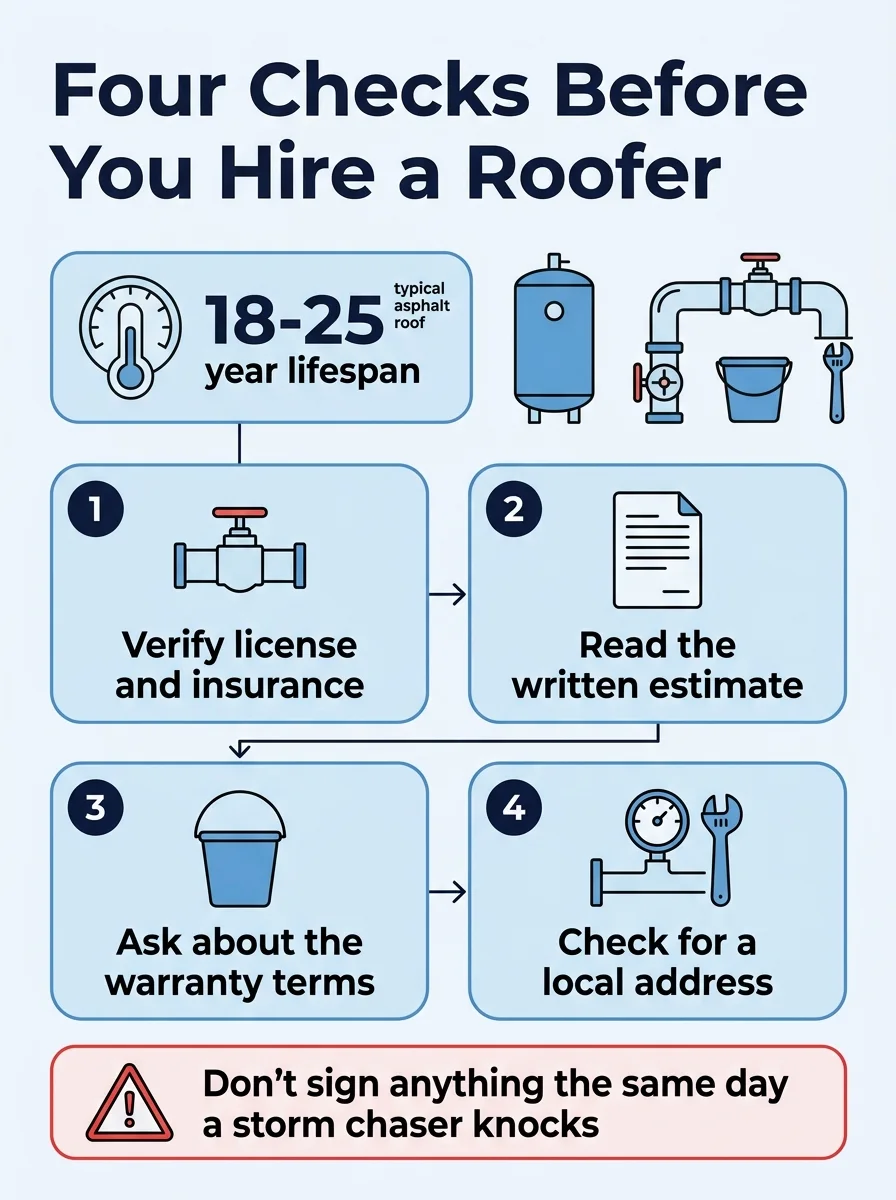
- Ask for license and insurance: Request proof directly and verify it rather than taking a verbal claim at face value.
- Get it in writing: Insist on a written estimate covering scope of work, materials, and timeline before agreeing to anything.
- Ask about warranty terms: Get clear on what the workmanship warranty covers separately from the manufacturer's material warranty.
- Check local reputation: Look for an established local presence and reviews you can actually verify.
- Compare at least two quotes: A second estimate helps you spot anything unusually vague or aggressively priced.
- Take your time: Walk away from any contractor pressuring you to sign the same day, especially after a storm.
What happens after a bad hire versus a good one
The problems a bad hire creates
The most common issues homeowners run into with an out-of-town or unlicensed crew are workmanship warranties that turn out to be worthless once the company has moved on, incorrect installation that voids a manufacturer's material warranty, and no one to call when a problem shows up months later.
In the worst cases, improperly documented storm damage claims get denied by insurers, leaving the homeowner to cover a full replacement out of pocket after already paying a deposit to a contractor who's no longer answering the phone.
What a good hire delivers
A contractor with a real local track record stands behind their work because they plan to still be around when you call. That means a workmanship warranty that means something, proper documentation if you ever need it for insurance, and a straightforward answer when you ask a question.
It also means fewer surprises during the job itself, since a contractor with established processes for permitting, material ordering, and crew scheduling runs into fewer delays than one improvising as they go.
What you can research yourself versus what to ask a contractor directly
Homeowners can do a fair amount of research before ever picking up the phone. Checking online reviews, confirming a business address exists, and asking neighbors about contractors they've used are all reasonable first steps.
Some things are harder to verify without asking directly, like current license status, insurance coverage, and specific warranty terms. These are worth asking about plainly in the first conversation rather than assuming based on how professional a sales pitch sounds.
A contractor who answers these questions clearly and without hesitation is telling you something important about how they run their business, and that consistency usually carries through to the actual job.
Making the call with confidence
Choosing a roofing contractor in Colorado doesn't have to be a guessing game if you go in with a short list of questions and refuse to be rushed. License, insurance, a written estimate, and clear warranty terms cover most of what actually matters.
For a deeper look at the specific questions worth asking before you hire, see the ten questions to ask before hiring a roofing pro. Virtuous Roofing and Exteriors has served the Denver metro and Northern Colorado since 2021 with straightforward estimates and no pressure to sign on the spot.
Frequently asked questions
How do I verify a roofing contractor is licensed in Colorado?
Ask the contractor directly for their license and insurance information and confirm it before any work begins. A legitimate contractor is happy to share this proof without hesitation.
What's a red flag when getting a roofing estimate?
Pressure to sign a contract the same day, especially right after a storm, is one of the biggest warning signs. A trustworthy contractor gives you a written estimate and time to review it rather than pushing for an immediate decision.
Should I get more than one roofing quote?
Yes, comparing a couple of written estimates helps you see whether the scope of work, materials, and warranty terms line up with what you're being asked to pay. It also helps you spot a quote that's unusually vague or unusually aggressive on price.
Does a roofing company need a local address to be trustworthy?
Not always, but it matters for accountability. A contractor with an established local presence is easier to hold to a warranty years down the road than a crew that showed up after a storm and moves on to the next town.
What warranty should I expect from a roofing contractor?
At minimum, ask about the workmanship warranty covering the installation itself, separate from the manufacturer's material warranty. A contractor should be able to explain clearly what each warranty covers and for how long.