
Why Nail Length Matters More Than People Think
Most homeowners never think about the nails holding their shingles down until something goes wrong. But nail length, gauge, and placement are some of the biggest factors in whether a roof survives a wind event or sheds shingles down the driveway. In the Denver Metro and Northern Colorado, where wind and hail are a regular part of the forecast, that detail carries more weight than it does in calmer climates.
The nail itself looks simple, but it has to do a specific job: reach through the shingle, through any underlayment or old roofing layers, and bite deep enough into solid decking to hold under uplift. Get the length wrong in either direction and the fastener stops doing its job, even if everything else about the installation looks fine from the ground.
What Actually Holds a Shingle Down?
A shingle stays in place because of two things working together: the nail's grip in the deck and the adhesive sealant strip that bonds one shingle to the one below it once the sun warms it up. Nail length and placement decide whether that first part of the system, the mechanical hold, is doing its share of the work before the adhesive ever kicks in.
Nail Length and Shank Type
Standard roofing nails for asphalt shingles generally run 1 to 1.25 inches long, with a shank diameter in the 11 to 12 gauge range and a wide, flat head that won't pull through the shingle mat. The length has to account for the thickness of the shingle itself, any underlayment beneath it, and the decking material, with enough left over to fully seat into solid wood.
Smooth-shank nails are common, but ring-shank nails grip harder once driven and resist back-out over time, which matters on a roof that goes through repeated freeze-thaw cycles and wind loading. The shank type matters almost as much as the length when it comes to long-term hold.
Nailing Pattern and Placement
Shingle manufacturers print a nail line on every shingle for a reason: nails placed above or below that line change how much of the shank is actually gripping solid material versus just the shingle's surface layer. Placement outside that zone is one of the quieter causes of shingles that lift in wind even when the nail length itself was correct.
Standard installs typically call for four nails per shingle, spaced evenly across the width, with six nails specified in higher wind exposure areas or by some manufacturer warranty terms. More fasteners per shingle means the load of a gust gets spread across more points instead of concentrating on just a couple of nails.
| Scenario | Typical Nail Length | Why |
|---|---|---|
| Single layer, new deck | 1 inch | Enough to clear the shingle and underlayment and seat fully into fresh plywood or OSB |
| Thicker or dimensional shingles | 1.25 inches | Extra shingle thickness means more material for the nail to pass through before reaching the deck |
| Re-roof over an existing layer | 1.5 inches or longer | The nail has to travel through the old shingle layer plus the new one to still reach solid decking |
| Metal roofing panels | Specified by panel manufacturer | Fastener type and length are usually dictated by the panel system rather than standard shingle sizing |
The Parts of a Roofing Nail Explained
A roofing nail has three parts that matter: the head, the shank, and the point. The head is wide and flat on purpose, built to sit flush against the shingle surface without punching through it, which is why a standard framing nail is never a substitute. The shank carries the load and resists pull-out, and galvanized coating on both resists the rust that would otherwise weaken the nail over years of exposure.
The point matters too. A diamond point is common on roofing nails because it pierces the shingle mat cleanly instead of tearing it, which keeps that section of material intact around the fastener. A torn mat around a nailhead is a weak point no matter how long the nail itself is.
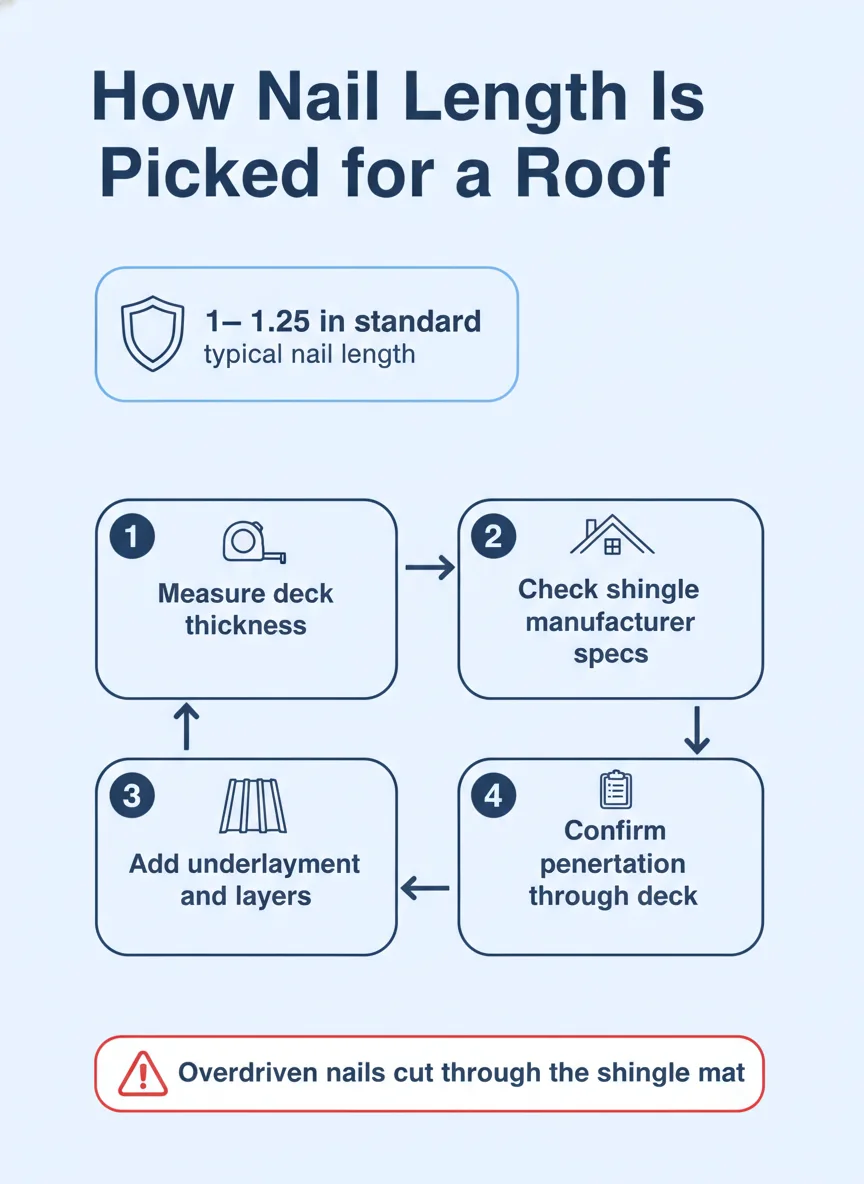
Step-by-step: How Nail Length Gets Chosen on a Real Job
On an actual installation, nail length isn't guessed at, it's worked out from the materials already on the roof and the materials going on top of it.
- Measure the deck: The installer checks deck thickness, since thinner decking changes how much nail length is available before the point exits the underside.
- Check shingle specs: Shingle manufacturers publish a minimum nail length for their product, which sets the floor for what gets used.
- Account for underlayment: Synthetic or felt underlayment adds a small amount of material the nail has to clear before reaching the deck.
- Factor in existing layers: A re-roof over an old layer needs longer nails to still achieve full penetration into the deck below both layers.
- Set the nail gun: Pneumatic nailers get depth-adjusted so the head sits flush on the shingle surface, not sunk below it.
- Spot-check placement: Nails are checked against the manufacturer's nail line as the crew works across the roof, not just at the end.
What Happens When Nail Length or Depth Is Off?
Nails That Are Too Short
A nail that's too short for the deck thickness and layers above it never achieves full penetration, which means it's holding on by friction instead of a true bite into solid wood. In a wind event, shingles held by under-penetrating nails are the first to lift, and once one shingle lifts, water and more wind pressure can get under its neighbors.
This usually isn't visible from the ground or even from a quick walk across the roof. It tends to show up later as a pattern of lifted or missing shingles concentrated in the same section, usually the section with the most wind exposure.
Nails That Are Overdriven
The opposite problem, an overdriven nail, happens when a nail gun is set with too much depth or pressure and the head sinks below the shingle surface, tearing through the reinforcing mat underneath it. A torn mat means that nail is no longer gripping anything, even though it looks installed correctly at a glance.
Overdriving is one of the more common production-line mistakes on fast installs, since a nail gun set once at the start of the day doesn't automatically adjust for every variation in deck hardness across a roof. It's also one of the easier problems to catch during a quality walk, since torn mats are visible up close even when they're invisible from below.
Is This a DIY Job or Does It Need a Pro?
Patching a single lifted shingle with a dab of roofing cement and a hand-driven nail is within reach for a handy homeowner, as long as it's a small, isolated spot and the roof pitch is safe to walk. Anything beyond a quick spot fix starts running into questions of deck condition, existing layer count, and proper nail gun calibration that are hard to judge without experience.
A full section of nailing problems, whether from under-penetration or overdriving, usually means the original installation needs a closer look rather than a patch. Pulling a sample shingle to check the nail pattern and depth is a quick way to tell whether the issue is isolated or systemic.
A licensed roofer carries the ladder safety gear, knows what a proper nail line looks like for the shingle brand installed, and can tell the difference between a cosmetic issue and a structural one. For anything beyond a single shingle, a roof inspection is the more reliable starting point than guessing from a photo.
Getting the Fasteners Right the First Time
Nail length and placement are small details compared to shingle brand or color, but they're the difference between a roof that holds through a windy spring and one that sheds material down the block. It's worth asking any roofer bidding a job how they handle nail length and placement, especially if the project is a roof replacement over an existing layer.
Homeowners in Westminster and across the region deal with the same wind exposure regardless of neighborhood, which is why fastener details matter just as much as material choice. Virtuous Roofing and Exteriors installs with attention to these details on every job, not just the parts a homeowner can see from the yard.
Frequently asked questions
What size nails are used for asphalt shingles?
Most asphalt shingle installs use galvanized roofing nails around 1 to 1.25 inches long with a wide head and 11 or 12 gauge shank. The right size depends on deck thickness and how many layers of material the nail has to pass through to seat properly.
How many nails does each shingle need?
Standard shingles typically take four nails each, with six in higher wind areas, placed along the manufacturer's nail line. More nails spread the load across more fasteners, which matters a lot in a place with regular wind events.
Can a nail be too long for a shingle?
Yes, a nail that's too long can poke through the underside of the roof deck into the attic space, which creates a path for moisture and a visible tip that can snag insulation or wiring. Length should match deck thickness plus the material layers above it, not just be as long as possible.
What happens if roofing nails are overdriven?
An overdriven nail sinks its head below the shingle surface and tears through the fiberglass mat, which means that nail is no longer holding the shingle down at all. This is one of the most common installation mistakes and usually comes from a nail gun set too high.
Do I need special nails for a re-roof over an existing layer?
Yes, adding a layer of shingles over an existing roof means the nail has to travel through more material before it reaches the deck, so length needs to go up to keep full penetration. This is one reason many roofers recommend a full [tear-off over a roof-over](/blog/roof-over-vs-tear-off-colorado).