
What a wind storm actually does to a roof
Colorado gets wind events strong enough to lift asphalt shingles several times a year, and most homeowners only notice when a shingle ends up in the yard or a bare patch shows up on the slope facing the street. That visible damage is the easy part to spot. The harder part is figuring out what happened to the shingles that are still up there but got stressed in the same event.
This matters because wind damage doesn't announce itself neatly. A storm strong enough to tear a few shingles loose was strong enough to flex and crease dozens more nearby, even if they're still nailed down and look fine from the driveway. Treating the problem as just the missing pieces, instead of the full area the wind hit, is how a roof ends up with a second round of damage a year later.
Why wind takes shingles and what happens underneath
Asphalt shingles rely on a seal strip, a factory-applied adhesive line that bonds each shingle to the one below it once the sun warms it after installation. That bond is what keeps wind from getting underneath the tab and prying it up. Once that seal is broken, whether from age, heat cycling, or a direct gust, the shingle is vulnerable every time the wind picks up again.
Seal strip failure
A shingle that's lost its seal strip can look completely normal lying flat, but it will lift at the corner the next time wind gets under the edge. This is the detail a roofer is actually checking for during a wind damage inspection, more than just counting the bare spots. Seal strip failure tends to cluster near roof edges, ridges, and valleys where wind uplift is strongest.
Once a run of shingles has lost its seal, pressing them back down by hand doesn't fix the underlying problem. The adhesive doesn't re-bond on its own, so those shingles stay a weak point until they're either resealed with roofing cement or replaced outright.
Creased and cracked tabs
Wind that's strong enough to lift a shingle but not quite strong enough to tear it off will often fold it back and let it snap down again, leaving a visible crease across the tab. That crease is a permanent crack in the asphalt mat, and it will leak eventually even though the shingle is still attached and the seal might still be holding for now.
Creased shingles are easy to miss from the ground, which is part of why a visual check from the yard isn't enough after a real wind event. They show up clearly once someone's actually on the roof looking at each tab along the ridge and the edges where wind pressure is highest.
| What you see | What it usually means | Likely next step |
|---|---|---|
| A handful of shingles missing in one spot | Localized seal failure, often where the roof was already weakest | Spot repair if the surrounding shingles are still pliable |
| Missing shingles plus creased tabs nearby | Wind stress spread past the visible damage | Wider repair or a full slope replacement depending on extent |
| Granule loss and brittle tabs across the roof | Roof is near the end of its service life | Full replacement is usually the more cost-effective call |
| Missing shingles with exposed underlayment or decking | Active path for water intrusion | Tarping right away, repair or replacement scheduled quickly |
The shingle system and why one missing piece affects its neighbors
Asphalt shingles are installed in overlapping rows so that each course sheds water onto the one below it. A single missing shingle doesn't just leave a bare patch, it exposes the nail line and edge of the shingle above it to wind and water that the system was never designed to handle directly. That's why even one or two missing shingles can let water in faster than the gap itself would suggest.
The underlayment beneath the shingles is a secondary water barrier, not the primary one, and it's not built to handle prolonged direct exposure. A missing shingle left in place through a few more storms gives wind and water more time to work on that underlayment, which is how a simple shingle repair can turn into a decking repair if it sits too long.
Step-by-step: how a roofer assesses wind damage
A thorough wind damage check covers more ground than just the spot where shingles are visibly missing. Here's generally how it goes.
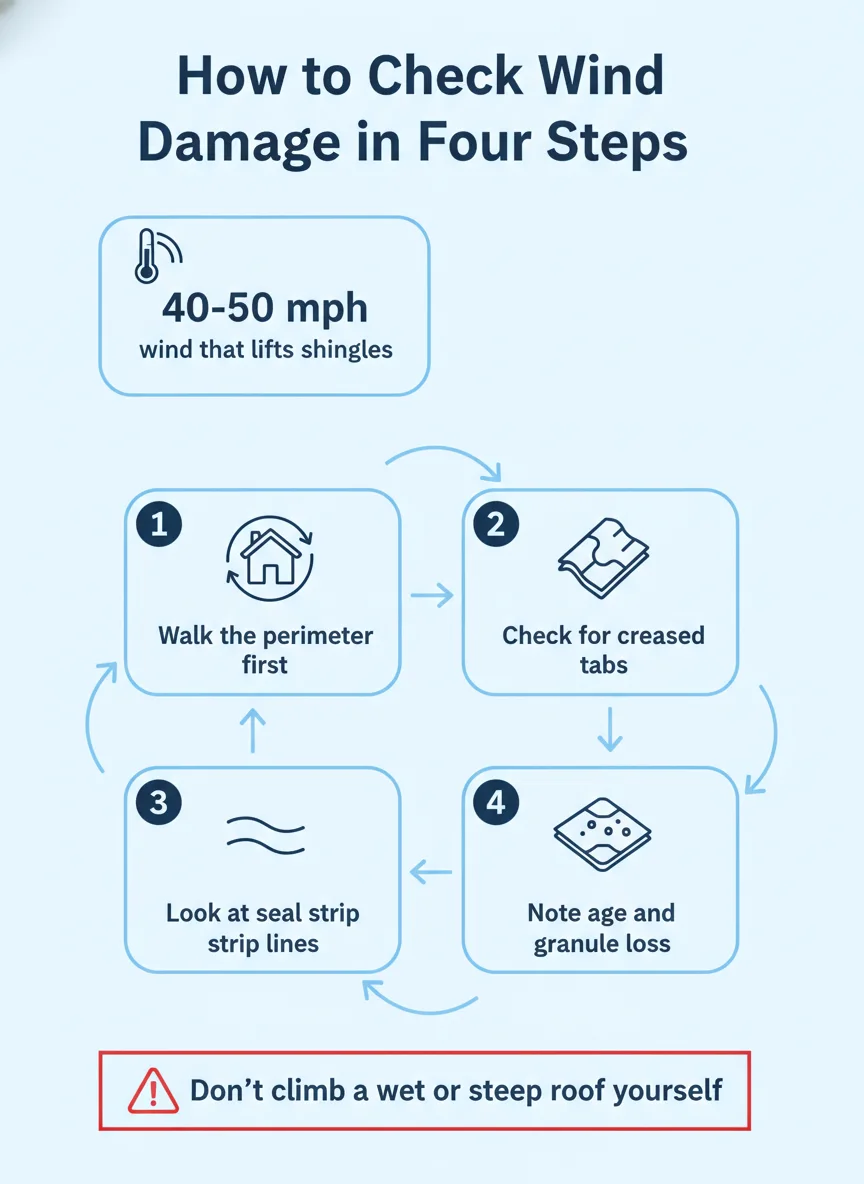
- Ground-level walk: We start by walking the property line looking for shingle pieces, granules in gutters or flower beds, and any debris the storm left behind.
- Full roof access: We get up on the roof itself rather than relying on photos from the ground, since creased and lifted shingles aren't always visible from below.
- Edge and ridge check: We check high-wind zones first, including eaves, ridges, and valleys, since that's where seal strip failure concentrates.
- Field inspection: We check tabs across the rest of the field for creasing, lifting, and granule loss, not just the area around the missing shingles.
- Underlayment check: Where shingles are missing, we check whether the underlayment or decking beneath has been exposed to moisture.
- Age and material review: We factor in the roof's overall age and shingle condition, since that changes whether a repair will actually hold.
- Written recommendation: We walk you through what we found and explain whether a roof repair or a fuller roof replacement makes more sense for your situation.
What you'll actually find once you're up there
The repair scenario
A repair makes sense when the damage is contained to one area, the surrounding shingles are still flexible and well sealed, and the roof overall still has useful life left in it. In that case, replacing the missing section with matching shingles and resealing any lifted tabs nearby restores the system without the cost of a full tear-off.
Matching older shingles exactly can be tricky since color and texture shift between manufacturing batches over the years. A roofer will tell you upfront if an exact match isn't realistic so you can decide whether a visible patch on one slope is acceptable or whether replacing that whole slope makes more sense.
The replacement scenario
Replacement becomes the more sensible call when the wind damage is spread across a large share of the roof, when shingles elsewhere are already brittle or losing granules from age, or when the roof is close to the end of its expected service life anyway. At that point a patch is a short-term fix on a roof that's going to need full replacement soon regardless.
If your insurance is involved because the damage came from a documented wind event, that claim process can also factor into the decision, since adjusters evaluate the full roof's condition, not just the obviously missing shingles. Our storm damage and insurance team can walk through that side of it with you.
What a homeowner can safely check versus what needs a pro
From the ground, you can look for shingle pieces in the yard, granules collecting in gutters or downspouts, and any obvious bare patches on a slope you can see from the street or a safe window. Binoculars help here more than a ladder does, and it's a reasonable first step after any strong wind event.
Getting on the roof itself to check seal strips, creased tabs, and underlayment exposure isn't something to do without the right footing and experience, especially on a steep pitch or a wet roof. Misjudging a single step up there is a far bigger risk than the roof damage itself.
A licensed roofer also brings something a homeowner's visual check can't, which is knowing what normal wear looks like versus active wind damage on that specific shingle type and age. That distinction is exactly what separates a repair recommendation from a replacement recommendation, and it's worth getting a second set of trained eyes on it before deciding either way.
Getting an honest answer on repair versus replace
The right call after a wind event almost always comes down to how much of the roof was actually affected, not just how many shingles you can count missing from the driveway. A roof with isolated damage and a good amount of life left is usually a repair. A roof that's older, already showing wear, or hit broadly across the field is usually better served by a full roof replacement, and it's worth reading more on when to repair and when to replace if you want the fuller picture.
If a wind storm just came through your part of the Denver Metro or Northern Colorado, including towns like Fort Collins, getting an inspection before the next storm hits the same weak spots is the smart move. Virtuous Roofing and Exteriors can take a look and give you a straight answer on which one your roof actually needs.
Frequently asked questions
Why did only a few shingles blow off in the storm?
Wind usually catches the weakest spots first, the shingles whose seal strip had already started to let go from age or heat. The ones you can see missing are often just the worst of a wider batch that got lifted and partially resealed crooked, which is why a roofer checks well beyond the bare spots.
Can you just replace the missing shingles?
Sometimes, yes, if the roof is younger and the surrounding shingles are still pliable and well sealed. A roofer pulls a few tabs near the damage to check the seal strip condition before deciding a patch will actually hold.
How do I know if wind damage is bad enough for a full replacement?
It usually comes down to how widespread the lifted seal strips are, not just how many shingles are visibly gone. If a large share of the field has lost its seal or the shingles are brittle with age, patching one section just moves the next failure to next door.
Does the age of my roof affect whether it's repaired or replaced?
Yes, significantly. A roof near the end of its expected lifespan is far more likely to need full replacement after wind damage, because the shingles throughout the field are already brittle even where nothing is visibly missing yet.
Will new shingles match my existing roof?
Matching exactly can be difficult once a shingle line has weathered or the manufacturer has changed color batches, so a roofer will walk you through what's realistic for your roof before starting a repair. In some cases replacing a full slope looks better than patching a mismatched spot.