Why Shingle Grade Matters More Than You'd Think
When a homeowner in the Denver Metro area starts pricing out a roof replacement, the conversation almost always turns to shingles at some point, and that's where things get confusing fast. Terms like three-tab, architectural, and designer get thrown around like homeowners already know what they mean, and most don't. They're not just marketing labels. Each grade is built differently, performs differently in Colorado's weather, and carries a different price tag.
Understanding the difference matters because it affects two things you'll live with for decades: how your roof looks from the street and how well it holds up against hail, wind, and UV exposure. Picking a grade without knowing what you're actually buying is how homeowners end up disappointed either by the look or by how fast the roof wears out. This guide breaks down what separates the three grades in plain terms.
What Actually Separates the Three Grades
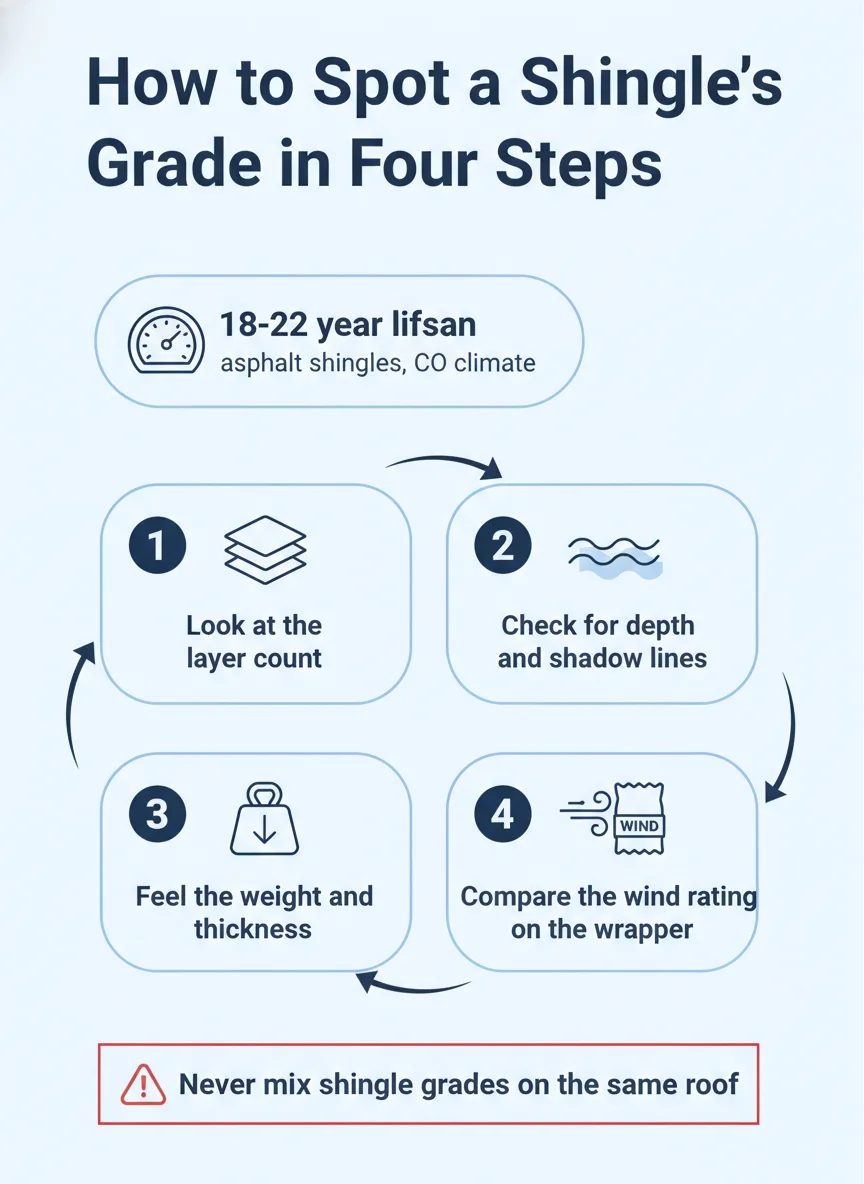
The core difference between shingle grades comes down to how many layers of material are laminated together, how much the shingle weighs per square, and how the manufacturer finishes the surface. More layers generally mean more weight, a thicker profile, and a higher wind rating, which is why grade and price climb together.
Three-Tab Shingles: The Builder-Grade Option
Three-tab shingles are a single flat layer of asphalt cut into three even tabs, which is where the name comes from. They're lightweight, uniform in appearance, and have been the budget standard in residential roofing for decades. Because they're one layer, they install fast and cost less than other grades.
The tradeoff is durability. Three-tab shingles typically carry a lower wind rating than laminated products and tend to show wear, like curling tabs or granule loss, sooner than architectural shingles in the same climate. Many manufacturers have scaled back three-tab production industry-wide as demand has shifted toward architectural, so availability has narrowed in recent years.
Architectural and Designer Shingles: Where Most Replacements Land
Architectural shingles, sometimes called laminated or dimensional shingles, are built from two or more layers fused together. That extra material gives them a thicker profile with visible shadow lines, a higher wind rating, and generally a longer service life. Today, architectural is where the large majority of residential replacements land, since it offers a better balance of cost and performance than three-tab.
Designer shingles sit a step above architectural. They're built to mimic the look of natural slate or wood shake, with irregular shapes and deeper texture. They cost more because of the extra material and manufacturing detail, and homeowners typically choose them for a specific architectural style rather than for added durability alone, though many designer lines carry strong wind ratings as well.
| Shingle Grade | Layers & Weight | Typical Look |
|---|---|---|
| Three-tab | Single layer, lightest weight per square | Flat, uniform tabs with minimal shadow |
| Architectural | Two or more laminated layers, heavier | Dimensional with visible depth and shadow lines |
| Designer | Multiple layers, heaviest of the three | Irregular shapes mimicking slate or wood shake |
What a Shingle Is Actually Made Of
Every asphalt shingle, regardless of grade, starts with the same basic recipe: a fiberglass mat, saturated with asphalt, and topped with mineral granules that give it color and UV protection. What changes between grades is how many of these mats get laminated together and how the granules are applied to create texture or a flatter finish.
The granules do more work than most homeowners realize. They shield the asphalt underneath from sun exposure, which is a real factor at Colorado's elevation, and they give the shingle its color. When a roof starts shedding granules into the gutters or downspouts in noticeable amounts, that's usually a sign the shingle is aging out of its useful life regardless of grade.
Step-by-step: How to Evaluate Which Shingle Grade Fits Your Home
Choosing a grade doesn't have to be a guessing game. Walking through these steps before you meet with a contractor gives you a clearer sense of what you're working with and what questions to ask.
- Check your home's age: Older homes with three-tab shingles are more likely due for an upgrade, since three-tab has mostly been phased out of new construction.
- Look at neighboring rooflines: Architectural and designer shingles create visible depth from the street, so compare your roof's flatness against homes with newer installs nearby.
- Factor in your home's style: Designer shingles tend to suit homes with a traditional, craftsman, or historic look where a slate or shake appearance matters.
- Ask about wind ratings: Higher-grade shingles generally carry stronger wind ratings, which matters given Colorado's exposure to high wind events.
- Get an honest assessment: A roof inspection will tell you the actual condition and grade of your current shingles before you commit to anything.
- Compare total project scope: A full roof replacement is the point to decide on grade, since upgrading mid-life isn't practical.
What Does Worn-Out Look Like for Each Grade?
What Three-Tab Wear Looks Like
Three-tab shingles tend to show their age through curling or cupping at the tab edges, which happens as the single asphalt layer dries out and loses flexibility. You'll also often see cracking along the tab lines and noticeable granule loss, which leaves bald, darker patches where the asphalt is exposed directly to UV.
Because three-tab is a single layer, damage tends to show up uniformly across the roof rather than in isolated spots. If one section looks worn, it's a safe bet the rest of the roof is close behind, since the shingles were installed and have aged together.
What Architectural Shingle Wear Looks Like
Architectural shingles wear more gradually because the laminated layers add thickness and protection. The first signs are usually granule loss in the gutters, a flattening of the shadow lines that gave the roof its dimensional look, or isolated cracking where hail or wind damage has occurred, like after a hail or wind event.
Because architectural shingles are built from multiple bonded layers, damage can sometimes be localized rather than roof-wide, especially after a specific storm event. That's part of why a close inspection after severe weather matters, since a few damaged shingles don't always mean the whole roof needs replacing.
DIY vs Calling a Pro
Identifying your current shingle grade from the ground, or even up close, is something most homeowners can do on their own with a little guidance. Comparing thickness, shadow lines, and tab uniformity doesn't require tools or training, just a careful look and maybe a pair of binoculars for anything above a single story.
Where it gets more complicated is figuring out how much life is actually left in those shingles and whether damage you're seeing is cosmetic or structural. Granule loss, cracking, and curling can look similar across grades but mean very different things depending on the underlying layers, the decking condition, and how the shingles were installed originally.
That's the point where a licensed roofer earns their keep. A trained eye can tell the difference between normal aging and a problem that's going to leak, and can tell you honestly whether a repair makes sense or whether you're better off planning for a full replacement. Climbing a roof to inspect shingles closely also isn't something to take on without the right safety setup.
Choosing the Right Shingle for Your Next Roof
There's no single right answer across every home in Denver or the surrounding area, since the right shingle grade depends on your budget, your home's style, and how long you plan to stay put. What matters most is going in with a clear understanding of what separates three-tab, architectural, and designer, rather than picking based on price alone or a sales pitch you don't fully follow.
If you're not sure what's currently on your roof or how much life is left in it, that's worth sorting out before a small problem turns into a bigger one, and it helps to see what actually happens on replacement day before you commit. Virtuous Roofing and Exteriors walks homeowners through these choices as part of every estimate, so you know exactly what you're getting before any work starts.
Frequently asked questions
What is the difference between three-tab and architectural shingles?
Three-tab shingles are a single flat layer cut into even tabs, while architectural shingles are made of two or more layers laminated together for a thicker, dimensional look. Architectural shingles also carry a higher wind rating and tend to outlast three-tab in most climates.
Are designer shingles worth the extra cost?
Designer shingles are worth it mainly for curb appeal and matching a specific architectural style, since they mimic the look of slate or wood shake. Whether the upgrade is worth it comes down to how long you plan to stay in the home and how much the look matters to you.
Do three-tab shingles still get installed on new roofs?
Three-tab shingles are rarely the first choice on new installs today because architectural shingles have become the industry standard at a similar price point. Most manufacturers have scaled back three-tab production as demand has shifted.
How long do architectural shingles last in Colorado?
Architectural shingles generally hold up across a range of roughly 20 to 30 years industry-wide, though Colorado's UV exposure, hail, and freeze-thaw cycles can shorten that depending on the specific product and installation. A [roof inspection](/services/roof-inspection) is the most reliable way to know where your roof actually stands.
Can I tell the shingle grade just by looking at my roof from the ground?
You can usually get a rough idea from the ground based on whether the roof looks flat and uniform (three-tab) or has visible depth and shadow lines (architectural or designer). A close-up look is needed to confirm the grade for certain.