
Why Roof Claims Get Denied or Underpaid in Colorado
Colorado sees more hail activity than most of the country, which means more roof claims get filed here every year and more of them come back with a denial letter or a check that doesn't cover the real cost of the work. If you just opened one of those letters, you're not alone and you're not out of options. A denial is a starting position from the insurance company, not a final ruling, and most policies include ways to push back on both denials and underpayments.
The frustrating part is that the reasoning in these letters is often vague. You might see language about damage being consistent with normal wear, or about the slope in question not meeting the threshold for replacement. Understanding what those phrases actually mean, and what documentation changes the outcome, is the difference between accepting a check that falls short and getting the roof you're actually owed under your policy.
How Insurance Adjusters Decide What a Roof Claim Pays For
Adjusters are working from a set of internal guidelines about what counts as storm damage versus what counts as aging or maintenance issues. They're looking at granule loss patterns, the size and spacing of impact marks, and whether damage shows up consistently across a slope or only in isolated spots. The call they make depends heavily on how much evidence is in front of them, which is exactly where a documented inspection from your roofer makes the biggest difference.
Wear and Tear vs. Storm Damage
Every roof shows some wear over time, and insurers know that distinguishing old wear from a specific storm event protects them from paying for damage that existed before the policy period or before the storm in question. The challenge is that hail bruising and wind-lifted shingles can look similar to aging if you're not trained to tell the difference, which is part of why adjusters sometimes classify genuine storm damage as pre-existing wear.
A thorough inspection looks at the pattern and consistency of the damage, not just isolated spots. Fresh hail hits tend to show bright, exposed mat where granules knocked loose recently, while old wear shows uniform fading and brittleness across the whole surface. Photographing both the damage and the surrounding undamaged material gives the adjuster, and you, a clearer basis for comparison than a single zoomed-in photo.
Missed Slopes and Old Damage
A common reason for an underpaid claim is that the adjuster only fully assessed the slopes that were easiest to see from the ground or from one vantage point on the roof. If hail hit a home at an angle, some slopes take a harder hit than others, and a rushed inspection can miss damage on the back or side of the roof entirely. This is one of the most fixable problems in a claim dispute because it just requires getting eyes, and photos, on every slope.
Old damage is a separate issue. If a previous storm caused damage that was never repaired, insurers may try to attribute all current damage to that earlier, uncovered event. Keeping records of past repairs, past claims, and any inspection reports from previous years helps draw a clear line between what happened when, which matters a lot if a claim gets disputed.
| Reason for Denial or Low Payout | What It Usually Means | What You Can Do About It |
|---|---|---|
| Classified as wear and tear | Adjuster believes damage predates the storm or developed gradually | Request re-inspection with documented, dated storm evidence |
| Cosmetic damage only | Adjuster found marks but no functional impact on the roof system | Provide manufacturer guidance and a contractor's functional assessment |
| Missed slopes | Not all roof planes were fully inspected or documented | Submit photos and measurements from every slope, including hard-to-reach areas |
| Scope too narrow | Estimate excludes flashing, ventilation, or related interior damage | File a written supplement listing each missing item with support |
What a Supplement Is and When You Need One
A supplement is a formal, written request asking the insurer to revise their original estimate to include items that were missed or undervalued. Supplements are a normal and expected part of the claims process, not an aggressive escalation, and most adjusters have a standard way of processing them. You'd file one when the estimate leaves out materials, labor categories, or related damage that your Storm Damage & Insurance inspection documented but the adjuster's report didn't capture.
The strength of a supplement comes down to specificity. A vague request to reconsider the whole claim is easy to set aside, but a line-item list with photos, measurements, and a clear explanation of why each item belongs in the scope gives the adjuster something concrete to act on. This is usually where a roofer's documentation carries the most weight, since it ties the request directly to what was found on the roof rather than a general disagreement with the number.
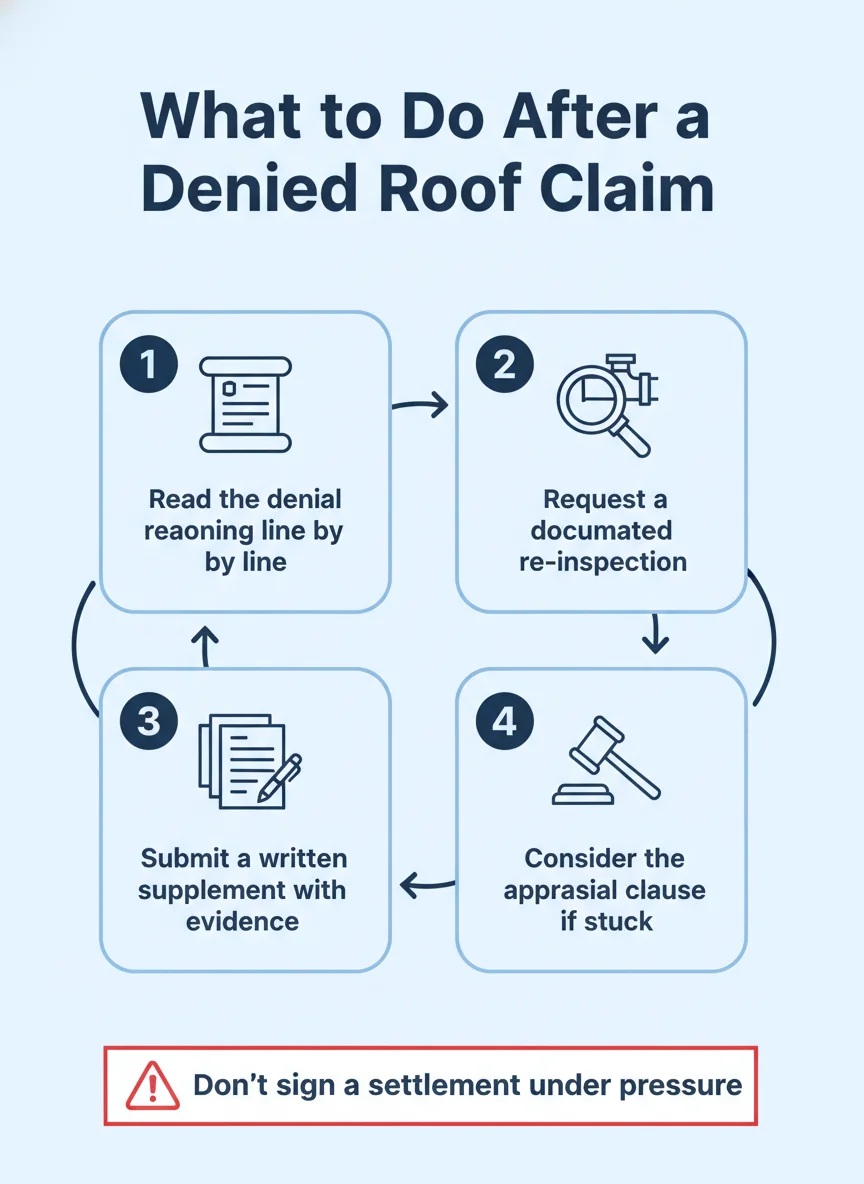
Step-by-Step: What to Do After a Denial or Low Payout
Once you have a denial letter or an estimate that looks short, the order you take action in matters. Moving straight to a dispute without reviewing the reasoning first can waste time, while sitting on a denial too long can make it harder to reopen the claim.
- Read the full letter: Go through the denial or settlement letter line by line and note the exact reasoning cited for each item, not just the bottom-line number.
- Pull your own documentation: Gather any photos, inspection reports, or repair history you have that relates directly to the reasoning in the letter.
- Get a second inspection: Have a roofer walk every slope and document damage the original adjuster's report may have missed or undervalued.
- Request a re-inspection: Ask your insurer in writing for a re-inspection, referencing the specific items you believe were missed or misclassified.
- File a written supplement: If the re-inspection doesn't resolve it, submit a formal supplement with photos, measurements, and a line-item breakdown.
- Consider the appraisal clause: If you and the insurer still disagree on the value of the loss, review your policy's appraisal clause as a formal next step.
- Escalate if needed: If the dispute stalls, you can involve a public adjuster, an attorney, or file a complaint with your state's insurance department.
What a Re-Inspection and Appraisal Clause Actually Do
Requesting a Re-Inspection
A re-inspection is simply asking the insurer to send an adjuster back out, usually with new information in hand, like a contractor's report or additional photos. It's the lowest-friction way to correct a claim because it doesn't require any formal dispute process, just a documented reason to take a second look. Framing the request around specific, documented items rather than a general complaint gets better results.
Timing matters here too. The sooner you request a re-inspection after receiving the original decision, the more the storm conditions on the roof still match what they looked like at the time of loss. Weather, additional wear, and repairs made in the meantime can all complicate a later re-inspection, so acting promptly once you've gathered your documentation is worth prioritizing.
Invoking the Appraisal Clause
If a re-inspection and a supplement still don't close the gap, many homeowners policies include an appraisal clause as a built-in way to resolve disagreements over the dollar value of a covered loss. Under this process, you and the insurer each select an independent appraiser, and if those two can't agree, a neutral umpire makes the final call. It's a formal step, so reading your specific policy language or talking with your agent before invoking it is worth the time.
Appraisal is meant for disagreements about value, not about whether something is covered at all. If the insurer's position is that the damage isn't covered in the first place, rather than disputing the dollar amount, appraisal may not be the right tool and a complaint or legal review might fit better. Knowing which kind of dispute you're actually in helps you pick the right next step instead of spending time on the wrong one.
DIY vs. Calling a Pro: Who Should Push Back on the Insurer
Reading your denial letter, pulling together your own records, and requesting a basic re-inspection are all things a homeowner can reasonably do on their own. You know your home's history, you have your policy documents, and a polite, specific written request often gets a response without needing outside help. Keeping copies of every email and letter along the way is good practice regardless of who's handling the dispute.
Where it usually makes sense to bring in a professional is the technical documentation itself. Telling the difference between hail bruising and granule loss from age, or identifying damage on a steep or hard-to-reach slope, takes training most homeowners don't have. A Roof Inspection from a licensed roofer gives you a report written in the same technical language the adjuster uses, which tends to carry more weight than a homeowner's own photos alone.
If a dispute escalates past a supplement, a public adjuster or an attorney who handles property claims becomes worth considering, especially for larger losses. A roofing contractor can document damage and speak to the condition of the roof, but isn't in a position to interpret policy language or represent you in a formal dispute. Knowing where that line sits keeps expectations realistic on both sides.
Getting the Roof You're Owed
A denial letter or a short check feels like the end of the process, but for most Colorado homeowners it's closer to the middle. Re-inspections, supplements, and the appraisal clause all exist because insurers and homeowners don't always agree on the first try, and the process for resolving that disagreement is built into most policies for exactly this reason. Homeowners in Westminster and across the Front Range deal with this every storm season, and the path forward usually starts with better documentation, not a bigger fight.
If you want to understand the fuller claims process before you're in the middle of a dispute, our guide to the full insurance claim timeline walks through what happens from the first storm to a finished roof. Virtuous Roofing and Exteriors works through denials and underpaid claims with homeowners regularly and can document what your roof actually needs.
Frequently asked questions
Why would an insurance company deny a roof claim?
Most denials come down to the adjuster classifying the damage as wear and tear, pre-existing, or cosmetic rather than storm-caused. Insurers also deny claims when documentation is thin or when the damage doesn't meet their internal threshold for what counts as functional harm, so a detailed inspection report matters a lot.
What does it mean when an insurance claim is underpaid?
An underpaid claim usually means the adjuster's estimate missed slopes, undercounted materials, or left out related work like flashing, ventilation, or interior damage. A written supplement that lists the missing items with photos and measurements is the usual way to correct it.
Can I get a second opinion after my roof claim is denied?
Yes. You can request a re-inspection from your insurer, bring in a second contractor for an independent assessment, or in some cases hire a public adjuster to represent your interests. None of these options are off the table just because the first decision came back negative.
What is the appraisal clause in a homeowners policy?
The appraisal clause is a dispute resolution process built into most homeowners policies that lets you and the insurer each hire an independent appraiser to agree on the value of the damage. It's meant to resolve disagreements over the amount of a covered loss without going to court, though it varies by policy so it's worth reading your own documents or asking your agent.
Can a roofing contractor negotiate directly with my insurance company?
A contractor can document damage, provide an estimate, and communicate with your adjuster about scope and materials, which is a normal part of the claims process. A contractor is not a substitute for your own read of the policy or for a public adjuster or attorney if a dispute escalates.