Why Impact Resistance Comes Up So Often in Colorado
Colorado sits in a stretch of the country that gets hit by more hailstorms than almost anywhere else in the United States, and the Front Range in particular sees a steady run of them through spring and summer. That reality shapes a lot of roofing conversations here, and it's why terms like "Class 4" and "impact-resistant" show up on more estimates and insurance renewal notices than they do in calmer states.
If you're replacing a roof in Denver, Boulder, Fort Collins, or anywhere along that corridor, you'll likely be offered a choice between standard shingles and an impact-resistant option at some point in the quoting process. Understanding what that rating actually measures, and what it doesn't, helps you make that call with real information instead of just taking a salesperson's word for it.
How the Class 1 to Class 4 Rating Actually Works
The rating system homeowners run into is built around a lab test called UL 2218, developed by Underwriters Laboratories to give manufacturers, insurers, and builders a consistent way to compare how roofing materials hold up to impact.
The Steel-Ball Drop Test
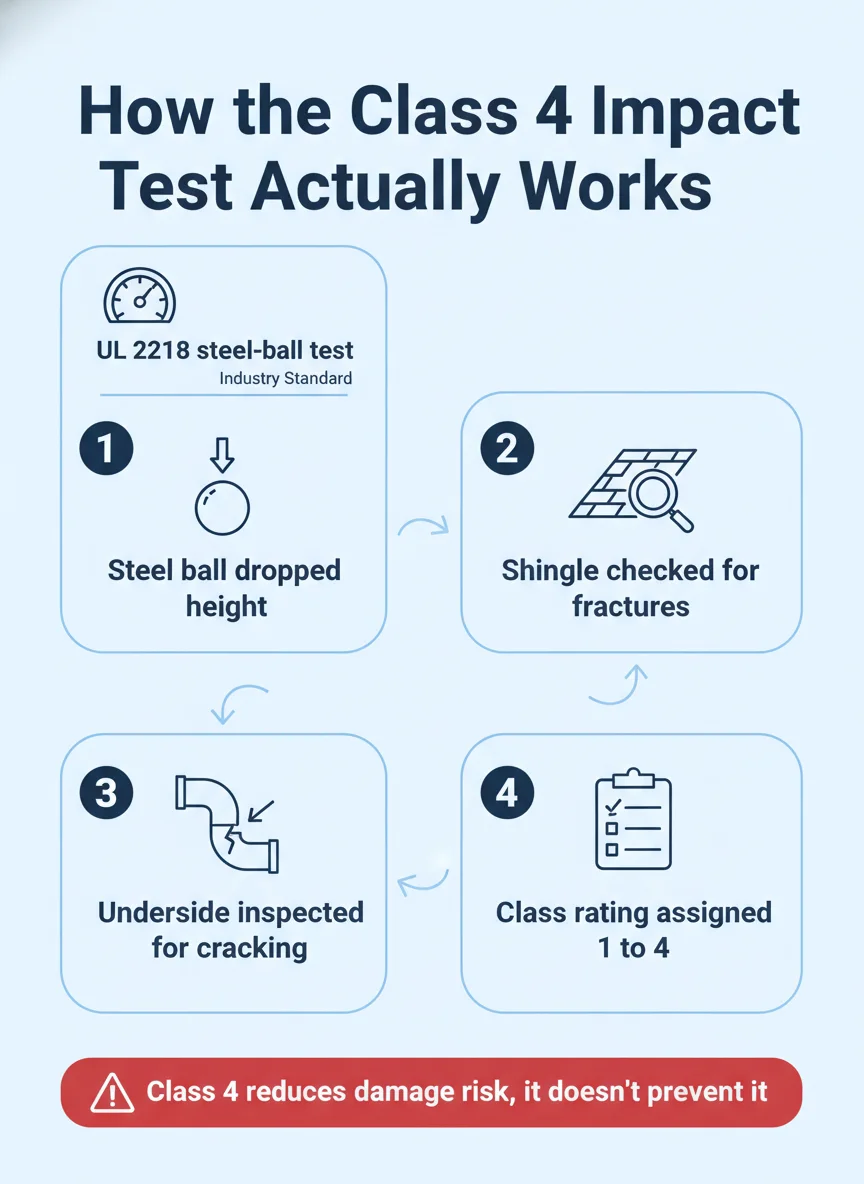
In the UL 2218 test, a steel ball of a specific size and weight is dropped from a measured height onto a shingle sample, simulating the kind of blunt impact a hailstone delivers. The shingle is then examined for cracks or fractures that go through the reinforcing mat underneath the surface granules, since that's the kind of damage that leads to leaks over time, not just cosmetic marks.
The test is run at increasing ball sizes for each class level. A shingle earns a Class 4 rating when it withstands the largest, heaviest ball used in the test series without that mat fracture happening. Classes 1 through 3 use smaller or lighter balls, so a shingle can pass a lower class and fail the Class 4 threshold.
What Class 4 Resists, and What It Doesn't
A Class 4 rating tells you the shingle performed well against a specific, standardized impact in a controlled lab setting. In practical terms, that generally translates to better resistance against granule loss, cracking, and mat fracture from moderate hail compared to a standard three-tab or lower-class architectural shingle.
It does not mean the shingle is hail-proof, and no manufacturer markets it that way. Real hailstorms involve variables a lab test can't fully replicate, like wind-driven impact angles, ice buildup, and hail larger than what's used in the standard test. Large enough hail, hitting at the right angle, can still dent or damage a Class 4 roof. The rating lowers your odds of damage, it doesn't eliminate them.
| Rating Class | Relative Impact Resistance | What It Generally Tells You |
|---|---|---|
| Class 1 | Lowest tested threshold | Passed the smallest steel-ball test in the series |
| Class 2 | Modest improvement | Holds up to slightly larger simulated impacts |
| Class 3 | Above-average resistance | Common step up from standard shingles |
| Class 4 | Highest tested threshold | Passed the largest steel-ball drop without mat fracture |
What's Actually Different About a Class 4 Shingle
Most Class 4 shingles get their added toughness from changes in the reinforcing mat and the rubberized or polymer-modified asphalt layer underneath the granules, rather than from a thicker shingle overall. That construction is designed to flex and absorb impact instead of cracking straight through, which is the failure mode the UL test is actually checking for.
From the ground, a Class 4 shingle often looks similar to a standard architectural shingle in the same style line, so you usually can't identify one just by looking up at a roof. The rating is a manufacturing and testing distinction, not a visual one, which is part of why checking your paperwork matters more than eyeballing the roof.
Step-by-Step: Checking Whether Your Roof Already Has Class 4 Shingles
If you're not sure what's currently on your roof, there's a reliable order of operations to work through before you assume either way.
- Pull your paperwork: Check the original install invoice, contract, or manufacturer warranty registration, since impact-resistant shingles are typically listed by product name or class rating on these documents.
- Check your insurance file: If you ever applied for a wind or hail mitigation credit, that paperwork often references the shingle's impact class directly.
- Look at leftover shingles: Extra bundles left in an attic or garage from the original install usually have the product name printed on the wrapper, which you can look up.
- Check the shingle wrapper code: Manufacturers print a product line name on the shingle wrapper and sometimes stamp a class designation on the back of individual shingles.
- Call the original installer: If the same company is still in business, they may have job records showing exactly what material went on your roof.
- Schedule a professional look: A trained eye can often identify the shingle line from the attic underside or a sample, which is a standard part of a thorough roof inspection.
What You'll Find When You Check Your Own Roof
Once you've gone through your records or had someone take a closer look, you'll generally land in one of two camps, and each one points you toward a different next step.
Signs You Likely Already Have Impact-Resistant Shingles
If your paperwork specifically names a Class 4 or impact-resistant product line, or your insurance company previously applied a hail mitigation credit to your policy, that's a strong indicator the shingles are already on the roof. Some manufacturers also offer longer warranty terms specifically tied to their impact-resistant lines, which can show up on a warranty certificate even if the word "Class 4" isn't printed anywhere obvious.
If you find any of these, it's still worth confirming with a roofer at your next roof inspection, since age and prior damage both affect how much resistance is left in a shingle that's been on the roof a decade or more.
Signs You Probably Don't
If your paperwork just says "architectural shingle" or lists a standard product line with no mention of impact rating, and you've never gone through an insurance hail mitigation review, there's a good chance you have a standard shingle rather than a Class 4 product. That's common and not a problem by itself, it just means the upgrade conversation is still an open one for your next roof replacement.
A visible mismatch between neighboring sections of roof, or shingles that look notably older or more granule-worn in spots, can also suggest a prior repair used a different material than the original install, which is worth flagging to whoever quotes your next project.
DIY vs. Calling a Pro
Checking old paperwork, invoices, and warranty documents is something any homeowner can do on their own time, and it's genuinely the fastest path to an answer if those records still exist. Looking up a shingle product name online once you find it on a wrapper or invoice is also a reasonable DIY step.
Where it gets harder to DIY is physically identifying a shingle you can't match to any paperwork. That usually means getting someone safely on the roof or into the attic to check the shingle's underside markings, and climbing a roof without the right footing and equipment is not something to attempt casually, especially on steeper pitches common in Colorado's mountain and foothill communities.
Deciding whether to upgrade to Class 4 shingles on your next replacement is also a conversation better had with a professional, since it involves weighing material cost against your specific insurance policy's terms, which a roofer and your agent can walk through together more accurately than a general online estimate can.
Making the Call for Your Next Roof
Class 4 shingles are one tool in a bigger conversation about protecting a Colorado roof from the hail this region sees regularly, alongside things like proper attic ventilation, flashing quality, and how storm damage gets handled after the fact. None of those pieces work in isolation, and a shingle rating alone won't make up for poor installation elsewhere on the roof.
If you're weighing the upgrade for a home anywhere from Denver to the foothills, it's worth reading up on what actually drives roof replacement costs in Colorado before you compare quotes, since material choice is only one factor in the total price. Virtuous Roofing and Exteriors can walk you through whether the upgrade makes sense for your specific roof and policy.
Frequently asked questions
What does a Class 4 shingle rating actually mean?
It means the shingle passed a standardized impact test, UL 2218, where a steel ball is dropped onto the shingle from a set height without causing a fracture through the mat. It's the highest of four classes, and it tells you the shingle resisted that specific lab test better than a Class 1, 2, or 3 product.
Will Class 4 shingles stop hail damage completely?
No, and no manufacturer claims that. Class 4 shingles are built to resist cracking and granule loss better than standard shingles under lab conditions, but large hail at the right angle and speed can still dent, bruise, or damage any roofing material.
How can I tell if my roof already has Class 4 shingles?
Check your closing paperwork or the original invoice first, since impact-resistant shingles are usually called out by name on the estimate. If you don't have that paperwork, a roofer can often identify the shingle line from the attic underside or a small sample, which is part of what a [roof inspection](/services/roof-inspection) covers.
Do insurance companies give discounts for Class 4 shingles?
Some insurers offer a premium credit for impact-resistant roofing, but this varies by company and by policy, so it's worth asking your agent directly rather than assuming a discount applies. Ask for it in writing before you count on it.
Are Class 4 shingles worth the upgrade in Colorado?
For a lot of homeowners in hail-prone parts of Colorado, yes, because the added durability and potential insurance credit can offset the higher material cost over time. It's a conversation worth having with your roofer when you're already planning a [roof replacement](/services/roof-replacement), since it costs much less to choose the material upfront than to switch later.