
Why Replacement Day Looks Different Than You'd Expect
Homeowners across Denver, Aurora, and the rest of the Front Range usually picture roof replacement as a single loud day where new shingles appear. In reality it's a sequence of smaller jobs stacked on top of each other, each one setting up the next. Tear-off has to finish before the deck can be checked, the deck has to be sound before underlayment goes down, and the underlayment has to be right before anything new gets nailed in.
Understanding that sequence matters because it tells you what to expect at each hour of the day, and it explains why a crew might pause mid-morning to talk to you about something they found. Colorado's freeze-thaw cycles and intense summer sun both take a toll on decking and flashing over the years, so surprises under the old roofing are common enough that a good crew builds time into the schedule to handle them.
What Actually Drives the Schedule
Three things control how fast replacement day moves: the size and pitch of the roof, the condition of the decking underneath, and the weather. A steep pitch slows down every stage because crews move more carefully and use more safety gear, while a low, simple roof on a ranch-style home can move much faster.
Roof Size and Complexity
A roof with multiple valleys, dormers, and chimneys takes longer than a simple gable because every transition point needs its own flashing work. Crews also have to cut materials to fit irregular shapes instead of running long, uninterrupted courses, which adds time at nearly every stage of the job.
Square footage matters too, but complexity usually slows a job down more than raw size does. A large, simple roof can sometimes move faster than a smaller roof packed with angles and penetrations for vents, skylights, or solar equipment.
Decking Condition
Once the old roofing comes off, the crew can finally see the plywood or board decking underneath, and that's where Colorado's weather history shows up. Years of moisture intrusion, old leaks, or ice damming can leave sections soft or delaminated, and those sections need to be cut out and replaced before anything goes back on.
This is the single biggest reason a replacement day can run longer than planned. A reasonable estimate accounts for some deck repair, but a roof with a long history of leaks may need more sheets of decking than anyone could know until the old material is off.
| Stage | What Happens | Typical Timing |
|---|---|---|
| Setup | Dumpster placed, materials staged, property protected | First hour of day one |
| Tear-off | Old roofing stripped down to the deck | Morning of day one |
| Deck and underlayment | Repairs made, ice barrier and felt installed | Midday, day one |
| Installation and cleanup | New roofing installed, flashing finished, magnet sweep | Afternoon, day one into day two |
The Layers Between the Deck and the Weather
What goes on top of the deck matters as much as what you can see from the street. Ice and water barrier gets installed along eaves and valleys, the spots most prone to ice damming and wind-driven moisture in Colorado winters. Synthetic underlayment or felt covers the rest of the deck as a second line of defense.
Drip edge goes on at the eaves and rakes to direct water away from the fascia, and flashing gets installed or replaced around every chimney, skylight, and wall intersection. These details don't show up in a photo of the finished roof, but they're usually where leaks start if they're rushed or skipped.
Step-by-Step: A Typical Replacement Day
Every house is a little different, but the stages below are consistent across most residential jobs, whether it's a straightforward ranch in Thornton or a steep, multi-valley roof in the foothills.
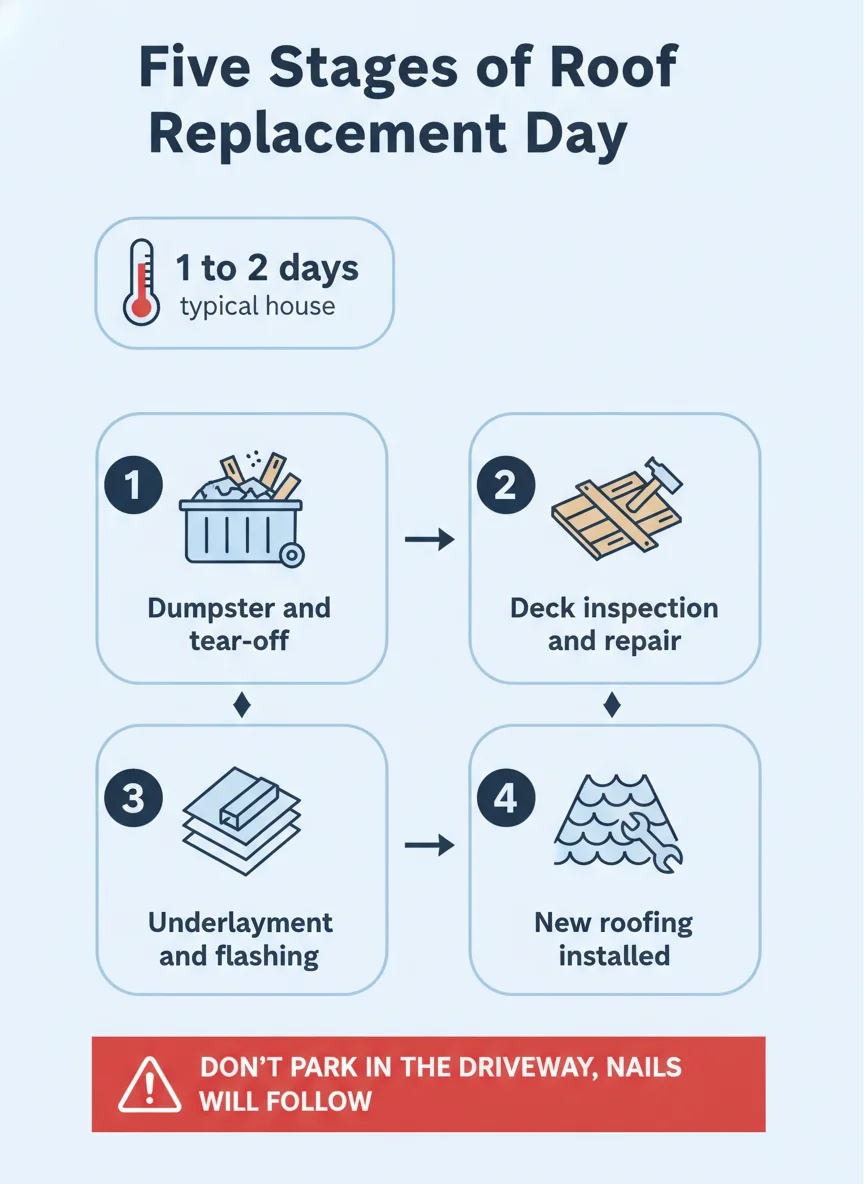
- Dumpster arrives: A crew drops a dumpster trailer in the driveway or on the street, then stages materials, ladders, and safety equipment around the house before anyone touches a shingle.
- Property protection: Tarps go over landscaping, AC units, and anything else near the drip line, since debris and granules fall straight down during tear-off.
- Tear-off begins: Old roofing is stripped course by course and loaded directly into the dumpster, exposing the decking section by section.
- Deck inspection: Each section of decking gets checked for soft spots, delamination, or past water damage, and any bad sections are cut out and replaced.
- Underlayment and flashing: Ice and water barrier, underlayment, drip edge, and new flashing go down in sequence before any new roofing is installed.
- New roofing installed: Materials are installed course by course up to the ridge, with valleys, penetrations, and transitions finished as the crew works.
- Cleanup and magnet sweep: The yard, driveway, and flower beds get swept and raked, and a magnetic roller is run across the ground to catch stray nails before the crew leaves.
What You'll Find When the Inspection Happens
A final walk-through happens once the new roofing is on and the site is cleaned up. This is the point where you and the crew lead can look over the ridge lines, valleys, and flashing details together before calling the job finished.
What a Good Inspection Checks
A proper inspection covers the ridge cap for consistent alignment, valleys for clean water channels, and every penetration point for solid flashing. It also includes a check of gutters and downspouts to make sure nothing got knocked loose or clogged with debris during the work.
Attic ventilation gets a look too, since proper airflow affects how long the new materials last. If your home runs solar panels, this is also a natural point to talk about options like solar critter guards to keep pests from nesting underneath the array.
Signs the Job Was Done Right
Clean, straight shingle or seam lines, flashing that's tight against every wall and penetration, and a yard free of nails and old debris are all good signs. Downspouts should be flowing freely and nothing should look loose or improperly nailed along the edges.
If you're still deciding between a roof-over and a full tear-off before your own project, the inspection stage is where the difference really shows, since a tear-off lets the crew verify the deck in a way a roof-over never can.
What You Can Handle Yourself vs. What Needs a Pro
Homeowners can absolutely handle the prep work, moving cars, covering patio furniture, taking fragile items off walls, and letting neighbors know a noisy day is coming. None of that requires a ladder or any roofing knowledge, and it genuinely helps the crew move faster.
Everything from the tear-off forward needs a licensed, insured crew. Working at height, identifying rotten decking, and installing flashing correctly around penetrations all carry real risk and real consequences if they're done wrong, from safety hazards to leaks that don't show up for a year or two.
If you're not sure whether your situation calls for a full roof replacement or a more limited repair, that's worth sorting out before replacement day gets scheduled at all. A proper estimate should walk you through what the crew expects to find and what would change the scope once the old roofing comes off.
Getting Ready for Your Own Replacement Day
Once you know the sequence, replacement day stops feeling unpredictable. It's tear-off, deck check, underlayment and flashing, new roofing, and cleanup, in that order, with the deck condition being the one variable that can genuinely shift the timeline.
If you're in Denver or anywhere else across the Front Range and want to know what your own roof will run into on replacement day, Virtuous Roofing and Exteriors can walk the property with you and lay out the sequence before any work starts.
Frequently asked questions
How long does it take to replace a roof in one day?
Most single-family homes in the Denver Metro and Northern Colorado region take one to two days once a crew is on site, depending on the size, pitch, and how much decking needs attention. Weather can push that timeline, since wind and moisture both affect when certain materials can go down safely.
What should I do to prepare my house for roof replacement day?
Move vehicles out of the driveway and away from the house, take down wall art or mirrors that could shake loose, and cover anything stored in the attic. The vibration from tear-off travels through the whole structure, not just the roof deck.
Will my roof be exposed overnight during replacement?
A reputable crew does not leave a home open to the weather overnight. Sections are typically torn off and covered or replaced the same day, and any job that runs long gets protected before the crew leaves.
What happens to the old shingles and debris?
Everything comes off into a dumpster staged in the driveway or yard for the duration of the job, and the crew does a full cleanup sweep, including a magnetic pass for stray nails, before they consider the job finished.
Can I stay home during roof replacement?
Yes, most homeowners stay home during the work, though it is loud, especially directly under the roof deck. Pets tend to do better somewhere quieter, and anyone sensitive to noise may want to plan around it.