
A Common Fork in the Road for Colorado Homeowners
At some point, almost every homeowner in the Denver Metro or Northern Colorado ends up asking the same question: does this roof need a repair, or does it need to come off entirely? It's not always obvious from a leak or a few missing shingles which situation you're actually in, and the wrong call in either direction costs you, either through wasted repairs on a roof that needed replacing anyway, or premature replacement of a roof that had life left in it.
Colorado's mix of hail, wind, heavy snow load, and UV exposure means roofs here take a different kind of beating than roofs in milder climates. That affects how quickly wear shows up and how much confidence you can have in a repair holding up long-term. Getting an honest read on where your roof actually stands is the first step to making the right call.
What Actually Tips the Decision One Way or the Other
The decision usually comes down to three things working together: how old the roof is relative to its expected lifespan, whether the current issue is isolated or has already recurred, and how much of the roof is actually affected. No single factor decides it alone.
Roof Age and Remaining Life
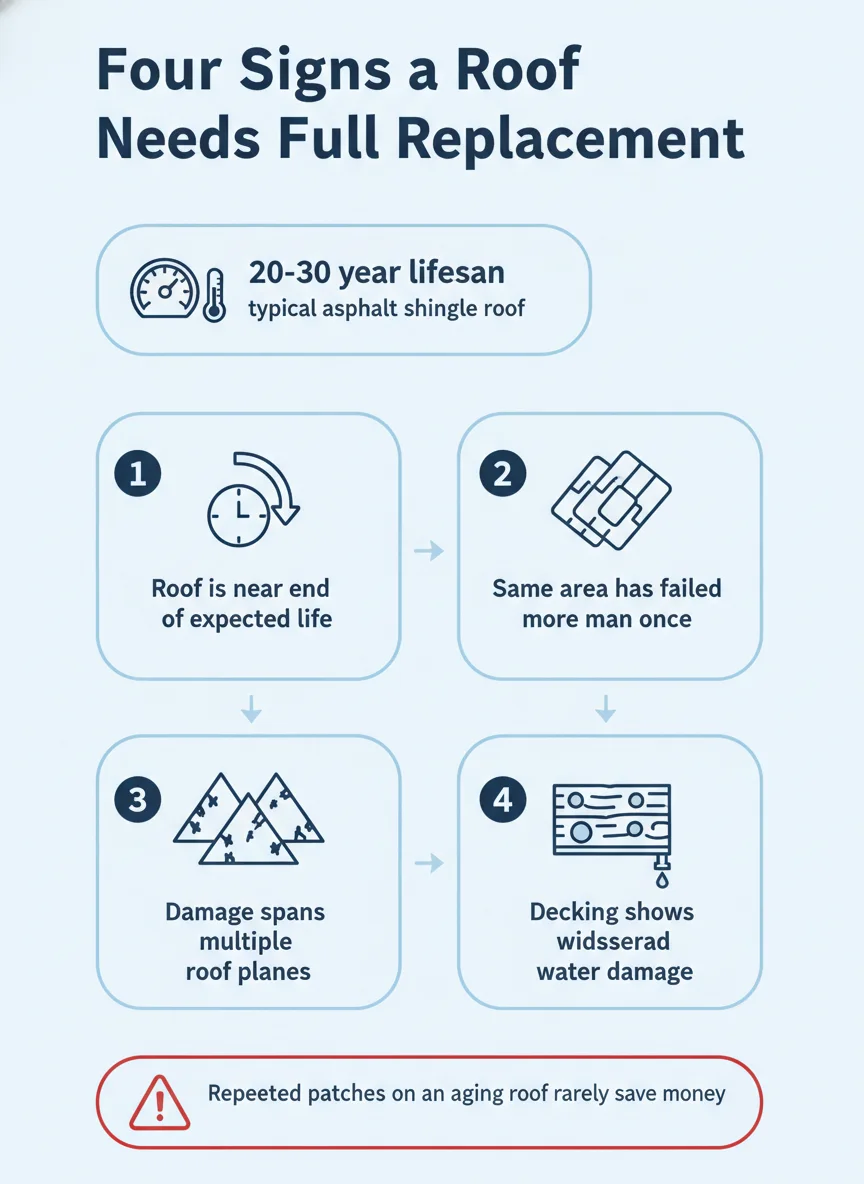
Asphalt shingle roofs typically last somewhere in the 20 to 30 year range depending on the specific product, installation quality, and local climate exposure. A roof in the first half of that lifespan with an isolated problem is usually a strong repair candidate. A roof already near or past that range is a different conversation, since a repair there is patching a system that's already at the end of its useful service life.
Age alone doesn't tell the whole story though. A well-maintained older roof in a lower-exposure area can still be a reasonable repair candidate, while a newer roof that's taken a hard hit from hail or wind might need more than a patch can fix. Age is one input among several, not the only one.
Isolated Issue vs. Repeat Failure
A single leak in one spot, especially one with a clear cause like a cracked flashing seal or a small area of wind-lifted material, is a strong candidate for a straightforward repair. The rest of the roof is unaffected, and fixing the specific problem area resolves the issue.
It's a different situation when the same general area has already been repaired once or twice and keeps coming back, or when leaks are showing up in more than one place. That pattern usually means the underlying material or structure is failing more broadly, and repeated patching is just delaying a replacement that's coming anyway, while costing more in the meantime.
| Situation | Repair Usually Makes Sense | Replacement Usually Makes Sense |
|---|---|---|
| Roof age | Early to mid life expectancy | Near or past expected lifespan |
| Damage pattern | Single, isolated area | Multiple areas or spreading damage |
| History | First occurrence | Same spot has failed before |
| Underlying decking | Dry, sound condition | Widespread moisture or rot found |
What Each Path Actually Involves
A repair targets the specific problem area. That means removing the damaged section down to the decking, checking underneath for hidden moisture, and installing matching material back over a sound base. It's faster, less disruptive, and cheaper, provided the rest of the roof is genuinely in good condition.
A full roof replacement is a different scope entirely. It starts with a complete tear-off of the old material down to the decking, an inspection and repair of any compromised decking underneath, and a full new roof system installed with new underlayment, flashing, and surface material. It comes with proper permitting and a fresh workmanship warranty, since you're starting the roof's lifespan over rather than extending an aging one.
Step-by-Step: How to Evaluate Your Own Situation
Before calling anyone, there's a useful sequence for thinking through where your roof actually stands, which helps you have a more informed conversation once a professional does come out.
- Check the roof's age: Look at any paperwork from the last install or ask a previous owner, and compare that to typical lifespans for the material you have.
- Note the damage pattern: Is the issue in one specific spot, or are you seeing problems in more than one area of the roof or attic?
- Review repair history: Has this same area been fixed before? A repeat failure in the same spot is a bigger flag than a first-time issue.
- Look at the attic: Check for moisture stains, daylight through the decking, or damp insulation, which point to how far water has traveled.
- Get a professional opinion: A documented inspection gives you an objective read on decking condition and remaining roof life before you decide.
What an Inspection Typically Uncovers
A Roof That Still Has Life Left
Sometimes an inspection confirms what you were hoping to hear: the decking is sound, the issue is contained, and a targeted repair will hold up for years to come. This is common with roofs that are still within their expected lifespan and haven't taken widespread storm damage.
In this scenario, a repair is the responsible choice, both for cost and for not disturbing a roof system that's otherwise performing well. There's no benefit to replacing a roof early just because one section needed attention.
A Roof That's Reached the End
Other times, what looked like a simple repair turns up wet decking across a wider area, multiple sections of failing material, or a roof that's simply outlived its expected service life. In that case, a repair would be a short-term fix on a system that's going to keep generating problems.
This is where a full replacement, while a bigger project up front, ends up being the more cost-effective choice over time. You're not paying for a series of repairs on a roof that's already failing, and you get a fresh warranty backing the new system.
What You Can Assess Yourself and What Needs a Professional
A homeowner can reasonably track repair history, note when and where leaks show up, and check the attic for visible moisture. These observations are genuinely useful and help a contractor understand the pattern faster once they're out to look at the roof in person.
Determining decking condition, remaining roof life, and whether a repair will actually hold requires getting on the roof and often opening up a section to check underneath. That's not something to attempt without the right training and equipment, especially on a steep or aging roof where the surface itself may be compromised.
A licensed roofer can give you an honest read on which path makes sense for your specific roof rather than defaulting to whichever is easier to sell. That honest assessment is what actually saves money in the long run, whether the answer ends up being a repair or a full replacement.
Making the Call With Confidence
The right answer between repair and replacement isn't about which one sounds bigger or smaller, it's about what your specific roof actually needs based on its age, condition, and damage pattern. A good contractor will walk you through both options honestly rather than pushing toward whichever job is more profitable.
If you're weighing this decision anywhere from Thornton to Breckenridge, it's worth reading what to expect from roof leakage repair, step by step before you commit to a path. Virtuous Roofing and Exteriors offers free assessments to help homeowners across the region make that call with real information.
Frequently asked questions
How do I know if my roof needs to be replaced instead of repaired?
A roof usually needs replacement rather than repair when the damage is spread across multiple areas, the roof is near or past its expected lifespan, or the same spot has already failed more than once. A single isolated issue on an otherwise sound roof is usually a repair.
Is it cheaper to keep repairing an old roof?
Not usually, once a roof is aging and failing in multiple spots, repeated repairs add up and still leave you with an aging roof underneath. A full replacement resets the clock and typically comes with a stronger warranty than a patch.
Does one leak mean the whole roof is failing?
Not necessarily, a single leak can be an isolated issue like a cracked flashing seal or a small area of storm damage on an otherwise healthy roof. It becomes a bigger concern when leaks show up in multiple areas or keep recurring after repair.
How long does a roof replacement take compared to a repair?
Most roof replacements take one to two days once a crew is on site, depending on size, pitch, and weather, while a repair is often completed the same day. The larger project involves a full tear-off, so the timeline reflects that added scope.
Can hail damage force a replacement even on a newer roof?
Yes, hail can affect a roof's surface enough to compromise its performance even if the roof isn't old, which is why storm damage gets evaluated on its own terms rather than just by age. An inspection after a significant hail event is the best way to know for sure.