Why This Decision Matters More in Colorado
Front Range and Northern Colorado homes see wide temperature swings, heavy snow loads, and regular hail, all of which put real stress on a roof system. When it's time to put a new layer of protection on, homeowners are often surprised to learn there's a choice between adding new material over the old roof or stripping everything down to the decking first.
That choice isn't just about cost. It determines whether problems sitting underneath the current layer, like soft decking, damaged flashing, or a ventilation system that's never worked right, get caught now or get buried under a fresh layer of shingles and discovered later as a leak or a sag. For a home expected to last decades, what's underneath matters as much as what's on top.
What's Actually Happening Under Each Approach
A roof isn't just the visible shingle layer. It's a system: decking underneath, flashing around penetrations and edges, and a ventilation path that lets heat and moisture escape the attic. Each approach treats that system differently.
The Layover Approach
A layover installs new shingles directly over the existing layer. It's faster because there's no tear-off labor or disposal, and it can look identical to a fresh install from the curb. But it leaves the old layer, and everything underneath it, untouched and unexamined.
That means any soft spots in the decking, corroded flashing, or blocked ventilation stay exactly where they are, now carrying the weight of two layers of material instead of one. If there's an undetected problem, it tends to surface as a leak that's harder to trace because there are two layers between the water and the attic.
The Tear-Off Approach
A tear-off strips the roof down to bare decking before anything new goes on. That takes more labor and generates more debris to haul away, but it gives the crew a direct look at the one part of the roof a homeowner otherwise never sees.
If the decking has soft spots from long-term moisture, if flashing around a chimney or vent has corroded, or if the attic ventilation has never moved air the way it should, a tear-off is the point where all of that gets caught and fixed before the new material goes down. It's also usually the install method manufacturers expect for a full workmanship warranty.
| Factor | Roof-Over | Tear-Off |
|---|---|---|
| Decking inspection | Not possible, stays hidden | Fully exposed and checked |
| Added weight | Carries two layers | Carries one new layer |
| Manufacturer warranty | Often reduced or excluded | Typically full coverage eligible |
| Code eligibility | Only allowed with one existing layer | Always allowed |
The System Underneath the Shingles
Decking is the wood layer the shingles are fastened to, and it's what actually holds the roof together structurally. Flashing seals the joints around chimneys, skylights, and roof-to-wall transitions where water is most likely to find a way in. Ventilation keeps air moving through the attic so heat and moisture don't build up and shorten the life of everything above it.
All three of those are invisible once shingles are on, which is exactly why a tear-off matters. It's the one point in a roof's life where a crew can see the decking, flashing, and ventilation path directly instead of guessing about their condition from the attic or the ground.
What Does a Tear-Off Actually Look Like Step by Step?
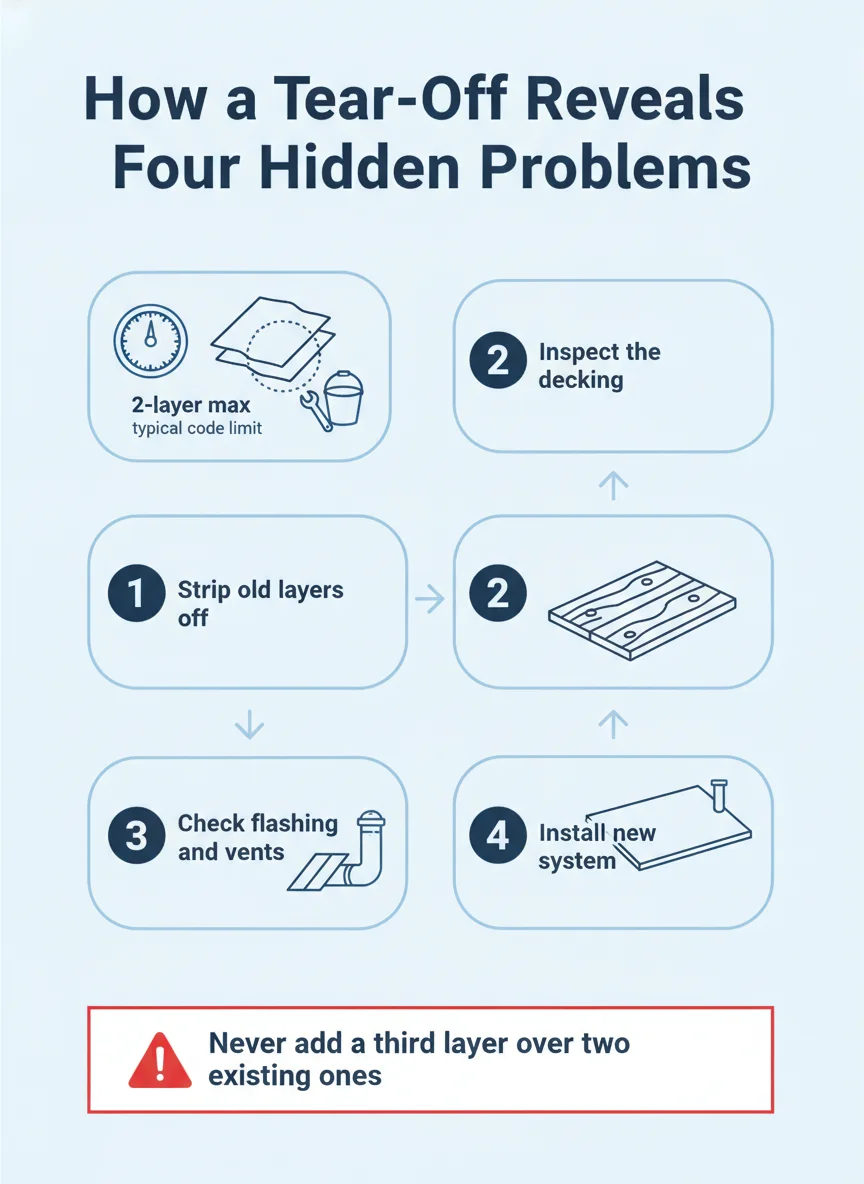
A tear-off follows a fairly consistent sequence regardless of the roofing material going back on. Here's the general order a crew works through.
- Remove old layers: Crews strip shingles, underlayment, and any prior layover material down to the bare wood decking.
- Inspect the decking: Every section of exposed decking gets checked for soft spots, rot, or delamination before anything new is installed.
- Replace damaged wood: Any decking that fails inspection gets cut out and replaced so the new roof has a solid base.
- Check flashing and vents: Flashing around chimneys, skylights, and walls, along with the attic ventilation path, gets inspected and corrected if needed.
- Install new underlayment: A fresh moisture barrier goes down across the entire deck before the new roofing material is installed.
- Install the new roof: The new shingle, metal, or other roofing system goes on over the prepared deck and flashing.
- Haul away debris: Old material is removed from the property so the job site is clear when the crew leaves.
What Do You Actually Find When You Tear Off an Old Roof?
Every tear-off tells a different story depending on the home's age and history, but a few patterns show up often enough that they're worth expecting. Decking near valleys, chimneys, and roof edges tends to show the most wear since those are the spots water concentrates.
Decking and Structural Findings
Soft or delaminated decking usually traces back to a slow leak that was never visible from inside the attic. It's most common near valleys, skylights, and chimney bases, where flashing failures let moisture track along the wood over time instead of showing up right away.
Catching this during a tear-off means the bad sections get replaced before new material goes down, so the new roof has a solid, dry surface to attach to. Skipping that step with a layover means that same soft decking is now carrying twice the material weight.
Flashing and Ventilation Findings
Flashing corrodes or works loose over years of temperature swings, and it's one of the most common sources of a leak that starts small and grows. A tear-off is the point where a crew can replace it correctly instead of just shingling over it.
Ventilation problems, like blocked soffit vents or an attic fan that's stopped working, often surface as excess heat or moisture buildup that a homeowner may have already noticed as ice damming in winter or a hot upstairs in summer. A full tear-off gives a crew the access to correct it.
What Can a Homeowner Decide on Their Own, and What Needs a Pro?
A homeowner can reasonably decide their budget, their timeline, and how long they plan to stay in the home, all of which factor into whether a layover is even worth considering. None of that requires a licensed contractor to figure out.
What does require a pro is determining how many layers are currently on the roof, whether the decking underneath is sound, and whether local code even allows another layover. Those are physical, technical findings that come from a hands-on roof inspection, not a guess from the ground.
A licensed roofer is also the one who can tell you how a layover versus tear-off affects your manufacturer warranty eligibility, since that's a detail buried in product documentation most homeowners never see until it's relevant. That's worth asking about directly before signing off on either approach.
Making the Right Call for Your Home
A layover can be a reasonable short-term move in narrow circumstances, but for most Colorado homes planning to stay put for years, a full tear-off is what protects the investment. It's the only way to confirm the decking, flashing, and ventilation underneath are actually sound instead of hoping they are.
If you're weighing a roof replacement for a home in Westminster or anywhere across the region, it's worth reading up on when to repair and when to replace before deciding how the job gets done. Virtuous Roofing and Exteriors walks homeowners through that decision as part of every estimate.
Frequently asked questions
Can you put a new roof over an old one?
In many cases a layover is physically possible if there's only one existing layer, but it covers up the decking and flashing instead of letting anyone check them. Most building departments also cap how many layers a roof can carry, so a home that already has two layers isn't eligible for another.
Is a roof-over cheaper than a tear-off?
A layover can cost less upfront because it skips the labor of stripping and disposing of the old material. That savings can disappear fast if hidden rot or bad flashing surfaces later and has to be fixed from the outside in, which is harder and more expensive than catching it during a tear-off.
Does a roof-over void the warranty?
Many shingle manufacturers either shorten or exclude warranty coverage on a layover installation, since they can't confirm the decking and ventilation underneath meet their requirements. A full tear-off lets the installer confirm the roof deck is sound, which is usually required for a full manufacturer warranty.
How do I know if my roof already has two layers?
A roofer can tell during a visual inspection by looking at the edge of the roofline, where layered shingles often show a thicker, stepped profile. A written estimate should always note how many layers are currently on the roof before recommending a layover or tear-off.
When does a layover make sense?
A layover can be a reasonable short-term call on a roof with only one existing layer, no signs of deck damage, and a homeowner who plans to sell or replace again within a few years. For a long-term home, a tear-off is the more common recommendation because it addresses what's underneath instead of covering it.