Why Metal Roofing Comes Up So Often in Colorado
Ask around the Denver Metro and Northern Colorado and you'll hear metal roofing mentioned constantly, especially from homeowners who've been through a few rounds of hail. It's not a new material. Metal has been used on barns, cabins and mountain homes for generations, but it's become a mainstream option for suburban homes too as more manufacturers offer it in styles that mimic traditional profiles.
Part of the appeal is simple math. Colorado's UV exposure, temperature swings between day and night, and seasonal hail all wear down roofing materials faster than milder climates. Metal is built to shrug off a lot of that punishment, which is why it keeps coming up in conversations about what to install next, whether that's a full roof replacement or a rebuild after storm damage.
What's Actually Different Between the Panel Types
Not all metal roofs are built the same way, and the system you choose affects cost, appearance, and how the roof performs over decades. The two most common residential options are standing seam and screw-down (also called exposed-fastener) panels, and the difference comes down to how the panels attach to the roof and to each other.
Standing Seam Panels
Standing seam panels run vertically from eave to ridge and lock together at raised seams, with fasteners hidden underneath rather than driven through the panel face. That design means there's nothing on the exposed surface for water to creep into over time, which is a big part of why standing seam roofs are known for long service life and fewer leak points.
The trade-off is cost and installation time. Standing seam requires more precise fabrication and a crew that knows how to work with the seaming tools, so labor runs higher than screw-down systems. For homeowners planning to stay in a house for the long haul, it's often viewed as the system worth the extra investment.
Screw-Down (Exposed-Fastener) Panels
Screw-down panels are fastened directly through the panel with exposed screws, typically with a rubber washer under each screw head to seal the penetration. It's a simpler, faster install, which makes it a common choice for garages, sheds, barns, and budget-conscious projects.
The catch is that those washers degrade with UV exposure and temperature cycling over the years, and once they do, each screw becomes a potential leak point. Screw-down roofs generally need more maintenance over their lifespan, including periodic re-torquing or replacing fasteners, something a homeowner should factor in before choosing it for a primary residence.
| Factor | Standing Seam | Screw-Down |
|---|---|---|
| Fasteners | Hidden, no exposed penetrations | Exposed screws with rubber washers |
| Typical lifespan | Decades longer with minimal upkeep | Shorter life unless fasteners are maintained |
| Install cost | Higher due to labor and fabrication | Lower, faster to install |
| Best fit | Primary residences, long-term owners | Outbuildings, garages, budget projects |
What a Metal Roofing System Is Actually Made Of
A metal roof is more than the panels you see from the street. Underneath, there's typically a synthetic or felt underlayment over the deck, sometimes with an ice-and-water shield at eaves and valleys where moisture tends to collect. The panels themselves come in various gauges, with thicker gauges holding up better to foot traffic and hail but adding weight and cost.
Trim and flashing matter just as much as the panels. Ridge caps, valley flashing, and the transitions around chimneys or vents are where most metal roof problems actually start, not the flat panel field. A well-detailed install pays close attention to these transition points, since that's where water finds its way in if something's off.
Step-by-Step: How a Metal Roof Installation Comes Together
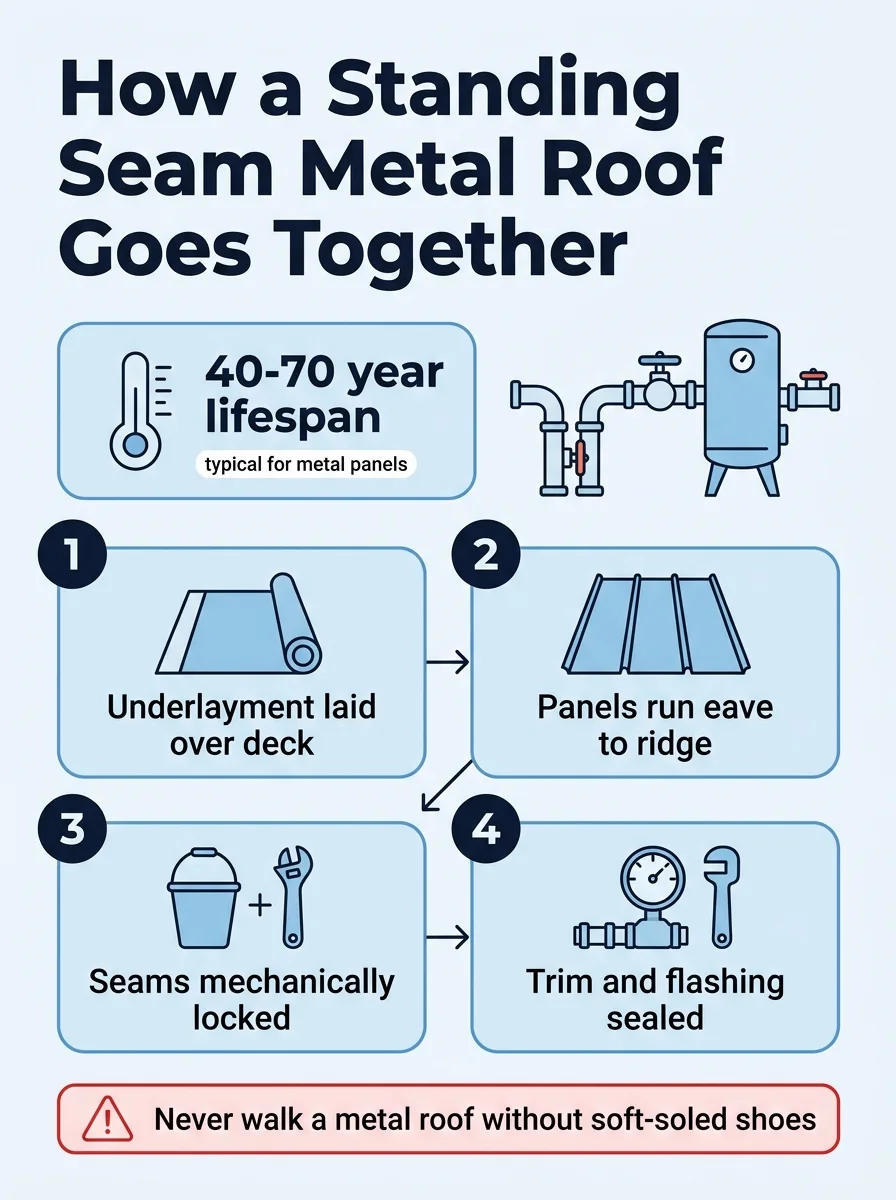
The sequence below is a general overview of how a metal roof gets installed on a typical home. Specifics vary by panel type, roof pitch, and existing deck condition, but the overall order stays fairly consistent across most jobs.
- Tear off or prep: The old roofing material is removed or, in some rare roof-over scenarios, battens are installed over the existing surface to create an even plane.
- Deck inspection: The decking is checked for rot or soft spots and repaired before anything else goes down, since metal panels need a solid, flat surface underneath.
- Underlayment installed: A synthetic or felt underlayment goes down across the whole roof, with extra protection added at eaves, valleys, and other vulnerable areas.
- Panels run and set: Panels are measured, cut to length, and run from eave to ridge, either locked together (standing seam) or fastened directly (screw-down).
- Seams and edges locked: Standing seam panels are mechanically seamed together using a seaming tool, while screw-down panels are fastened at specified intervals with sealed washers.
- Trim and flashing added: Ridge caps, valley flashing, and penetration flashing are installed and sealed to close off every transition point on the roof.
What You'll Notice Living Under a Metal Roof
Noise and Temperature
One of the most common questions homeowners ask is whether metal roofs are loud during rain or hail. With proper underlayment, solid decking, and insulation in the attic, the noise difference from inside a finished living space is minimal. Older installs over open rafters without insulation are where the loud-roof reputation comes from.
Metal also reflects more solar heat than dark asphalt, which can help keep attic temperatures lower in summer. In winter, metal sheds snow more readily than textured roofing materials, which is worth considering if you have walkways or entries directly below roof edges.
Long-Term Appearance and Aging
Quality metal roofing is finished with a protective coating designed to resist fading and chalking for a long time, though some gradual color change is normal over decades of UV exposure. Unlike asphalt, metal doesn't lose granules or curl at the edges as it ages, so the roof tends to look consistent from year one through year thirty.
The main cosmetic concern in Colorado is hail denting on lighter-gauge panels. Many manufacturers now offer Class 4 impact-rated metal panels specifically to address this, similar in concept to the impact-resistant shingle ratings used on asphalt roofs.
What a Homeowner Can Handle vs. What Needs a Licensed Roofer
Metal roofing is not a realistic DIY project for most homeowners, even those comfortable with other home repairs. Cutting and fitting panels, seaming standing seam systems correctly, and detailing flashing around penetrations all require specialized tools and experience that take years to develop.
What a homeowner can reasonably do is visual monitoring from the ground: watching for loose panels after high wind, checking gutters for excessive granule or coating flakes, and noting any interior ceiling stains early. Anything beyond that, including walking the roof itself, carries real fall risk on a metal surface, especially when it's wet, icy, or has any slope at all.
When it's time for an install or repair, a licensed roofer brings the fabrication equipment, fastener knowledge, and flashing experience the job actually requires. A roof inspection beforehand also helps confirm the deck is sound enough to support the new system before panels ever go down.
Deciding if Metal Is Right for Your Home
Metal roofing isn't the right fit for every budget or every home, but for homeowners planning to stay put and wanting to minimize how often they deal with a roof, it's hard to beat on longevity. Weigh the higher upfront cost against the decades of reduced maintenance and the hail resistance that matters so much across the Denver Metro and Northern Colorado.
If you're comparing materials for an upcoming project, it helps to also understand what drives roof replacement costs in general, since panel type is just one piece of that picture. Virtuous Roofing and Exteriors can walk homes in Denver and across the region through their options in person.
Frequently asked questions
Is metal roofing worth it in Colorado?
For homeowners planning to stay long-term, metal is a strong fit because of its lifespan and hail resistance compared to many other materials. The upfront investment is higher than asphalt, but the trade-off is decades of use and less frequent replacement.
Does a metal roof make more noise in rain or hail?
With proper underlayment and solid decking, a metal roof is not noticeably louder than any other roof type from inside a finished attic or living space. Noise complaints usually come from older installs over open framing without insulation.
Can metal roofing handle Colorado hail?
Metal holds up well against hail in terms of keeping water out, though it can show cosmetic denting depending on panel gauge and hailstone size. Many metal panels carry Class 4 impact ratings, similar to what's available in [impact-resistant shingles](/blog/impact-resistant-class-4-shingles-colorado).
How much does a metal roof weigh compared to asphalt?
Most standing seam and screw-down metal systems weigh less per square than asphalt shingles, which is one reason metal is popular on additions and structures where load matters. An engineer or roofer can confirm what your specific framing can carry.
What's the difference between standing seam and screw-down metal panels?
Standing seam panels interlock with hidden fasteners and no exposed screws, while screw-down panels are fastened directly through the face of the panel. Standing seam costs more but holds up longer because there are no screw heads to work loose or leak over time.