Why Repair Costs Vary So Much Across the Denver Metro and Northern Colorado
Ask five homeowners in the Denver Metro or Northern Colorado what they paid for a roof repair and you'll likely get five different numbers. That's normal. Repair pricing depends on what's actually wrong, how hard it is to reach, and how much of the roof system got affected before anyone noticed. A single popped fastener is a different job than water that's been finding its way into an attic for weeks.
Colorado adds its own variables on top of that. Hail, high wind, heavy snow load, and rapid freeze-thaw cycles all put different kinds of stress on a roof, and the repair that follows depends on which of those did the damage. A wind-lifted section of shingles repairs differently than a hail-cracked one, and both are different from ice damming at the eaves. Knowing what caused the problem is the first step toward understanding what it will take to fix.
What Actually Moves the Number Up or Down
Every repair estimate comes down to a handful of real variables: how much material is damaged, how it's accessed, what's underneath, and how urgent the timeline is. Two roofs with what looks like the same problem from the ground can price out very differently once a crew is actually up there looking at the decking and flashing.
Extent and Location of the Damage
A repair confined to one small area, like a handful of cracked shingles near a vent, is straightforward to scope and price. Once damage spreads across multiple planes of the roof, or shows up near valleys and chimneys where flashing is involved, the job takes longer and the material list grows. Water damage that's traveled into the decking itself, not just the surface layer, usually means that section needs to be opened up and replaced rather than patched.
Where the damage sits on the roof matters too. Repairs near ridge lines, skylights, or complex rooflines with lots of valleys and transitions take more time to do correctly than a flat, open section. Getting flashing details right around these areas is what keeps a repair from failing again in the next storm, which is worth the extra labor.
Access, Pitch, and Timing
A single-story home with a moderate pitch is a faster, safer job than a steep two-story roof that needs harnesses, extra ladders, and more careful staging. That added safety setup is real time and real cost, and it applies whether the job is a routine repair or an active leak. Homes in mountain communities or areas with tricky driveway access can add setup time as well.
Timing plays a role too. A repair scheduled during normal business hours, in dry weather, with the crew able to plan ahead is more efficient than an emergency call during an active storm. If you can safely wait for a scheduled repair rather than treating it as an emergency, it's usually the more cost-effective route, but an active leak inside the home changes that calculation fast.
| Factor | Lower Cost Scenario | Higher Cost Scenario |
|---|---|---|
| Damage extent | Isolated section, surface only | Spread across planes, decking affected |
| Access | Single story, moderate pitch | Steep, multi-story, tricky staging |
| Timing | Scheduled during business hours | Active leak during a storm |
| Material | Standard asphalt shingle patch | Tile, slate, or metal panel matching |
What's Actually Involved in a Repair or Tarp
A repair isn't just replacing what's visibly broken on top. It usually starts with removing the damaged section down to the decking, checking for any water intrusion underneath, and replacing underlayment or flashing if it's compromised. Only after that groundwork is confirmed solid does the visible material go back on, matched as closely as possible to what's already there.
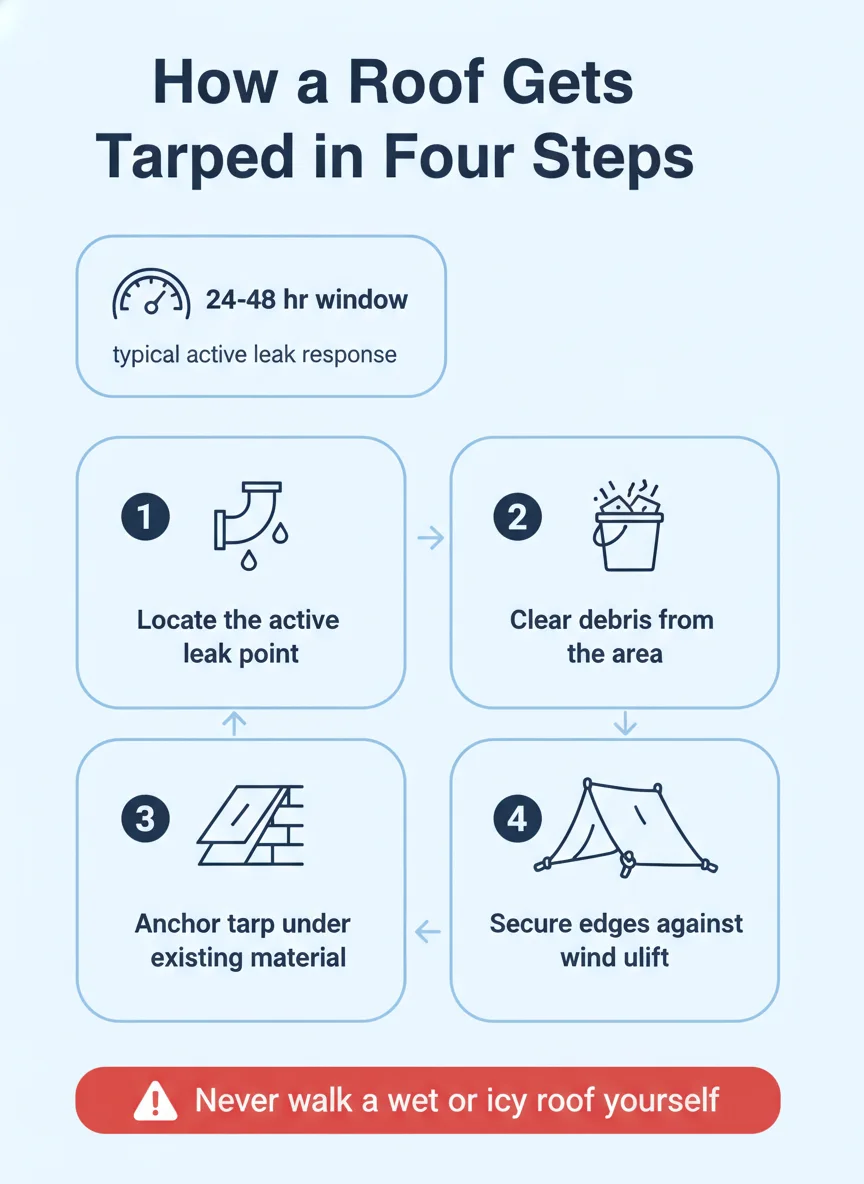
Emergency tarping is a different scope entirely. It's meant to stop water from entering the home right now, not to be the final fix. A good tarp job covers the full damaged area with margin on all sides, anchors under the surrounding material rather than just on top of it, and gets secured well enough to survive wind until the permanent repair can happen.
Step-by-Step: What Happens During an Emergency Response
When a leak is active, the priority is stopping water intrusion fast and safely, then scoping the permanent fix. Here's generally how that process unfolds from the first call to the tarp going up.
- Initial call and triage: You describe what's happening, and the severity of the leak determines how quickly a crew needs to get out to the home.
- Safety assessment first: Before anyone gets on the roof, weather conditions and structural safety are checked, since a wet or icy roof is not safe to walk.
- Locate the source: The visible leak inside often isn't directly above where water is entering, so the crew traces the path along the roof and decking.
- Tarp installation: The tarp is anchored under existing material at the top edge and secured against wind uplift on all sides, not just weighted down.
- Scope the permanent repair: Once the immediate threat is stopped, the crew documents what a full repair will require and schedules the follow-up work.
What You'll Find Once the Roof Is Opened Up
Surface-Level Damage
In the best-case scenario, the damage is limited to the top layer, the shingles, tiles, or metal panels themselves. Underlayment and decking underneath are dry and intact. This is the fastest and most affordable outcome, since the fix is largely cosmetic and structural once the new material is matched and installed.
Surface-only damage is more likely when a repair happens quickly after the event that caused it, whether that's a wind gust or a hail event. The sooner an issue is addressed, the less likely water has had time to work its way further into the roof system.
Water That's Already Traveled
The tougher outcome is finding that water has already made its way past the surface layer and into the decking or insulation below. This usually happens when a small issue goes unnoticed for a while, since water doesn't always show up as a ceiling stain right away. It can travel sideways along the decking before it ever becomes visible from inside the house.
When this is the case, the repair scope grows to include replacing wet decking, drying out the area properly, and checking for any secondary damage like mold or wood rot before the new roofing material goes back on. This is part of why a fast response to an active leak matters as much as the quality of the eventual repair.
What a Homeowner Can Do and What Needs a Licensed Roofer
There are a few things a homeowner can reasonably handle without getting on the roof. Checking the attic for signs of moisture, noting when and where a ceiling stain appears relative to weather, and photographing visible damage from the ground with binoculars or a zoom lens are all useful and safe steps that help a contractor scope the job faster once they arrive.
Getting on the roof itself is not one of those things, especially after a storm when surfaces may be wet, icy, or structurally compromised in ways that aren't obvious from below. Roof repair and tarping both involve working at height on a surface that may not be stable, and a fall from even a single-story roof can cause serious injury.
A licensed roofer brings the right safety equipment, the experience to know where to look for hidden damage, and the ability to match repair materials so the fix blends in and performs the way the rest of the roof does. For anything beyond a visual check from the ground, calling a professional is the safer and ultimately more cost-effective path.
Getting a Repair Done Right the First Time
The cheapest repair isn't always the best value if it doesn't address what's actually happening underneath the surface. A patch over a spot that still has wet decking underneath will likely fail again, and the second repair costs more than if the full scope had been handled the first time around. A thorough roof repair and emergency tarping visit should always include a look at what's beneath the surface layer, not just the visible damage.
If you're dealing with an active leak or storm damage anywhere in the region, from Aurora to Fort Collins, it helps to understand how hail or wind damage after a storm typically shows up before you call anyone out. Virtuous Roofing and Exteriors responds to leaks and storm damage across the Denver Metro and Northern Colorado and can walk you through what a repair actually involves before any work begins.
Frequently asked questions
Why does emergency tarping cost more than a scheduled repair?
Emergency work costs more because it happens outside a normal schedule and often in bad weather, which slows the crew down and adds risk. A scheduled repair lets a contractor plan materials and access ahead of time, which keeps labor more efficient.
Does the size of the leak change the repair price?
Yes, a small isolated leak is usually cheaper to fix than one that has spread under multiple layers of material. Water that has traveled along decking or framing before showing up as a stain often means more area needs to be opened up and repaired.
Is a tarp a permanent fix?
No, a tarp is a temporary measure to stop water from getting in while a permanent repair is scheduled. Leaving a tarp in place too long through wind and sun exposure can shorten its usefulness and let leaks restart.
What roof pitch and height factors affect repair pricing?
Steeper pitches and taller homes take longer to work safely, which adds labor time regardless of the repair itself. Access equipment and extra safety measures on steep or multi-story roofs are a real part of the cost.
Can the type of roofing material change repair costs?
Yes, some materials like tile or slate require more careful handling and specific replacement pieces than asphalt shingles. Metal roofing repairs often need matching panel work rather than a patch, which can change the scope.